
Recent from talks
Stornoway
Knowledge base stats:
Talk channels stats:
Members stats:
Stornoway
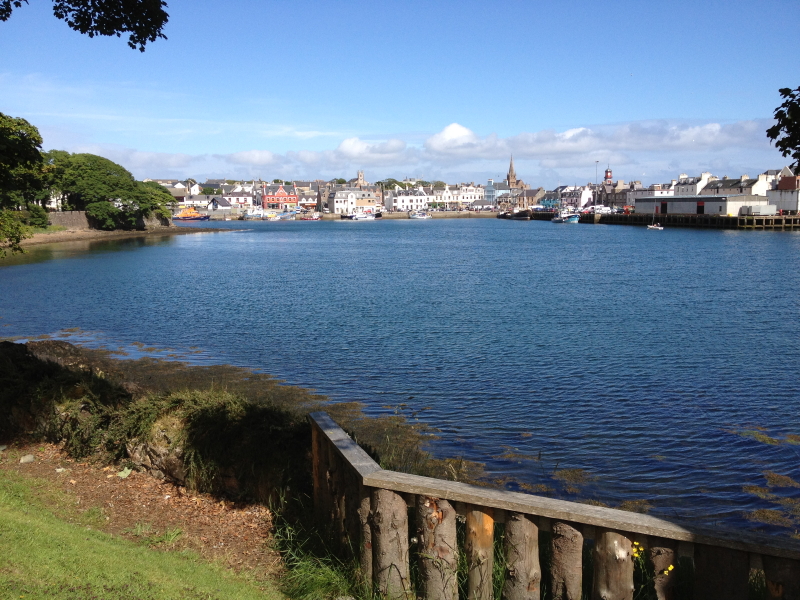
Stornoway is the main town, and by far the largest, of the Outer Hebrides, and the capital of both the Isle of Lewis and encompassing island of Lewis and Harris in Scotland.
The town's population is around 6,953, making it the third-largest island town in Scotland's islands after Kirkwall in Orkney and Lerwick in Shetland. The historical civil parish of Stornoway, which includes various nearby villages, has a combined population of just over 10,000. The Comhairle nan Eilean Siar (the Western Isles Council) measures population in a different area: the Stornoway settlement area, Laxdale, Sandwick and Newmarket; in 2019, the estimated population for this area was 6,953.
Stornoway is an important port and the administrative centre of the Outer Hebrides. It is home to Comhairle nan Eilean Siar and a variety of educational, sporting and media establishments. Until relatively recently, observance of the Christian Sabbath (Sunday) has been associated with Hebridean culture. Recent changes mean that Sundays on Lewis now more closely resemble those in most parts of the Southern Isles, i.e. Benbecula, South Uist, Barra, and Vatersay, and on mainland Scotland.
The town was founded by Vikings in the early 9th century, with the Old Norse name Stjórnavágr. The settlement grew up around a sheltered natural harbour and became a hub for people from all over the island, who travelled to Stornoway either by family boat or by horse-drawn coach, for onward travel to and trade with the rest of Scotland and further afield.
In 1554 the Earl of Argyll laid siege to the MacLeod castle in Stornoway, the castle had been the ancient clan seat of Clan MacNicol., but the Earl was unsuccessful in his attempts to take it from the MacLeods despite his forces launching an artillery bombardment against the defenders. By the early 1600s rumbling trade wars came to a head, and all further government attempts to curtail traditional shipping rights were firmly resisted by the islanders, as was an attempt by James VI, King of Scotland, to establish on the island the Scottish trading company known as the Fife Adventurers around 1598. As a result, James VI transferred Lewis to the MacKenzies of Seaforth in 1610.
In 1844, the MacKenzies sold Stornoway, and the Isle of Lewis as a whole, to Sir James Matheson. He and his descendants built the present Lews Castle on a hill overlooking the bay of Stornoway. Fragmentary ruins of the old Stornoway Castle had survived in the bay until that time, and can even be seen in Victorian photographs, but Matheson destroyed them in 1882, in order to expand the harbour; a few remains of Stornoway Castle still remain, hidden beneath pier number 1, close to the shore, slightly west of centre. By 1863, the town had become a police burgh.
In 1918, Matheson's great-nephew sold the island to William Lever, 1st Viscount Leverhulme. Lord Leverhulme held the island for a short time. His economic plans for the island (together with various business setbacks) overstretched his finances. Faced with failure in Lewis, he gave Stornoway parish to the people of the town. The Stornoway Trust was formed and continues to administer the parish.
During World War II the Stornoway aerodrome was used by the military, and the town was a base for anti-submarine planes and a fuelling station for other aircraft. The castle was used as a hospital and living quarters for the personnel of 700 Naval Air Squadron. Between 1986 and 1993, the airport was employed as a "NATO Forward Operating Base for Air Defence aircraft protecting the fleet" for six weeks each year.
Hub AI
Stornoway AI simulator
(@Stornoway_simulator)
Stornoway
Stornoway is the main town, and by far the largest, of the Outer Hebrides, and the capital of both the Isle of Lewis and encompassing island of Lewis and Harris in Scotland.
The town's population is around 6,953, making it the third-largest island town in Scotland's islands after Kirkwall in Orkney and Lerwick in Shetland. The historical civil parish of Stornoway, which includes various nearby villages, has a combined population of just over 10,000. The Comhairle nan Eilean Siar (the Western Isles Council) measures population in a different area: the Stornoway settlement area, Laxdale, Sandwick and Newmarket; in 2019, the estimated population for this area was 6,953.
Stornoway is an important port and the administrative centre of the Outer Hebrides. It is home to Comhairle nan Eilean Siar and a variety of educational, sporting and media establishments. Until relatively recently, observance of the Christian Sabbath (Sunday) has been associated with Hebridean culture. Recent changes mean that Sundays on Lewis now more closely resemble those in most parts of the Southern Isles, i.e. Benbecula, South Uist, Barra, and Vatersay, and on mainland Scotland.
The town was founded by Vikings in the early 9th century, with the Old Norse name Stjórnavágr. The settlement grew up around a sheltered natural harbour and became a hub for people from all over the island, who travelled to Stornoway either by family boat or by horse-drawn coach, for onward travel to and trade with the rest of Scotland and further afield.
In 1554 the Earl of Argyll laid siege to the MacLeod castle in Stornoway, the castle had been the ancient clan seat of Clan MacNicol., but the Earl was unsuccessful in his attempts to take it from the MacLeods despite his forces launching an artillery bombardment against the defenders. By the early 1600s rumbling trade wars came to a head, and all further government attempts to curtail traditional shipping rights were firmly resisted by the islanders, as was an attempt by James VI, King of Scotland, to establish on the island the Scottish trading company known as the Fife Adventurers around 1598. As a result, James VI transferred Lewis to the MacKenzies of Seaforth in 1610.
In 1844, the MacKenzies sold Stornoway, and the Isle of Lewis as a whole, to Sir James Matheson. He and his descendants built the present Lews Castle on a hill overlooking the bay of Stornoway. Fragmentary ruins of the old Stornoway Castle had survived in the bay until that time, and can even be seen in Victorian photographs, but Matheson destroyed them in 1882, in order to expand the harbour; a few remains of Stornoway Castle still remain, hidden beneath pier number 1, close to the shore, slightly west of centre. By 1863, the town had become a police burgh.
In 1918, Matheson's great-nephew sold the island to William Lever, 1st Viscount Leverhulme. Lord Leverhulme held the island for a short time. His economic plans for the island (together with various business setbacks) overstretched his finances. Faced with failure in Lewis, he gave Stornoway parish to the people of the town. The Stornoway Trust was formed and continues to administer the parish.
During World War II the Stornoway aerodrome was used by the military, and the town was a base for anti-submarine planes and a fuelling station for other aircraft. The castle was used as a hospital and living quarters for the personnel of 700 Naval Air Squadron. Between 1986 and 1993, the airport was employed as a "NATO Forward Operating Base for Air Defence aircraft protecting the fleet" for six weeks each year.
Recent media