
Recent from talks
Strategic Offensive Reductions Treaty
Knowledge base stats:
Talk channels stats:
Members stats:
Strategic Offensive Reductions Treaty
The Treaty Between the United States of America and the Russian Federation on Strategic Offensive Reductions (SORT), also known as the Treaty of Moscow, was a strategic arms reduction treaty between the United States and Russia that was in force from June 2003 until February 2011 when it was superseded by the New START treaty.
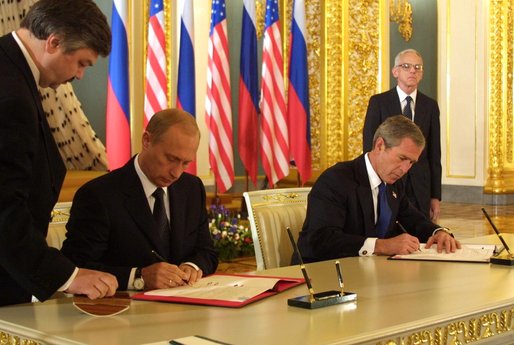
At the time, SORT was positioned as "represent[ing] an important element of the new strategic relationship" between the two countries with both parties agreeing to limit their nuclear arsenal to between 1,700 and 2,200 operationally deployed warheads each. It was signed in Moscow on 24 May 2002.
After ratification by the U.S. Senate and the State Duma, SORT came into force on 1 June 2003. It would have expired on 31 December 2012 if not superseded by New START. Either party could have withdrawn from the treaty upon giving three months written notice to the other.
SORT was one in a long line of treaties and negotiations on mutual nuclear disarmament between Russia (and its predecessor, the Soviet Union) and the United States, which includes SALT I (1969–1972), the ABM Treaty (1972), SALT II (1972–1979), the INF Treaty (1987), START I (1991), START II (1993) and New START (2010).
The Moscow Treaty was different from START in that it limited operationally deployed warheads, whereas START I limited warheads through declared attribution to their means of delivery (ICBMs, SLBMs, and Heavy Bombers).
Russian and U.S. delegations met twice a year to discuss the implementation of the Moscow Treaty at the Bilateral Implementation Commission (BIC).
The treaty was submitted for ratification in December 2002. However, the passage of the agreement took about a year because the bill had to be resubmitted after its rejection in committee due to concerns about funding for nuclear forces and about cutting systems that had not yet reached the end of their service lives. Further, the deputies were concerned about the U.S.'s ability to upload reserve nuclear warheads for a first strike (upload potential).
The ratification was also problematic because the chairman of the foreign affairs committee of the Duma, Dmitry Rogozin, disagreed with his Federation Council counterpart Margelov. Deputy Rogozin argued that the Moscow Treaty should be delayed because of the 2003 U.S. invasion of Iraq. In the end, however, this delay never happened. The final vote was similar to START II with nearly a third of the deputies voting against. The ratification resolution mandated presidential reporting on nuclear force developments and noted that key legislators should be included in interagency planning.
Hub AI
Strategic Offensive Reductions Treaty AI simulator
(@Strategic Offensive Reductions Treaty_simulator)
Strategic Offensive Reductions Treaty
The Treaty Between the United States of America and the Russian Federation on Strategic Offensive Reductions (SORT), also known as the Treaty of Moscow, was a strategic arms reduction treaty between the United States and Russia that was in force from June 2003 until February 2011 when it was superseded by the New START treaty.
At the time, SORT was positioned as "represent[ing] an important element of the new strategic relationship" between the two countries with both parties agreeing to limit their nuclear arsenal to between 1,700 and 2,200 operationally deployed warheads each. It was signed in Moscow on 24 May 2002.
After ratification by the U.S. Senate and the State Duma, SORT came into force on 1 June 2003. It would have expired on 31 December 2012 if not superseded by New START. Either party could have withdrawn from the treaty upon giving three months written notice to the other.
SORT was one in a long line of treaties and negotiations on mutual nuclear disarmament between Russia (and its predecessor, the Soviet Union) and the United States, which includes SALT I (1969–1972), the ABM Treaty (1972), SALT II (1972–1979), the INF Treaty (1987), START I (1991), START II (1993) and New START (2010).
The Moscow Treaty was different from START in that it limited operationally deployed warheads, whereas START I limited warheads through declared attribution to their means of delivery (ICBMs, SLBMs, and Heavy Bombers).
Russian and U.S. delegations met twice a year to discuss the implementation of the Moscow Treaty at the Bilateral Implementation Commission (BIC).
The treaty was submitted for ratification in December 2002. However, the passage of the agreement took about a year because the bill had to be resubmitted after its rejection in committee due to concerns about funding for nuclear forces and about cutting systems that had not yet reached the end of their service lives. Further, the deputies were concerned about the U.S.'s ability to upload reserve nuclear warheads for a first strike (upload potential).
The ratification was also problematic because the chairman of the foreign affairs committee of the Duma, Dmitry Rogozin, disagreed with his Federation Council counterpart Margelov. Deputy Rogozin argued that the Moscow Treaty should be delayed because of the 2003 U.S. invasion of Iraq. In the end, however, this delay never happened. The final vote was similar to START II with nearly a third of the deputies voting against. The ratification resolution mandated presidential reporting on nuclear force developments and noted that key legislators should be included in interagency planning.
Recent media