



Community hub
Recent from talks
Contribute something
Nothing was collected or created yet.
Strategic Arms Limitation Talks
View on Wikipedia | This article needs additional citations for verification. (October 2017) |
| Part of a series on |
| History of the Cold War |
|---|
.svg)  |
The Strategic Arms Limitation Talks (SALT) were two rounds of bilateral conferences and corresponding international treaties involving the United States and the Soviet Union. The Cold War superpowers dealt with arms control in two rounds of talks and agreements: SALT I and SALT II.
Negotiations commenced in Helsinki, in November 1969.[1] SALT I led to the Anti-Ballistic Missile Treaty and an interim agreement between the two countries.
Although SALT II resulted in an agreement in 1979 in Vienna, in response to the 1980 Soviet invasion of Afghanistan the US Senate chose not to ratify the treaty. The Supreme Soviet did not ratify it either. The agreement expired on December 31, 1985, and was not renewed, although both sides continued to respect it.
The talks led to the STARTs, or Strategic Arms Reduction Treaties, which consisted of START I, a 1991 completed agreement between the United States and the Soviet Union, and START II, a 1993 agreement between the United States and Russia which never entered into effect, both of which proposed limits on multiple-warhead capacities and other restrictions on each side's number of nuclear weapons. A successor to START I, New START, was proposed and was eventually ratified in February 2011.
SALT I Treaty
[edit]SALT I is the common name for the Strategic Arms Limitation Talks Agreement signed on May 26, 1972. SALT I froze the number of strategic ballistic missile launchers at existing levels and provided for the addition of new submarine-launched ballistic missile (SLBM) launchers only after the same number of older intercontinental ballistic missile (ICBM) and SLBM launchers had been dismantled.[2] SALT I also limited land-based ICBMs that were in range from the northeastern border of the Continental United States to the northwestern border of the continental Soviet Union.[3] In addition, SALT I limited the number of SLBM capable submarines that NATO and the United States could operate to 50 with a maximum of 800 SLBM launchers between them. If the United States or NATO were to increase that number, the Soviets could respond with increasing their arsenal by the same amount.
The strategic nuclear forces of the Soviet Union and the United States were changing in character in 1968. The total number of missiles held by the United States had been static since 1967 at 1,054 ICBMs and 656 SLBMs but there was an increasing number of missiles with multiple independently targetable reentry vehicle (MIRV) warheads being deployed. MIRVs carried multiple nuclear warheads, often with dummies, to confuse ABM systems, making MIRV defense by ABM systems increasingly difficult and expensive.[2] Both sides were also permitted to increase their number of SLBM forces but only if they disassembled an equivalent number of older ICBMs or SLBM launchers on older submarines.
One of the terms of the treaty required both countries to limit the number of deployment sites protected by an anti-ballistic missile (ABM) system to one each. The idea of that system was to prevent a competition in ABM deployment between the United States and the Soviet Union. The Soviet Union had deployed such a system around Moscow in 1966, and the United States announced an ABM program to protect twelve ICBM sites in 1967. After 1968, the Soviets tested a system for the SS-9 missile, otherwise known as the R-36 missile.[4] A modified two-tier Moscow ABM system is still used. The United States built only one ABM site to protect a Minuteman base in North Dakota where the "Safeguard" Program was deployed. That base was increasingly more vulnerable to attacks by the Soviet ICBMs because of the advancement in Soviet missile technology.
Negotiations lasted from November 17, 1969, to May 26, 1972, in a series of meetings beginning in Helsinki, with the American delegation headed by Gerard C. Smith, director of the Arms Control and Disarmament Agency. Subsequent sessions alternated between Vienna and Helsinki. McNamara played a significant role with working to reduce the arms race between the U.S. and Soviet Union. There were two distinct ways in which he worked to govern the nuclear threat. First, he thought the need to avoid the deployment of an ABM system from both countries. To do this, the second thing he believed was the only way to limit the tension was to have many negotiations and discussion about deterrence, holding each other responsible for keeping peace through full communication. One problem that he ran into was that limitation strategies weren't working and open to full of critiques, and the U.S. alongside Soviet continued to make new ballistic missiles. The US nuclear arsenals was far too large at that point in history to even pose for arms limitation at that point.[5] After a long deadlock, the first results of SALT I came in May 1971, when an agreement was reached over ABM systems. Further discussion brought the negotiations to an end in Moscow in 1972, when U.S. President Richard Nixon and Soviet General Secretary Leonid Brezhnev signed both the Anti-Ballistic Missile Treaty and the Interim Agreement Between the United States of America and the Union of Soviet Socialist Republics on Certain Measures With Respect to the Limitation of Strategic Offensive Arms.[6]
The two sides also agreed to a number of basic principles regarding appropriate conduct. Each recognized the sovereignty of the other; agreed to the principle of noninterference; and sought to promote economic, scientific, and cultural ties of mutual benefit and enrichment.[7][8][9]
Nixon was proud that his diplomatic skills made him achieve an agreement that his predecessors had been unable to reach. Nixon and Kissinger planned to link arms control to détente and to the resolution of other urgent problems through what Nixon called "linkage". David Tal argues:
The linkage between strategic arms limitations and outstanding issues such as the Middle East, Berlin and, foremost, Vietnam thus became central to Nixon's and Kissinger's policy of détente. Through employment of linkage, they hoped to change the nature and course of U.S. foreign policy, including U.S. nuclear disarmament and arms control policy, and to separate them from those practiced by Nixon’s predecessors. They also intended, through linkage, to make U.S. arms control policy part of détente. [...] His policy of linkage had in fact failed. It failed mainly because it was based on flawed assumptions and false premises, the foremost of which was that the Soviet Union wanted strategic arms limitation agreement much more than the United States did.[10]
The agreement paved the way for further discussion regarding international cooperation and a limitation of nuclear armaments, as seen through both the SALT II Treaty and the Washington Summit of 1973.
SALT II Treaty
[edit]
SALT II was a series of talks between American and Soviet negotiators from 1972 to 1979 that sought to curtail the manufacture of strategic nuclear weapons. It was a continuation of the SALT I talks and was led by representatives from both countries. It was the first nuclear arms treaty to assume real reductions in strategic forces to 2,250 of all categories of delivery vehicles on both sides.
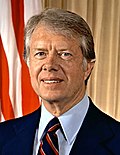
The SALT II Treaty banned new missile programs, defined as those with any key parameter 5% better than in currently-employed missiles. That forced both sides to limit their new strategic missile types development and construction, such as the development of additional fixed ICBM launchers. Likewise, the agreement would limit the number of MIRVed ballistic missiles and long range missiles to 1,320.[11] However, the United States preserved its most essential programs like the Trident missile, along with the cruise missiles President Jimmy Carter wished to use as his main defensive weapon as they were too slow to have first strike capability. In return, the Soviets could exclusively retain 308 of its so-called "heavy ICBM" launchers of the SS-18 type.
A major breakthrough for the agreement occurred at the Vladivostok Summit Meeting in November 1974, when President Gerald Ford and General Secretary Leonid Brezhnev came to an agreement on the basic framework for the SALT II agreement. The elements of the agreement were stated to be in effect until 1985.
An agreement to limit strategic launchers was reached in Vienna on June 18, 1979, and was signed by Brezhnev and Carter at a ceremony held in the Redoutensaal of the Hofburg Palace.[12]
Six months after the signing, the Soviets invaded Afghanistan, and in September, the United States discovered that a Soviet combat brigade was stationed in Cuba.[13] Although Carter claimed that the Soviet brigade had been deployed to Cuba only recently, the unit had been stationed on the island since the Cuban Missile Crisis of 1962.[14] In light of those developments, Carter withdrew the treaty from consideration in January 1980, and the US Senate never consented to ratification although terms were honored by both sides until 1986.[15]
See also
[edit]Citations
[edit]- ^ Paterson, Thomas G. (2009). American foreign relations: a history. Vol. 2 (7th ed.). Wadsworth. p. 376. ISBN 9780547225692. OCLC 553762544.
- ^ a b SALT I, 1969-1972, US State Department's Foreign Relations Series (FRUS)
- ^ "Interim Agreement Between the United States of America and the Union of Soviet Socialist Republics on Certain Measures with Respect to the Limitation of Strategic Offensive Arms (SALT I)" (PDF). Archived from the original (PDF) on May 2, 2014. Retrieved April 27, 2015.
- ^ Smart, Ian (1970). "The Strategic Arms Limitation Talks". The World Today. 26 (7): 296–305. JSTOR 40394395.
- ^ Chiampan, Andrea (2018-02-27), "SALT Treaty", The Encyclopedia of Diplomacy, Oxford, UK: John Wiley & Sons, Ltd, pp. 1–6, doi:10.1002/9781118885154.dipl0248, ISBN 9781118887912
- ^ "Strategic Arms Limitation Treaty I (1972) | Nuclear Arms Control Treaties". www.atomicarchive.com.
- ^ "SALT 1 | Détente | National Curriculum | Schools & Colleges | National Cold War Exhibition". Royal Air Force Museum. Archived from the original on 2018-08-14. Retrieved 2019-03-07.
- ^ Sargent, Daniel J. (2015). A Superpower Transformed : The Remaking of American Foreign Relations in the 1970s. Oxford University Press. pp. 62–63. doi:10.1093/acprof:oso/9780195395471.001.0001. ISBN 9780195395471.
The basic principles agreement affirmed that the superpowers would conduct their relations on "principles of sovereignty, equality, [and] non-interference in internal affairs.
- ^ Nixon, Richard M. (2005). Richard Nixon: 1972 : Containing the Public Messages, Speeches, and Statements of the President. pp. 633–635.
- ^ David Tal, "'Absolutes' and 'Stages' in the Making and Application of Nixon's SALT Policy." Diplomatic History 37.5 (2013): 1090–1116, quoting pp. 1091, 1092. doi:10.1093/DH/DHT064 S2CID 153329825 Nixon himself later wrote, "[W]e decided to link progress in such areas of Soviet concern as strategic arms limitation and increased trade with progress in areas that were important to us—Vietnam, the Mideast, and Berlin. This concept became known as linkage.” Richard Nixon (1978). RN: The Memoirs of Richard Nixon. Simon and Schuster. p. 346. ISBN 9781476731834.
- ^ Formigoni, Guido (2006). Storia della politica internazionale nell'età contemporanea (in Italian). Il Mulino. p. 463. ISBN 9788815113900. OCLC 470821042.
- ^ Schram, Martin (19 June 1979). "Carter and Brezhnev Sign SALT II". The Washington Post. Archived from the original on 10 April 2024.
- ^ Peters,Gerhard; Woolley, John T. "Jimmy Carter: "Peace and National Security Address to the Nation on Soviet Combat Troops in Cuba and the Strategic Arms Limitation Treaty.," October 1, 1979". The American Presidency Project. University of California - Santa Barbara.
- ^ Gaddis, John Lewis (2007). The Cold War: a new history. Penguin Books. p. 203. ISBN 978-1594200625.
- ^ Wilson, George C.; Smith, R. Jeffrey (27 November 1986). "U.S. to Break SALT II Limits Friday". The Washington Post. Archived from the original on December 25, 2024.
- ^ "Strategic Arms Limitation Talks (SALT II) | Treaties & Regimes | NTI". www.nti.org. Retrieved 23 March 2017.
General and cited sources
[edit]- Ambrose, Matthew, The Control Agenda: A History of the Strategic Arms Limitation Talks (Ithaca, New York: Cornell University Press, 2018). The Control Agenda: A History of the Strategic Arms Limitation Talks
- Burr, William (ed.), The Secret History of The ABM Treaty, 1969-1972, National Security Archive Electronic Briefing Book No. 60, The National Security Archive, George Washington University, Washington, D.C., 8 November 2001, The Secret History of The ABM Treaty
- Calvo-Goller Karin and Calvo Michel, The SALT AGREEMENTS: Content, Application, Verification, Brill, 1987, 428 p, [1] at Google Books
- Clearwater, John Murray, Johnson, McNamara, and the Birth of SALT and the ABM Treaty, 1963-1969 (Dissertation.Com, 1999) ISBN 978-1581120622
- Garthoff, Raymond L., "Negotiating SALT," Wilson Quarterly, vol. 1, no. 5, Autumn 1977, pp. 76–85, JSTOR 40255284
- Garthoff, Raymond L., Détente and Confrontation: American-Soviet Relations from Nixon to Reagan, 2nd ed. (Washington, D.C.: The Brookings Institution, 1994), esp. pgs. 146-223
- Haslam, Jonathan and Theresa Osborne, SALT I: The Limitations of Arms Negotiations. U.S.-Soviet Talks Leading to the Interim Agreement on the Limitation of Strategic Offensive Arms, 1969-1972, Pew Case Studies in International Affairs, Institute for the Study of Diplomacy, Georgetown University, Washington, D.C., 1987
- Mahan, Erin R. and Edward C. Keefer (eds.), Foreign Relations of the United States, 1969–1976, Volume XXXII, SALT I, 1969–1972 (Washington, D.C.: U.S. Government Printing Office, 2010),
- Newhouse, John, Cold Dawn: The Story of SALT (Holt, Rinehart and Winston, 1973)
- Payne, Samuel B. The Soviet Union and SALT (Cambridge, Massachusetts: MIT Press, 1980)
- Savel'yev, Alexander' G. and Nikolay N. Detinov, The Big Five: Arms Control Decision-Making in the Soviet Union (Westport, Conn.: Praeger, 1995)
- Smart, Ian. "The Strategic Arms Limitation Talks." The World Today, vol. 26, no. 7, 1970, pp. 296–305. JSTOR 40394395
- Smith, Gerard C., Doubletalk: The Story of SALT I by the Chief American Negotiator (New York: Doubleday, 1980)
- Smith, Gerard C., Disarming Diplomat: The Memoirs of Ambassador Gerard C. Smith, Arms Control Negotiator (Toronto, Ontario: Madison Books, 1996)
- Tal, David. " 'Absolutes' and 'Stages' in the Making and Application of Nixon’s SALT Policy." Diplomatic History 37.5 (2013): 1090-1116.
- Tal, David, US Strategic Arms Policy in the Cold War: Negotiation and Confrontation over SALT, 1969-1979 (New York: Routledge, 2017). [2]
- Talbott, Strobe, Endgame: The Inside Story of Salt II (New York: Harpercollins, 1979) online
External links
[edit]- Text of SALT I
- Text of SALT II
- Text of SALT II (cont.)
- Text of the treaty from the U.S. Department of State
- NuclearFiles.org Archived 2007-03-13 at the Wayback Machine Text of SALT II 1979
- "U.S.-Soviet/Russian Nuclear Arms Control", Arms Control Today, June 2002.
- Soviet Violations from the Dean Peter Krogh Foreign Affairs Digital Archives


Nuclear weapons limitation treaties | |
|---|---|
| Treaties |
|
| Related | |

| International | |
|---|---|
| National | |

Strategic Arms Limitation Talks
View on GrokipediaHistorical Background
Escalation of the Nuclear Arms Race
The United States and Soviet Union intensified their strategic nuclear arsenals in the post-World War II era, transitioning from atomic bombs to thermonuclear weapons and advanced delivery systems. The US, having detonated the first atomic devices in 1945, maintained a monopoly until the USSR's initial test on August 29, 1949. Both nations achieved thermonuclear capability by the mid-1950s—the US with Ivy Mike on November 1, 1952, and the USSR with its Joe-4 test on August 12, 1953—prompting a shift toward intercontinental bombers like the US B-52 Stratofortress, operational from February 1955, and the Soviet Tu-95 Bear, entering service in 1956. This bomber leg formed the initial triad pillar, enabling long-range strikes but vulnerable to interception, which spurred missile development. The 1950s ICBM race accelerated escalation, with the USSR launching Sputnik 1 on October 4, 1957, atop an R-7 Semyorka rocket adaptable as its first ICBM, while the US achieved operational Atlas missiles by September 1959.[6] The US followed with submarine-launched ballistic missiles (SLBMs), deploying the Polaris A-1 from USS George Washington on July 20, 1960, enhancing second-strike survivability. The Soviets lagged in SLBMs initially, fielding the SS-N-4 Sark from Golf-class submarines around 1960, but prioritized land-based ICBMs for rapid parity. By the mid-1960s, the USSR deployed SS-7 and SS-8 missiles in large numbers, achieving numerical equivalence in throw-weight while the US emphasized accuracy and multiple independently targetable reentry vehicles (MIRVs), first tested on Minuteman III in 1968.[7] Quantitative expansion underscored the race's momentum: the US strategic stockpile grew from approximately 1,000 warheads in the early 1950s to over 4,000 deliverable strategic warheads by the late 1960s, supported by roughly 1,000 ICBM silos.[8] The USSR, starting from zero strategic systems post-WWII, rapidly deployed ICBMs, reaching 896 operational launchers by late 1968 and surpassing US ICBM numbers by 1969 through silo-based SS-9 Scarp deployments.[7][9] This buildup reflected doctrinal shifts toward mutual assured destruction, where each side's second-strike capability deterred first use but incentivized countermeasures. The October 1962 Cuban Missile Crisis exemplified the perils of unchecked escalation, as Soviet medium-range missiles in Cuba threatened the US homeland, bringing both nations to the nuclear brink and revealing the instability of asymmetric deployments.[10] The crisis resolved with Soviet withdrawal on October 28, 1962, but intensified perceptions of vulnerability, prompting continued force modernization. The June 1967 Glassboro Summit between President Lyndon B. Johnson and Premier Alexei Kosygin further highlighted these dynamics, with discussions emphasizing the need to curb offensive arms amid ongoing Soviet ICBM silo construction, though no limits were agreed upon.[11][12] Such events underscored the causal imperative for stabilizing the arms competition to avert accidental war.Motivations and Strategic Context for Negotiations
The United States initiated the Strategic Arms Limitation Talks (SALT) in 1969 as part of President Richard Nixon's and National Security Advisor Henry Kissinger's broader détente strategy, aimed at stabilizing superpower relations amid the ongoing nuclear arms race and linking arms control to progress in other diplomatic arenas, such as ending the Vietnam War and improving ties with China.[1][13] This approach sought to reduce the risk of escalation from Cold War tensions into direct conflict, recognizing that unchecked competition in strategic weapons could undermine U.S. credibility and global influence.[14] Economically, the arms race imposed significant burdens, with U.S. defense spending diverted from domestic priorities and contributing to fiscal pressures during the late 1960s and early 1970s.[15] A key technical driver was the deployment of multiple independently targetable reentry vehicles (MIRVs), which enhanced counterforce capabilities and introduced instability by incentivizing preemptive strikes to neutralize fixed silos before retaliation, prompting U.S. leaders to pursue limitations to preserve mutual vulnerability.[16] From the Soviet perspective, participation in SALT reflected a desire to formalize advantages in land-based intercontinental ballistic missiles (ICBMs), where the USSR had rapidly expanded from fewer than a dozen launchers in 1960 to over 1,400 by 1970, outpacing U.S. ground-based forces.[17][18] The Soviet economy, strained by the push for parity in strategic forces amid broader inefficiencies, stood to benefit from curbing an open-ended competition that diverted resources from civilian sectors and exacerbated internal vulnerabilities.[19] Soviet leaders also perceived opportunities to exploit U.S. domestic war-weariness following Vietnam, viewing negotiations as a means to consolidate military edges without reciprocal concessions on offensive doctrines emphasizing warfighting over pure deterrence.[1] The strategic context underpinning SALT drew on deterrence theory, particularly the concept of mutual assured destruction (MAD), which posited that preserving sufficient offensive forces on both sides ensured stability by making any nuclear exchange suicidal, thereby creating space for negotiated restraints without eroding second-strike capabilities.[20] Proponents argued this framework mitigated crisis instability inherent in MIRV proliferation and escalating costs, fostering a balance where neither superpower could disarm the other.[15] However, skeptics contended that such optimism overlooked Soviet strategic doctrine, which prioritized offensive superiority and expansionist aims—evident in concurrent proxy interventions and conventional buildups—potentially rendering arms limits a unilateral U.S. concession that ignored historical precedents of Soviet non-compliance with international norms.[21][22] Realist assessments highlighted that Soviet motivations were less about reciprocal restraint than locking in asymmetries, raising doubts about whether SALT could reliably deter aggression without addressing underlying ideological hostilities.[23]SALT I Negotiations and Agreements
Negotiation Process and Key Participants
The Strategic Arms Limitation Talks (SALT I) were initiated on November 17, 1969, in Helsinki, Finland, as exploratory discussions to establish an agenda for limiting strategic offensive and defensive nuclear arms between the United States and the Soviet Union.[24][25] The U.S. delegation was led by Gerard C. Smith, director of the Arms Control and Disarmament Agency (ACDA), who guided the team through the subsequent two and a half years of sessions.[2] The Soviet delegation was headed by Vladimir Semyonov, a senior diplomat, with negotiations focusing initially on procedural matters such as verification through national technical means of reconnaissance, which resolved early disputes over on-site inspections.[2] From April 1970 onward, substantive talks alternated between Helsinki and Vienna, Austria, spanning seven sessions averaging about three months each, where negotiators grappled with definitional and inclusion issues.[2] Key procedural dynamics included U.S. insistence on addressing both offensive and defensive systems simultaneously, contrasted with Soviet proposals to prioritize anti-ballistic missile (ABM) limitations as a preliminary step, leading to extended debates on ABM site deployments and testing. Another major sticking point was the exclusion of U.S. forward-based systems—such as NATO medium-range missiles in Europe—which the Soviets classified as non-strategic theater weapons outside SALT's scope, prompting U.S. concessions to narrow focus to intercontinental-range delivery vehicles for progress.[26] Discussions also involved technical arguments over submarine-launched ballistic missile (SLBM) cruiser capabilities and definitions of "heavy" versus "light" launchers, influencing bargaining positions without resolution in working-level sessions.[2] These dynamics unfolded against a backdrop of improving bilateral relations, including the easing of the Berlin crisis through the September 1971 Quadripartite Agreement, which facilitated Soviet concessions by reducing U.S. concerns over European security linkages. Negotiations culminated at the Moscow Summit from May 22 to 30, 1972, where U.S. President Richard Nixon and Soviet General Secretary Leonid Brezhnev directly intervened to bridge remaining gaps, finalizing accords on May 26 after preparatory concessions on moratorium durations and system equalizers.[27] Throughout, working-level teams reported to principals like U.S. National Security Advisor Henry Kissinger and Soviet Foreign Minister Andrei Gromyko, emphasizing back-channel communications to navigate impasses.[2]Provisions of the ABM Treaty
The Anti-Ballistic Missile (ABM) Treaty, signed on May 26, 1972, by the United States and the Soviet Union, imposed strict limitations on the deployment and development of ABM systems intended to counter strategic ballistic missiles, with the explicit aim of prohibiting defenses capable of protecting the entire national territory.[28][29] Article I stipulated that each party would limit ABM systems to those used for defending against strategic offensive ballistic missiles and would not develop, test, or deploy ABM systems or components for other purposes, effectively barring comprehensive nationwide ballistic missile defense.[30][31] Under Article III, the treaty initially permitted each side two fixed, ground-based ABM deployment areas: one to protect its national capital and another to safeguard an intercontinental ballistic missile (ICBM) silo launcher region, with each site restricted to no more than 100 ground-based ABM interceptor missiles and 100 launchers.[32][33] A 1974 protocol amended this to a single deployment site per party—Grand Forks, North Dakota, for the United States (protecting an ICBM field) and the Moscow area for the Soviet Union (protecting the capital)—while maintaining the 100-interceptor limit per site and capping certain radars at 18, with no more than 15 possessing capabilities exceeding specified parameters for detection range and tracking accuracy.[29][32] These constraints ensured that defenses remained localized and insufficient to counter a large-scale offensive, preserving the credibility of mutual assured destruction through offensive capabilities.[28] Article V defined ABM systems narrowly to exclude sea-based, air-based, space-based, or mobile land-based components, prohibiting their development, testing, or deployment except for fixed systems at the designated sites or in designated test ranges.[30][31] The treaty banned testing or deployment of ABM interceptor missiles designed for rapid reload, space-based systems, or components interfering with national technical means of verification, such as satellite reconnaissance, while Article XII mandated non-interference with these means and allowed on-site inspections only by mutual agreement.[34][35] Originally set for a five-year duration with provisions for review and potential extension, the treaty became indefinite after 1977 unless terminated with six months' notice, subject to the Standing Consultative Commission for clarification and implementation disputes.[32][31]Provisions of the Interim Offensive Agreement
The Interim Agreement on Certain Measures with Respect to the Limitation of Strategic Offensive Arms, signed on May 26, 1972, in Moscow by United States President Richard Nixon and Soviet General Secretary Leonid Brezhnev, imposed a five-year moratorium on the construction of new fixed intercontinental ballistic missile (ICBM) silos and froze the total number of strategic ballistic missile launchers—both ICBM and submarine-launched ballistic missile (SLBM)—at levels operational or under construction as of November 1967, with specific numerical understandings.[1][36] The United States committed to no more than 1,054 ICBM launchers and initially 656 SLBM launchers on 41 submarines, though it was permitted to convert and increase to 710 SLBM launchers on 44 submarines; the Soviet Union committed to no more than 1,618 ICBM launchers and up to 950 SLBM launchers on 62 submarines upon completion of ongoing construction.[37] Strategic bombers were not subject to formal numerical limits under the agreement, though a unilateral U.S. understanding maintained its approximately 500 heavy bombers at 1972 levels, yielding an effective total of no more than 2,200 strategic offensive delivery vehicles.[38] Article I of the agreement prohibited either party from deploying additional ICBM or SLBM launchers beyond the frozen totals, while Article II barred increases in fixed ICBM silo numbers, though modernization and replacement of existing missiles and launchers were explicitly permitted, allowing qualitative enhancements without quantitative growth.[36] Conversions were tolerated, enabling the Soviet Union to rebuild or reconfigure silos—effectively increasing hardened launch sites without violating the silo freeze—and both sides to pursue multiple independently targetable reentry vehicle (MIRV) technology unencumbered by warhead or reentry vehicle restrictions, which facilitated significant improvements in missile accuracy and payload capacity during the agreement's term.[38][39] Article VI declared the accord temporary, expressing the non-binding intent to negotiate a follow-on treaty incorporating more comprehensive limitations on strategic offensive arms, thereby underscoring its role as a transitional measure rather than a permanent cap.[40] Verification relied solely on "national technical means of verification," primarily satellite reconnaissance, with Article V obligating both parties to avoid deliberate concealment of activities subject to the agreement and prohibiting interference with each other's monitoring capabilities, but excluding any provision for on-site inspections or cooperative measures.[36][39] This approach preserved asymmetries, as the Soviet Union's larger ICBM arsenal—nearly double the U.S. total—remained intact, while the absence of MIRV constraints permitted both superpowers to expand effective destructive potential through technological upgrades rather than sheer numbers.[41]Initial Implementation and Early Compliance Concerns
Following the signing of the ABM Treaty on May 26, 1972, the United States adjusted its Sentinel program to the Safeguard system, deploying a limited ABM deployment at the Grand Forks Air Force Base in North Dakota to protect ICBM fields, in compliance with the treaty's initial allowance for two sites.[35] The Soviet Union similarly limited its ABM efforts to upgrades around Moscow, dismantling or halting other potential sites to adhere to the two-site cap.[33] Under the Interim Offensive Arms Agreement, both parties froze the number of fixed land-based ICBM launchers at existing levels: 1,054 for the United States (primarily Minuteman silos) and 1,618 for the Soviet Union.[38] The Soviets dismantled older SS-7 and SS-8 heavy missile silos while constructing replacement silos for light ICBMs like the SS-11, maintaining the aggregate total without exceeding the freeze, though U.S. observers noted potential circumvention through slight enlargements of some silos to accommodate newer missiles such as the SS-17 and SS-19, raising questions about the prohibition on "significant" dimension increases.[42][43] Early verification challenges emerged in the Standing Consultative Commission, established under the agreements, including Soviet initiation of telemetry encryption on ICBM flight tests, which had not occurred prior to SALT I and impeded U.S. monitoring of missile performance and payload data.[44] Disputes also arose over radar deployments potentially dual-capable for ABM purposes, with U.S. concerns raised in 1973 sessions about Soviet large phased-array radars under construction that exceeded permitted early-warning parameters.[2] On July 3, 1974, a protocol to the ABM Treaty further restricted each side to one operational site—the U.S. at Grand Forks and the USSR at Moscow—effectively resolving some deployment ambiguities while reinforcing compliance.[45] Through quantitative assessments via national technical means, both superpowers approached but did not exceed the launcher freezes by the Interim Agreement's expiration on October 18, 1977, with the Soviets adding SLBM tubes on Delta-class submarines within allowed conversions but halting net increases in fixed ICBM silos.[1] These patterns reflected initial adherence amid growing technical and interpretive frictions addressed in consultative forums, without formal accusations of material breach during this period.[41]SALT II Negotiations and Outcomes
Extended Talks and Evolving Challenges
Following the signing of SALT I agreements in 1972, SALT II negotiations commenced that year and continued intermittently in Geneva and other venues, including high-level meetings in Vienna, aiming to codify a more comprehensive long-term framework for strategic offensive arms limitations.[3][46] A pivotal interim step occurred at the Vladivostok Summit on November 23-24, 1974, where U.S. President Gerald Ford and Soviet General Secretary Leonid Brezhnev established a basic outline, including equal ceilings of 2,400 strategic delivery vehicles for each side by 1985 and sublimits of 1,320 on multiple independently targetable reentry vehicle (MIRV)-equipped systems, though unresolved issues like verification and qualitative restraints persisted.[1] The transition to the Carter administration in 1977 introduced procedural strains, as President Jimmy Carter sought deeper reductions beyond the Vladivostok parameters, proposing in March 1977 options for cuts to 2,000-2,250 delivery vehicles with further MIRV limitations, which Soviet leaders rejected in May 1977 as deviations from prior understandings, prompting a reversion to refining the 1974 framework amid mutual accusations of asymmetry.[3][47] This rejection exacerbated timeline delays, with negotiations stalling over protocol ambiguities, such as definitions for counting rules and temporary restraints, while shifting U.S. priorities clashed with Soviet insistence on parity without concessions on emerging technologies. Technical disputes prolonged the talks, including contentious MIRV counting methodologies, where the U.S. pushed for stricter attribution of warheads to launchers amid rapid Soviet deployments, and debates over including heavy bombers equipped with long-range air-launched cruise missiles (ALCMs) or Soviet Backfire bombers within overall limits, alongside ground- and sea-launched cruise missile ranges exceeding 600 kilometers.[23][48] Soviet persistence in encrypting missile test telemetry hindered U.S. verification efforts, violating informal understandings and fueling compliance distrust, while multiple draft iterations were required to prohibit fractional orbital bombardment systems (FOBS), mandating dismantlement of associated launchers at test sites like Tyuratam by the treaty's entry into force.[49][44] Leading U.S. negotiators included Arms Control and Disarmament Agency Director Paul Warnke and Secretary of State Cyrus Vance, who conducted plenary sessions with Soviet Foreign Minister Andrei Gromyko, though domestic U.S. opposition from groups like the Committee on the Present Danger amplified pressures by publicizing perceived Soviet advantages and verification gaps, influencing administration concessions and extending the process through 1979.[50]Core Limitations and Technical Details
The SALT II Treaty imposed an aggregate ceiling of 2,400 strategic nuclear delivery vehicles (SNDVs) on each party, encompassing intercontinental ballistic missile (ICBM) launchers, submarine-launched ballistic missile (SLBM) launchers, and heavy bombers.[3][51] This limit required a phased reduction to 2,250 SNDVs by January 1, 1981, permitting both sides to dismantle or convert excess systems while maintaining overall parity in launcher numbers.[52] A subceiling capped MIRVed systems at 1,320, defined to include MIRV-equipped ICBM and SLBM launchers as well as heavy bombers equipped for air-to-surface ballistic missiles (ASBMs) or air-launched cruise missiles (ALCMs) with ranges exceeding 600 kilometers.[3][53] Within this subceiling, MIRVed ICBM and SLBM launchers were further restricted to 1,200, effectively allocating up to 120 slots for MIRV-capable bombers to accommodate ALCM deployments without proportional reductions in ballistic missile inventories.[53][54]| Category | Limit |
|---|---|
| Total SNDVs | 2,400 (reducing to 2,250 by 1981)[52] |
| MIRVed systems | 1,320[3] |
| MIRVed ICBM/SLBM launchers | 1,200[53] |