
Recent from talks
High-altitude balloon
Knowledge base stats:
Talk channels stats:
Members stats:
High-altitude balloon
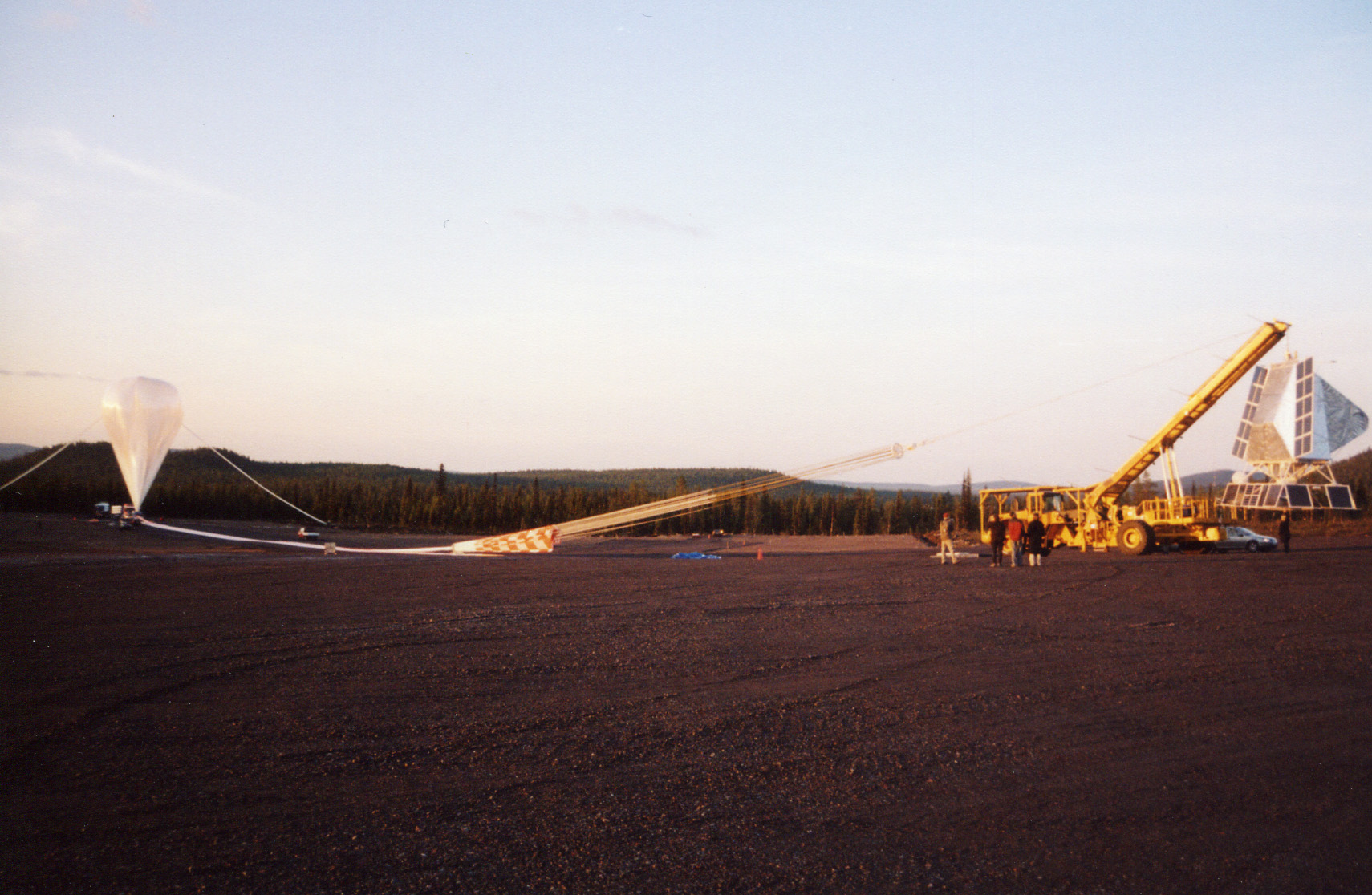
High-altitude balloons (HABs) or stratostats are usually uncrewed balloons typically filled with helium or hydrogen and released into the stratosphere, generally attaining between 18 and 37 km (11 and 23 mi; 59,000 and 121,000 ft) above sea level. In 2013, a balloon named BS 13-08 reached a record altitude of 53.7 km (33.4 mi; 176,000 ft).
The most common type of high-altitude balloons are weather balloons. Other purposes include use as a platform for experiments in the upper atmosphere. Modern balloons generally contain electronic equipment such as radio transmitters, cameras, or satellite navigation systems, such as GPS receivers. Hobbyists frequently purchase weather balloons because of their ease of use, low price point, and widespread commoditisation.
These balloons are launched into what is defined as "near space", defined as the area of Earth's atmosphere between the Armstrong limit (18–19 km (11–12 mi) above sea level), where pressure falls to the point that a human being cannot survive without a pressurised suit, and the Kármán line (100 km (62 mi) above sea level), where astrodynamics must take over from aerodynamics in order to maintain flight.
Due to the low cost of GPS and communications equipment, high-altitude ballooning is a popular hobby, with organizations such as UKHAS assisting the development of payloads.
In France during 1783, the first public experiment with hydrogen-filled balloons involved Jacques Charles, a French professor of physics, and the Robert brothers, renowned constructors of physics instruments.
Charles provided large quantities of hydrogen, which had only been produced in small quantities previously, by mixing 540 kg (1,190 lb) of iron and 270 kg (600 lb) of sulfuric acid. The balloon took 5 days to fill and was launched from Champ de Mars in Paris where 300,000 people gathered to watch the spectacle. The balloon was launched and rose through the clouds. The expansion of the gas caused the balloon to tear and it descended 45 minutes later 20 km (12 mi) away from Paris.
Crewed high-altitude balloons have been used since the 1930s for research and in seeking flight altitude records, including Auguste Piccard's flights up to 16,201 m (16.2 km), the Soviet Osoaviakhim-1 at 22,000 m (22.0 km), and the American Explorer II at 22,066 m (22.1 km).
Notable crewed high altitude balloon flights include three records set for highest skydive:
Hub AI
High-altitude balloon AI simulator
(@High-altitude balloon_simulator)
High-altitude balloon
High-altitude balloons (HABs) or stratostats are usually uncrewed balloons typically filled with helium or hydrogen and released into the stratosphere, generally attaining between 18 and 37 km (11 and 23 mi; 59,000 and 121,000 ft) above sea level. In 2013, a balloon named BS 13-08 reached a record altitude of 53.7 km (33.4 mi; 176,000 ft).
The most common type of high-altitude balloons are weather balloons. Other purposes include use as a platform for experiments in the upper atmosphere. Modern balloons generally contain electronic equipment such as radio transmitters, cameras, or satellite navigation systems, such as GPS receivers. Hobbyists frequently purchase weather balloons because of their ease of use, low price point, and widespread commoditisation.
These balloons are launched into what is defined as "near space", defined as the area of Earth's atmosphere between the Armstrong limit (18–19 km (11–12 mi) above sea level), where pressure falls to the point that a human being cannot survive without a pressurised suit, and the Kármán line (100 km (62 mi) above sea level), where astrodynamics must take over from aerodynamics in order to maintain flight.
Due to the low cost of GPS and communications equipment, high-altitude ballooning is a popular hobby, with organizations such as UKHAS assisting the development of payloads.
In France during 1783, the first public experiment with hydrogen-filled balloons involved Jacques Charles, a French professor of physics, and the Robert brothers, renowned constructors of physics instruments.
Charles provided large quantities of hydrogen, which had only been produced in small quantities previously, by mixing 540 kg (1,190 lb) of iron and 270 kg (600 lb) of sulfuric acid. The balloon took 5 days to fill and was launched from Champ de Mars in Paris where 300,000 people gathered to watch the spectacle. The balloon was launched and rose through the clouds. The expansion of the gas caused the balloon to tear and it descended 45 minutes later 20 km (12 mi) away from Paris.
Crewed high-altitude balloons have been used since the 1930s for research and in seeking flight altitude records, including Auguste Piccard's flights up to 16,201 m (16.2 km), the Soviet Osoaviakhim-1 at 22,000 m (22.0 km), and the American Explorer II at 22,066 m (22.1 km).
Notable crewed high altitude balloon flights include three records set for highest skydive:
Recent media