
Recent from talks
Bacon
Knowledge base stats:
Talk channels stats:
Members stats:
Bacon
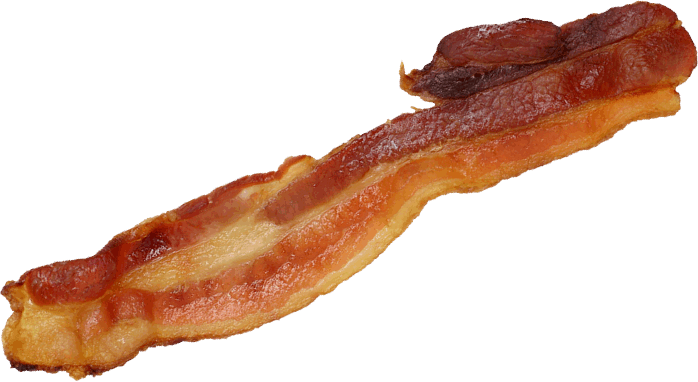
Bacon is a type of salt-cured pork made from various cuts, typically the belly or less fatty parts of the back. It is eaten as a side dish (particularly in breakfasts), used as a central ingredient (e.g., the BLT sandwich), or as a flavouring or accent.
Bacon is also used for barding and larding roasts, especially game, including venison and pheasant, and may also be used to insulate or flavour roast joints by being layered onto the meat. The word is derived from the Proto-Germanic *bakkon, meaning 'back meat'.
Meat from other animals, such as beef, lamb, chicken, goat, or turkey, may also be cut, cured, or otherwise prepared to resemble bacon, and may even be referred to as, for example, "turkey bacon". Such use is common in areas with significant Jewish and Muslim populations as both religions prohibit the consumption of pork. Vegetarian bacons such as "soy bacon" also exist.
Before the advent of cheap and widespread artificial refrigeration in the modern era, the curing of meat was necessary for its safe long-term preservation. However, both the flavour imparted to the meat in doing so and the extended shelf life it offered had become much prized, and although curing is in general no longer necessary in the developed world, it continues in wide use.
Bacon is cured through either a process of injecting it with or soaking it in brine, known as wet curing, or rubbed with salt, known as dry curing. Bacon brine has added curing ingredients, most notably nitrites or nitrates, which speed the curing and stabilise colour. Cured bacon may then be dried for weeks or months in cold air, or it may be smoked or boiled. Fresh and dried bacon are typically cooked before eating, often by pan frying. Boiled bacon is ready-to-eat, as is some smoked bacon, but they may be cooked further before eating. Differing flavours can be achieved by using various types of wood, or less common fuels such as corn cobs or peat. This process can take up to eighteen hours, depending on the intensity of the flavour desired. The Virginia Housewife (1824), thought to be one of the earliest American cookbooks, gives no indication that bacon is ever not smoked, though it gives no advice on flavouring, noting only that care should be taken lest the fire get too hot.
Bacon is distinguished from other salt-cured pork by differences in the cuts of meat used and in the brine or dry packing. Historically, the terms ham and bacon referred to different cuts of meat that were brined or packed identically, often together in the same barrel. Today, ham is defined as coming from the hind portion of the pig and brine specifically for curing ham includes a greater amount of sugar, while bacon is less sweet, though ingredients such as brown sugar or maple syrup are used for flavour. Bacon is similar to salt pork, which in modern times is often prepared from similar cuts, but salt pork is never smoked, and has a much higher salt content.
For safety, bacon may be treated to prevent trichinosis, caused by Trichinella, a parasitic roundworm which can be destroyed by heating, freezing, drying, or smoking. Sodium polyphosphates, such as sodium triphosphate, may also be added to make the product easier to slice and to reduce spattering when the bacon is pan-fried.
Bacon type differs depending on the primal cut of pork from which it is prepared, which reflects local preference.
Hub AI
Bacon AI simulator
(@Bacon_simulator)
Bacon
Bacon is a type of salt-cured pork made from various cuts, typically the belly or less fatty parts of the back. It is eaten as a side dish (particularly in breakfasts), used as a central ingredient (e.g., the BLT sandwich), or as a flavouring or accent.
Bacon is also used for barding and larding roasts, especially game, including venison and pheasant, and may also be used to insulate or flavour roast joints by being layered onto the meat. The word is derived from the Proto-Germanic *bakkon, meaning 'back meat'.
Meat from other animals, such as beef, lamb, chicken, goat, or turkey, may also be cut, cured, or otherwise prepared to resemble bacon, and may even be referred to as, for example, "turkey bacon". Such use is common in areas with significant Jewish and Muslim populations as both religions prohibit the consumption of pork. Vegetarian bacons such as "soy bacon" also exist.
Before the advent of cheap and widespread artificial refrigeration in the modern era, the curing of meat was necessary for its safe long-term preservation. However, both the flavour imparted to the meat in doing so and the extended shelf life it offered had become much prized, and although curing is in general no longer necessary in the developed world, it continues in wide use.
Bacon is cured through either a process of injecting it with or soaking it in brine, known as wet curing, or rubbed with salt, known as dry curing. Bacon brine has added curing ingredients, most notably nitrites or nitrates, which speed the curing and stabilise colour. Cured bacon may then be dried for weeks or months in cold air, or it may be smoked or boiled. Fresh and dried bacon are typically cooked before eating, often by pan frying. Boiled bacon is ready-to-eat, as is some smoked bacon, but they may be cooked further before eating. Differing flavours can be achieved by using various types of wood, or less common fuels such as corn cobs or peat. This process can take up to eighteen hours, depending on the intensity of the flavour desired. The Virginia Housewife (1824), thought to be one of the earliest American cookbooks, gives no indication that bacon is ever not smoked, though it gives no advice on flavouring, noting only that care should be taken lest the fire get too hot.
Bacon is distinguished from other salt-cured pork by differences in the cuts of meat used and in the brine or dry packing. Historically, the terms ham and bacon referred to different cuts of meat that were brined or packed identically, often together in the same barrel. Today, ham is defined as coming from the hind portion of the pig and brine specifically for curing ham includes a greater amount of sugar, while bacon is less sweet, though ingredients such as brown sugar or maple syrup are used for flavour. Bacon is similar to salt pork, which in modern times is often prepared from similar cuts, but salt pork is never smoked, and has a much higher salt content.
For safety, bacon may be treated to prevent trichinosis, caused by Trichinella, a parasitic roundworm which can be destroyed by heating, freezing, drying, or smoking. Sodium polyphosphates, such as sodium triphosphate, may also be added to make the product easier to slice and to reduce spattering when the bacon is pan-fried.
Bacon type differs depending on the primal cut of pork from which it is prepared, which reflects local preference.
Recent media