Hubbry Logo
Stretcher barStretcher barMain
Open search
Stretcher bar
Community hub
Stretcher bar
logo
8 pages, 0 posts
0 subscribers
Be the first to start a discussion here.
Stretcher bar
Stretcher bar
from Wikipedia
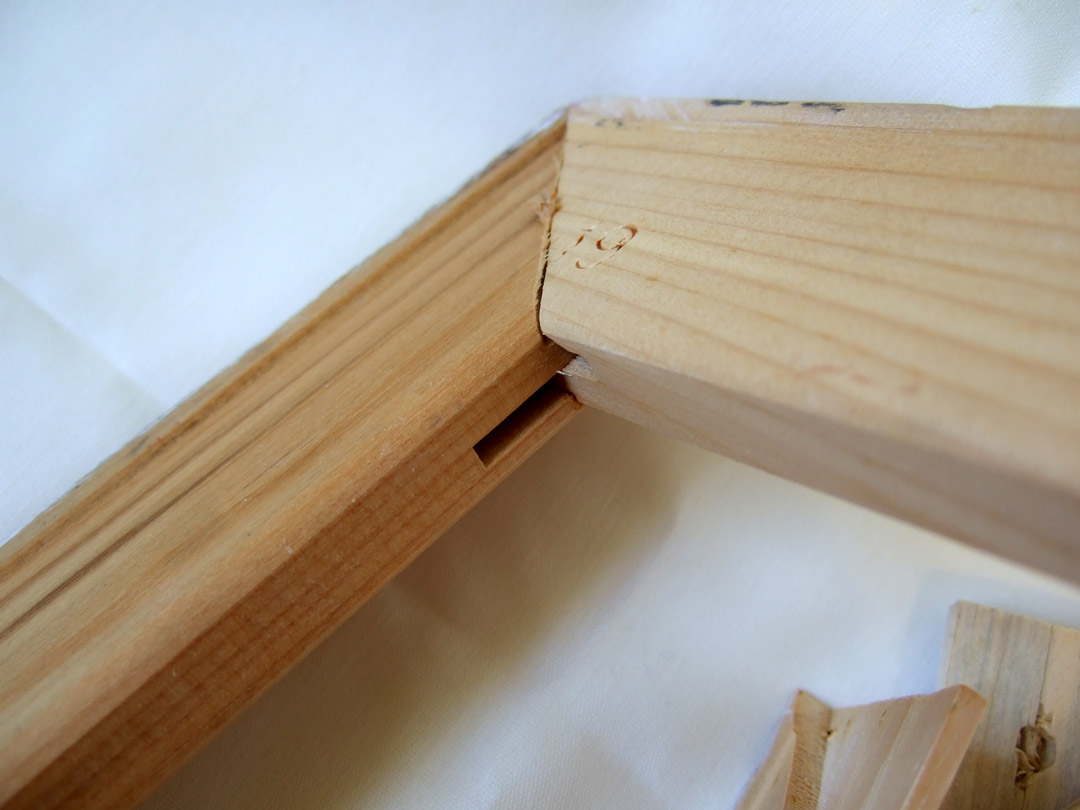
Interior angle of a completed stretcher bar corner showing the slot designed to fit a Corner key.
A fully assembled stretcher bar corner. Two unassembled stretcher bars displaying corner mitre construction.

A stretcher bar is used to construct a wooden stretcher used by artists to mount their canvases.

They are traditionally a wooden framework support[1] on which an artist fastens a piece of canvas. They are also used for small-scale embroidery to provide steady tension, affixing the edges of the fabric with push-pins or a staple gun before beginning to sew, and then removing it from the stretcher when the work is complete. Stretchers are usually in the shape of a rectangle, although shaped canvases are also possible.

Construction

[edit]

Since a stretcher is simply a frame, it can be constructed in a variety of ways. The differences in construction have to do with how the corners are built. Commercially available pre-fabricated stretchers come in segments with interlocking corners, that can be fit together like puzzle pieces. Corner supports can also be made using simple woodworking techniques, however.

In the case of the French stretcher, a mitre joint is used to adhere the corners. "Keys" or small triangle wedges are inserted in the joint after stretching the canvas to give the canvas its final tension. When fastening the canvas, pressure should be distributed evenly around the stretcher to minimize warping due to unequal distribution of pull. Unlike other types of stretchers, the corner joints in French stretchers are not glued or fastened in any permanent way. This allows the canvas to be re-tensioned later, as it has a natural tendency to stretch and sag over time. In contrast, strainer bars stretch canvas in a fixed (non-adjustable) way. The keys became popular in the 19th century.[2]

A simpler form of stretcher employs butt joints to adhere the corners. The joint is pinned and glued into place and can not be expanded after assembly.

Design

[edit]

The profiles on the stretcher bar should be slightly rounded. This has three advantages:

  1. It allows the framer to see and obtain clear edges on images that have precise borders
  2. It allows the canvas weave to "roll over" the profile rather than snap over a sharp edge which is a major cause of canvas cracking.[3]
  3. It also increases the surface area of the frame, which reduces its friction with the canvas. This will make it easier to pull the canvas and make it more taut.[4]

There are many different stretcher bar profiles, and many different styles of cutting the wood. So it is impossible to say anything is "standard." There are also many big regional differences in the style and cutting of the wood, due to the historical reasons. For the same reasons, the wood used for making stretcher bars differs a lot from country to country depending on the forest that is present. But most stretchers, to avoid warping is made in well dried Nordic pinewood sourced from Scandinavia, Russia, and Canada.

Another way in which stretcher bars can be strengthened is by having a cross brace inserted. It is advised that lengths over 40" or 1m be fitted with a cross brace. By doing this it ensures the wood will not warp and will hang flat.

Uses

[edit]

The use of stretcher bars in the home print market has become increasingly prominent with inkjet-printed canvas prints becoming more popular in the home. This has given a rebirth to this old technique used in the art market for so many years.

Although artists use blank canvases and pre-stretched canvases in the art business, many photographers use stretcher bars for framing wedding photography and reproduction of photographic prints. Stretcher bars are also used in picture framing when framers are framing things like sport shirts etc. Stretcher bars are used extensively in theatrical productions for framing material backdrops.

When a photographer takes a picture then digitally transfers this onto a canvas via inkjet printing, he then stretches this over a stretcher frame. By wrapping the canvas all the way around the frame, known as gallery wrap, the photographer can then hang his picture on the wall, already framed.

See also

[edit]

References

[edit]
Revisions and contributorsEdit on WikipediaRead on Wikipedia
from Grokipedia
A stretcher bar is a precision-crafted wooden component used to assemble a rectangular or square frame that supports and tensions for , ensuring a flat and stable surface essential for artistic application. Typically constructed from kiln-dried softwoods such as or hardwoods like and , stretcher bars feature a profiled with a flat back, a slanted or beveled front edge, and a raised lip along the outer side to prevent canvas contact and ridges on the painting surface. These bars interlock at mitered corners using tongue-and-groove or mortise-and-tenon joints, often secured with wedges or keys—small triangular wooden pieces inserted into the joints to allow for expansion and tightening of the canvas over time as it responds to environmental changes like . Stretcher bars differ from rigid strainers, which use fixed joints and cannot be adjusted, by incorporating expandable joints that maintain tension without requiring restretching. They are available in various profiles defined by width (typically 1-3 inches for depth), depth, and bevel angle, with shallower profiles suited for framed artworks and deeper "gallery-wrap" bars (often 1.5-2 inches deep) enabling canvases to wrap around the edges for a frameless, modern presentation. For larger canvases exceeding 24 inches, crossbars or center braces are added to prevent warping and provide additional support. Stretcher bars developed in the with the rise of as a support, with adjustable designs emerging in the mid-18th century and gaining popularity by the late 1700s to address canvas sagging; commercial production proliferated in the , leading to patented innovations and standardized sizes. Today, while traditionally wooden, modern variants include hybrid models with aluminum reinforcements for enhanced durability in large-scale or traveling artworks, though wood remains preferred for its lightweight stability and compatibility with conservation practices. In addition to , stretcher bars support applications in prints, custom framing, and even small-scale , underscoring their versatility in visual media.

Fundamentals

Definition and Purpose

A stretcher bar is an elongated strip, typically constructed from or metal, designed to interlock with others to create a rigid frame that supports and stretches material. These bars form the foundational for mounting artwork, ensuring the canvas is held securely without direct attachment to walls or other surfaces. The primary purpose of stretcher bars is to provide a stable and taut surface for creative processes such as , , or , by distributing tension evenly across the to prevent sagging, wrinkling, or distortion. This even tension allows artists and printers to work on a flat, responsive medium that maintains its integrity over time, facilitating precise application of media without compromising the support structure. Stretcher bars consist of individual components designated for each side of the frame—top, bottom, left, and right—that assemble into rectangular or custom shapes to accommodate various artwork dimensions. This enables flexibility in sizing while upholding the frame's overall rigidity. Originating in artistic practices as a durable alternative to temporary tacking methods, stretcher bars introduced reusable and adjustable that enhance longevity and ease of maintenance for works. This innovation evolved from early framing techniques to standardize support systems in production.

Historical Development

While the use of stretched over wooden frames dates to the in —where artists transitioned from rigid panel supports to flexible for greater portability and scale in oil paintings, with Italian painters like popularizing on simple rectangular frames as early as the —the specific adjustable bars emerged in the mid-18th century. Early supports were often fixed strainers, which differ from stretchers by lacking adjustability. By the , French artists were purchasing pre-stretched and primed canvases, indicating early commercialization of these frames. Adjustable designs, including corner keys—triangular wooden wedges inserted into frame joints to expand and tighten the structure—were introduced by French artists in the mid-18th century to maintain canvas tension amid environmental changes. This technique, allowing non-invasive adjustments, gained popularity alongside oil painting's expansion. The 19th century saw further innovations, such as patented designs for interlocking stretcher bars, including an 1880 U.S. patent for an improved canvas-stretcher emphasizing stability and ease of assembly. The Industrial Revolution facilitated mass production of these components, shifting from artisanal to factory-made wooden bars with tongue-and-groove joints, enabling wider availability for professional and amateur artists. The 20th century saw further evolution through adoption in emerging media like backdrops and supports after the 1950s, as canvas stretching techniques adapted to larger formats and synthetic materials. A key milestone came in the with industry standardization in art supplies, driven by surveys like Richard Buck's 1972 classification of joint types, which influenced consistent manufacturing practices across suppliers. In the , stretcher bars integrated with technologies, supporting high-resolution canvas prints for commercial and decorative applications beyond traditional . As of 2025, trends emphasize sustainable wooden or aluminum-reinforced bars for large-scale, eco-friendly prints, reflecting broader demands for customizable, durable supports in the print-on-demand market.

Materials and Construction

Materials Selection

Stretcher bars are traditionally constructed from kiln-dried pinewood, such as Nordic or Baltic , valued for its lightness, stability, and low moisture content that minimizes warping under environmental fluctuations. The kiln-drying process reduces the wood's moisture to below 10%, enhancing dimensional stability and preventing the expansion or contraction that could loosen canvas tension. This material is often sourced sustainably, with many manufacturers using FSC-certified from responsibly managed forests to ensure environmental accountability. Alternative woods include basswood and poplar, selected for their lightweight properties and fine grain that facilitate smooth stretching without adding excessive bulk. For heavy-duty applications requiring greater rigidity, hardwoods like may be employed, though they are denser and better suited to larger frames where strength outweighs weight concerns. These options provide flexibility in material choice based on the frame's scale and intended use. In modern contexts, aluminum and composite alloys have emerged as rust-resistant, non-warping alternatives, particularly since the early , offering superior performance in variable climates. Aluminum bars, often reinforced with wood elements in hybrid designs, are significantly lighter than equivalent wooden bars, reducing overall frame burden while maintaining structural . For humidity-prone environments, these materials resist and moisture-induced deformation better than untreated wood. Material selection for stretcher bars hinges on several criteria, including cost—where remains economical compared to premium hardwoods or metals—weight for ease of handling, environmental resistance to ensure longevity, and compatibility with adhesives or staples, as wood surfaces provide better grip than slick metals. These factors collectively influence the bar's role in maintaining tautness and overall stability.

Assembly Methods

Stretcher bars are primarily assembled using interlocking joints such as configurations, which allow for easy disassembly and reassembly without additional fasteners. These joints feature a protruding tenon on one bar end that fits into a corresponding mortise slot on the adjacent bar, often at a 45-degree to form right-angled corners. For greater precision, mitre joints are employed, where bar ends are cut at 45 degrees and secured with along the joint face, reinforced by or pins to prevent slippage during use. A common variation is the French-style assembly, which incorporates wooden corner keys—small triangular wedges inserted into pre-cut slots at each corner after the frame is joined. These keys enable post-assembly tension adjustments by tapping them gently with a to expand the frame and tighten the , compensating for any loosening over time. This method is particularly valued in professional art conservation for maintaining structural integrity without permanent alterations. For permanent installations, the butt joint technique is utilized, where bar ends are cut square and abutted directly, then fixed by hammering nails through the joint or screwing them together for enhanced stability. This approach suits strainers, which are rigid frames not intended for adjustment. Assembly requires basic woodworking tools, including a tape measure for ensuring equal bar lengths, a mallet for tapping joints securely, a drill for pre-drilling holes to avoid splitting (especially in harder woods), and wood glue for added adhesion in mitre or butt joints. A step-by-step process for constructing a basic 24x36 inch rectangular frame begins with selecting two 24-inch bars for the short sides and two 36-inch bars for the long sides, verifying measurements to within 1/16 inch for squareness. Next, align the bars on a flat surface with mortises facing inward, insert tenons starting from one corner to form a U-shape, then complete the rectangle by connecting the final joint. Pre-drill and apply glue if using mitre or butt reinforcements, then tap evenly with a mallet until corners are flush. Finally, check diagonals (both should measure approximately 43.3 inches) and adjust by tapping opposite corners until equal, ensuring even pressure to prevent future canvas distortion. A common error is creating uneven joints through rushed tapping, which can lead to frame warping and canvas sagging over time.

Design and Variations

Structural Features

Stretcher bars are engineered with a profiled cross-section that includes beveled or rounded inner edges, which slope continuously from the outer to the inner edge of the bar to minimize contact with the and reduce stress that could lead to cracking or stretcher marks. This design, originating from chamfered edges introduced in the early , creates a small gap between the and the bar's interior, preventing abrasion and promoting even tension distribution. The outer edge features a raised or , providing a secure surface for stapling the while maintaining structural . Standard dimensions for stretcher bars vary to suit different applications, with depths typically ranging from 3/4 inch for light-duty to 1.5 inches for gallery wraps that require greater projection and stability. Lengths are available up to 72 inches, allowing for large-scale artworks, though longer bars often incorporate additional support elements to maintain rigidity. To ensure stability in larger frames, bracing systems such as diagonal cross-braces or center struts are integrated, particularly for dimensions exceeding 40 inches on any side, to counteract warping forces from tension and environmental changes. These braces, often connected via half-lap joints, bisect the longer members and enhance overall frame resistance to twisting. The core tension mechanics rely on this beveled profile and keyable joints, where wooden wedges inserted into corner grooves allow incremental adjustments to distribute pull evenly across the . Heavy-duty stretcher bars incorporate reinforced grooves for these keys, providing enhanced adjustability and longevity, especially in varying humidity conditions where wood expansion or contraction could otherwise compromise frame stability. Assembly of braces integrates seamlessly with the bar profiles through tongue-and-groove or mortise connections for precise alignment.

Types and Profiles

Stretcher bars are categorized into several types based on their intended use and structural demands, primarily light-duty, heavy-duty, and varieties. Light-duty stretcher bars, typically thin and constructed from with rounded edges to minimize friction, are designed for small-scale artworks up to around 24 inches, providing sufficient support without excessive weight. Heavy-duty stretcher bars, featuring thicker profiles often exceeding 1.5 inches in depth and made from finger-spliced for enhanced stability, are suited for large over 48 inches, capable of supporting spans up to 12 feet (144 inches) with added cross-bracing. bars, or deep-profile bars for gallery wraps and floater effects, characterized by their deep, beveled edges that allow the canvas to wrap around the frame for a frameless appearance, are commonly used in contemporary displays where edge visibility is desired. Profile variations in stretcher bars adapt to artistic and framing needs, with standard bevel profiles featuring a slanted front edge and raised outer lip to prevent canvas contact and ensure even tension in traditional paintings. Deep-profile designs, often 1.25 to 1.5 inches thick, enable three-dimensional gallery wraps by allowing canvas to fold around the edges for a taut, modern finish without additional framing. Custom curved profiles, machined from kiln-dried wood to form arcs or irregular contours, support shaped canvases such as rounds or ovals, distributing tension evenly across non-rectangular forms up to 15 feet in diameter. Additional variations include pre-stretched kits, which arrive fully assembled and primed for immediate use but limit sizes to standard dimensions, versus DIY stretcher bars sold in loose lengths for custom assembly, offering flexibility for non-standard shapes at lower costs. Aluminum profiles, combining kiln-dried exteriors with recycled aluminum cores, provide for outdoor or archival applications by resisting and over alone. In the , modular designs with joints or expansion bolts have emerged, facilitating disassembly for compact shipping and reducing expenses through knock-down . Regional adaptations reflect market priorities, with European manufacturers often prioritizing through kiln-dried, FSC-certified sourced from managed forests to minimize environmental impact. In contrast, U.S. production emphasizes heavy-duty options from North American , tailored for commercial large-format prints and gallery-scale works.

Applications

Fine Art and Traditional Uses

Stretcher bars have long served as the foundational support in painting, primarily for stretching or to create a taut surface suitable for , acrylic, or watercolor applications in professional studios. Stretcher bars originated in the mid-18th century as wooden frameworks to replace rigid panels, offering artists greater flexibility in size and portability while resisting issues like warping or damage common to wood supports. This traditional method ensures the canvas remains drum-tight, essential for even paint application and detailed brushwork in classical techniques. In historical artistic practices, hand-stretching onto stretcher bars was a standard technique, particularly in workshops from the late through the period. Artists would secure the fabric using tacks, nails, or lacing to temporary wooden frames, allowing for adjustments during the painting process. For instance, 17th-century Dutch master employed early stretcher systems, where canvas was secured with tacks or laces to larger wooden frames rather than using modern wedge keys, as seen in works like , which required robust support for its expansive scale. The introduction of corner keys in the mid-18th century further refined this approach, enabling ongoing tension adjustments to counteract canvas relaxation as layers of were applied, a practice that persists in traditional ateliers for maintaining structural integrity over time. Fine artists have traditionally favored stretcher bars for their adaptability to custom dimensions, accommodating unique compositional needs without reliance on standardized panels. This modularity supports the creation of frames in professional settings, as evidenced by historical examples from Rembrandt's era where tailored supports were essential for guild-regulated yet variable sizes. Additionally, in and , stretcher bars form the core of frames, providing steady tension for fabric since the to facilitate intricate stitching on or , much like their role in painting preparation.

Modern and Commercial Applications

In the realm of , stretcher bars facilitate the framing of inkjet canvas prints for home decor and applications, enabling gallery wraps where the image extends around the edges for a frameless presentation. This technique is particularly popular for wedding portraits and personal photographs, as the bars provide a stable, adjustable tension to maintain a taut surface without requiring traditional . Pre-stretched on these bars supports quick assembly for fulfillment, contributing to the sector's expansion. Commercially, large-scale aluminum stretcher bars are utilized for theatrical backdrops, advertising banners, and retail displays, where their lightweight yet robust construction accommodates oversized fabric or vinyl graphics. These bars allow for modular setups in trade shows and promotional environments, enabling easy graphic swaps to align with branding needs. Modern composite materials, such as those in aluminum profiles, enhance resistance to environmental stresses in these applications. Innovations in the emphasize sustainable and recyclable stretcher bars, with FSC-certified and aluminum variants gaining traction in eco-friendly art supplies to reduce environmental impact. Custom profiles, often produced via CNC machining, support tailored designs for commercial scalability. The U.S. stretched market has seen growth bolstered by such advancements, with driving a significant portion of sales. Adapting stretcher bars to non-porous materials like vinyl for outdoor presents challenges, including achieving uniform tension on slick surfaces and ensuring longevity against weather exposure, often necessitating reinforced aluminum frames with specialized tensioning mechanisms.

References

Add your contribution
Related Hubs
User Avatar
No comments yet.