Hubbry Logo
Pauline SmallPauline SmallMain
Open search
Pauline Small
Community hub
Pauline Small
logo
8 pages, 0 posts
0 subscribers
Be the first to start a discussion here.
Pauline Small
Pauline Small
from Wikipedia

Pauline Small (November 30, 1924 – March 9, 2005) was the first woman to be elected to office in the Crow Tribe of Montana. In 1966 she was elected to Vice-Secretary of the Crow Tribal Council, holding office de facto to 1972, and served in various positions within the Crow Tribal Offices, many to do with supporting education.

Key Information

Early life and education

[edit]

Pauline White Man Runs Him was born on the Crow Indian Reservation in Lodge Grass, Montana. The youngest of three children, she was raised in the Valley of the Chiefs district on the reservation. Small was a granddaughter of White Man Runs Him.[1]

Marriage and family

[edit]

She married Ivan James Small, Sr., a member of the Northern Cheyenne Tribe of Indians. They made their home in Busby, Montana. Eventually they moved to the family allotment of Packs The Hat in the Rotten Grass area.[1]

Tribal politics

[edit]

Small was active in Crow tribal politics. In 1966 she was elected to the position of Vice-Secretary of the Tribal Council, the first woman to hold any office. She served in that position until 1972, and has been active on various committees of the Tribal council.

Deeply interested in education, she was a member of the Lodge Grass Board of Trustees, serving as Chair for eight years; Crow Tribal Education Committee; and the 107th Committee of the Crow Tribal Council. A member of the Crow Tribe, she was very involved with tribal government.[1] Small was an active supporter of Indian rodeo for 30 years.[2]

References

[edit]
[edit]
Revisions and contributorsEdit on WikipediaRead on Wikipedia
from Grokipedia
Pauline Small (November 30, 1924 – March 9, 2005) was a Crow Tribe member recognized as the first woman elected to office within the tribe, serving as vice-secretary of the Crow Tribal Council in 1966. Born in , to Blake and Annie Blaine Whitemanrunshim, she was the granddaughter of the famed Crow chief Medicine Crow and dedicated her life to family, tribal service, education, and cultural traditions. Small raised five children on the Crow and Northern Cheyenne Reservations after marrying Ivan J. Small Sr. in 1948, while actively participating in ranching, activities, and tribal organizations such as the Big Lodge Clan, Greasy Mouth Clan, Night Hawk Society, and Tobacco Society. She contributed to education through a decade-long tenure on the Lodge Grass School Board and involvement in the Crow Tribal Education Committee, and later served on the tribe's 107th Committee from 1996 to 2000. Additionally, Small held roles in the National Historical Preservation Society, , and Historical Society, and was a charter member of the Crow Cattle Association and Tri-State Indian Livestock Association. A lifelong participant in the Crow Fair, camping there for over 75 years and parading on horseback—including at age 79 in 2004—Small embodied tribal heritage and leadership, promoting educational opportunities and historical preservation for the people until her death in Crow Agency.

Early Life and Background

Birth and Family Ancestry

Pauline Small, originally named Pauline Whiteman Runs Him, was born on November 30, 1924, in Lodge Grass, Montana, a community on the Crow Indian Reservation in Big Horn County. Lodge Grass lies within the reservation boundaries established by U.S. treaties, including the 1868 Fort Laramie Treaty and subsequent land cessions in the 1880s that reduced the Crow's territory from approximately 30 million acres to about 2.3 million acres by 1904, forcing adaptation to sedentary reservation economies amid the near-extinction of herds essential to traditional lifeways. She was the daughter of Blake Whitemanrunshim and Florence Annie Blaine Whitemanrunshim, both members of the Tribe whose names reflect linguistic ties to historical figures in tribal oral traditions. Small's paternal ancestry linked her directly to Whiteman Runs Him (c. 1852–1929), a prominent scout who served the U.S. 7th Cavalry under General , including reconnaissance ahead of the in 1876; his role exemplified the Crow's strategic alliances with the U.S. against common and adversaries, though such service yielded limited long-term territorial gains for the tribe amid broader federal assimilation policies. This heritage underscored her roots in the 's equestrian and scouting traditions, forged in the pre-reservation era of nomadic hunting and intertribal warfare on the Northern Plains.

Childhood and Upbringing

Pauline Small, born Pauline White Man Runs Him on November 30, 1924, in Lodge Grass on the in , was the youngest of three children to Blake Whitemanrunshim and Florence Annie Blaine Whitemanrunshim. Her paternal grandfather, the famed scout Whitemanrunshim (), who had served with General George Armstrong Custer's Seventh Cavalry during the 1876 , exemplified the tribe's historical ties to military scouting traditions that persisted into reservation life. Raised amid the austere rural conditions of the Crow Reservation during the 1920s and 1930s, Small's early years unfolded in a community reliant on cattle ranching, subsistence farming, and seasonal labor, with limited infrastructure and federal support exacerbating poverty common to many Plains tribes post-allotment era under the of 1887. Family life centered on extended networks, where traditional practices such as affiliations—Small being a child of the Big Lodge Clan and a member of the Greasy Mouth Clan—instilled values of communal reciprocity and self-sufficiency before the expansion of relief programs in the mid-1930s. Her immersion in Crow cultural elements, including pre-reservation from elders and early exposure to tribal societies like the Night Hawk and Tobacco Societies alongside Catholic mission influences, shaped a rooted in ancestral resilience and collective governance, distinct from urban or off-reservation experiences. These formative reservation dynamics, marked by isolation from broader American prosperity yet enriched by linguistic and ceremonial continuity in the Apsáalooke and customs, fostered the independence that later informed her tribal leadership.

Education and Early Influences

Pauline Small attended Albright Country School at Good Luck Creek and St. Ann’s near Lodge Grass Creek for her , reflecting the limited but localized schooling options available to Crow reservation youth in . She completed her by graduating from Lodge Grass High School in 1944, during the height of when federal policies were expanding oversight of Native American affairs, including education and resource allocation on reservations. Post-high school, Small pursued further training at Haskell Indian College, a federal boarding institution focused on vocational and cultural education for Native students, and Sheridan Business College, where she acquired administrative and clerical skills essential for organizational roles. These experiences provided her with practical tools in , , and , directly applicable to tribal council duties amid post-war economic shifts on the Crow Reservation. Small's formal schooling intertwined with profound informal influences rooted in her heritage. As the granddaughter of scout Whitemanrunshim and named "Strikes Twice In One Summer" by her grandfather Packs the Hat prior to her birth on November 30, 1924, she absorbed oral histories and from family elders, fostering resilience and communal decision-making. Her affiliation with the Big Lodge Clan, Greasy Mouth Clan, Night Hawk Society, and Tobacco Society reinforced traditional governance structures, emphasizing consensus and stewardship, which complemented her business training in preparing her for tribal administration without reliance on external advocacy frameworks. Raised in a ranching family, she gained hands-on knowledge of and self-sufficiency, key to navigating reservation challenges like federal allotments and wartime .

Personal Life

Marriage and Spouse

Pauline Small, born Pauline Whiteman Runs Him, married J. Small Sr., a fellow member of Tribe, on April 15, 1948, in . The union occurred within the context of reservation life, where both partners contributed to sustaining a through ranching on lands spanning the Crow and Northern reservations. Their marriage reflected practical partnership dynamics centered on economic , with Ivan Small Sr. actively involved in operations alongside Pauline, navigating the challenges of arid reservation terrain and limited external resources typical of mid-20th-century tribal economies. This collaborative approach aligned with traditions of familial interdependence, though specific details on Ivan Small's independent tribal roles remain sparsely documented in available records.

Children and Immediate Family

Pauline Small married Ivan J. Small, Sr., on April 15, 1948, in ; he preceded her in death. The couple had five biological children: sons Ivan Small Jr. (married to Lucille), Blaine Small (married to Beldean), John Small (married to Francine), Henry Small (married to Sarah), and Eugene Small, who predeceased her; and daughter Veronica Small (married to Sidney), all residing in Lodge Grass on the at the time of her death in 2005. Small also raised stepchildren from her husband's previous relationships, including Simon Small in , Dennis Shoulderblade in Lame Deer, and Ruby Harte in . She adopted Kevin Old Coyote and Carrie Old Coyote, who were affiliated with the Tobacco Society in Crow Agency, a traditional Crow cultural organization focused on spiritual and communal practices; two other adopted daughters, Monica Falls Down and Diane Old Elk, predeceased her. These adoptions reflect customary extensions, emphasizing clan-based support networks on the reservation. The family produced 22 grandchildren, contributing to the multi-generational continuity of Small's lineage, which traces back to her grandfather, the Crow scout . While specific details on the children's direct roles in tribal governance or ranching are limited in available records, the household's residence in Lodge Grass aligned with common reservation family dynamics, including economic reliance on tribal allotments and potential challenges from health and resource constraints typical in such communities.

Residence and Community Involvement

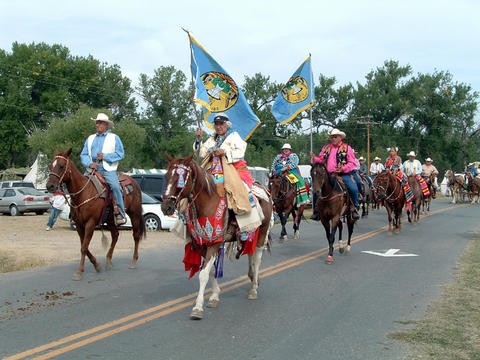
Pauline Small was born in Lodge Grass, Montana, on the Crow Indian Reservation, and maintained her primary residence there throughout her life, later settling with her family on Rotten Grass Creek. Her household engaged in ranching, focusing on rearing as a core family livelihood on reservation lands. She raised her five children—Ivan Jr., Blaine, John, Henry, and Veronica—in Lodge Grass, prioritizing family stability amid reservation-based self-reliance. Small was deeply involved in the Catholic community as an active member of Our Lady of Loretto Catholic Church in Lodge Grass and the Little Portion Franciscan Fraternity Third Order, contributing to religious gatherings and spiritual practices that strengthened local bonds. For over 75 years, Small's family camped at a consistent site during the annual Crow Fair, where she participated in parade dances and activities, supporting cultural continuity through hands-on involvement in these reservation-wide events. At age 79 in 2004, she continued this tradition by parading on horseback, exemplifying enduring personal commitment to communal traditions predating her public roles.

Political Career in the Crow Tribe

Entry into Tribal Governance

In the mid-1960s, the Crow Tribe's governance structure saw adjustments amid broader federal shifts toward tribal , including a 1961 amendment to the tribal constitution and investigations into practices that prompted proposals for direct funding to tribes. Under Chairman Edison Real Bird, who led from 1966 to 1968, the Tribal Council addressed reservation challenges such as emerging interests in and mineral resources, which highlighted needs for improved resource oversight and economic decision-making. These issues underscored gaps in tribal administration, setting the stage for expanded participation in leadership roles. Pauline Small entered Crow tribal governance in 1966 by running for and winning election as Vice-Secretary of the Tribal Council. Her success marked her as the first woman elected to any official position in the tribe, breaking into a body that had historically excluded women from elected roles. This structural barrier stemmed from traditions of male-dominated councils, where women had limited formal pathways to despite community involvement in other capacities. Small's entry aligned with the era's push for diversified representation to tackle practical governance demands, including and resource stewardship amid external pressures like proposals. Her role facilitated tribal engagements, such as agreements on with federal entities during Real Bird's chairmanship.

Elections and Key Positions Held

In 1966, Pauline Small was elected as Vice-Secretary of the Tribal Council, becoming the first woman to hold any elected office in the tribe's , where governance structures had previously been limited to male officials. This election represented a departure from the all-male composition of prior tribal councils, though specific vote tallies from the 1966 contest are not documented in available records. Small retained the Vice-Secretary position through re-elections or continuations in office into the early , serving alongside Chairman Edison Real Bird's administration, which oversaw her initial term. During this period, she also held membership on the Crow Tribal Council itself, contributing to the executive branch's operations amid the tribe's evolving administrative framework. Her tenure underscored incremental shifts in tribal participation, without evidence of formalized quotas or external mandates driving the change.

Legislative and Administrative Roles

Pauline Small served as Vice-Secretary of the Crow Tribal Council from 1966 to 1972, marking her primary legislative and administrative role within the tribe's governing structure. In this position, she supported the council's operations by assisting with the documentation of proceedings, coordination of meetings, and facilitation of resolutions on reservation matters, including land management and federal relations. The Crow Tribal Council, as the central legislative body at the time, handled ordinances, budgets, and negotiations requiring tribal consensus, with Small's administrative duties ensuring procedural continuity amid evolving tribal governance. A documented example of her involvement in administrative decisions occurred in negotiations over Bighorn Canyon lands. As Council secretary, Small co-signed an agreement with Tribal Chairman Edison Real Bird to transfer select Crow Indian lands into the Bighorn Canyon National Recreation Area, enabling federal oversight while preserving tribal interests in the sacred canyon region impacted by the dam construction. This action, executed under facilitation, addressed jurisdictional boundaries and resource access without specified quantifiable fiscal outcomes for the tribe at the time. Small also held membership on the , contributing to administrative oversight of programs aimed at reservation development. Her participation aligned with broader tribal efforts to allocate federal funds for low-income , though specific decisions or allocation metrics from her tenure remain sparsely detailed in available records. These roles underscored her focus on practical amid the Crow Tribe's transition toward formalized branches of government in the late and early .

Specific Initiatives and Decisions

One notable initiative under Pauline Small's involvement as vice-secretary and later secretary of the Tribal Council was the December 1, 1967, agreement to incorporate select tribal lands adjacent to the Yellowtail Dam reservoir into the Bighorn Canyon National Recreation Area. Authorized by Congress in 1966, this 50-year lease—modifiable by mutual consent—enabled federal management of the lands while designating the Tribe as the principal concessioner for tourism-related activities. Small signed the document alongside Tribal Chairman Edson Real Bird and Director George B. Hartzog, Jr., with approval from Secretary of the Interior Stewart L. Udall. The agreement aimed to leverage the reservoir's recreational potential for tribal economic gain, including rights to issue and hunting permits, sell handicrafts, and develop accommodations such as motels and boating facilities. Real Bird highlighted its role in fostering employment and business opportunities within the industry, aligning with broader efforts to develop tribal resources amid ongoing federal oversight of reservation lands. This decision reflected a pragmatic balance between asserting tribal over concessions and partnering with federal entities for access, though long-term economic impacts, such as sustained revenue from , depended on external factors like visitor numbers and federal policy continuity. No documented intra-tribal disputes specifically critiquing Small's role in this pact were identified in available records.

Later Life, Death, and Legacy

Post-Political Activities

After leaving her elected position as Vice-Secretary of the Tribal Council around 1972, Pauline Small maintained active involvement in tribal community organizations and cultural traditions. She served as a member of the Tribal Education Committee, contributing to initiatives on the reservation. Additionally, she held a position on the Lodge Grass School Board for ten years, supporting local schooling efforts. Small participated in cultural preservation through memberships in the Night Hawk Society and Tobacco Society, traditional groups focused on ceremonial and spiritual practices. She also engaged with historical organizations, including positions in the National Historical Preservation Society/Historical Sites and the Historical Society, aiding efforts to document and protect Crow heritage. As a charter member of the Crow Cattle Association and the Tri-State Indian Livestock Association, she promoted economic self-sufficiency in ranching among tribal members. In the 1990s, Small joined the Crow Tribe's 107th Committee from 1996 to 2000, advising on tribal matters outside formal governance. She remained a fixture at the annual Crow Fair, parading on horseback for over 75 years, including in 2004 at age 79, embodying ongoing cultural participation.

Death and Funeral

Pauline Small died on March 9, 2005, in , at the age of 80. Funeral services followed traditional Catholic rites combined with practices, including a and wake held at 5 p.m. on March 13, 2005, at Our Lady of Loretto Catholic Church in Lodge Grass, Montana. A was conducted at 10 a.m. on March 15, 2005, at the same location. She was buried in the Small Family Cemetery at Rotten Grass Creek. Surviving immediate family included her children—Ivan Jr., Blaine, John, Veronica, and Henry—as well as stepchildren Simon Small, Dennis Shoulderblade, and Ruby Harte, along with numerous grandchildren, great-grandchildren, siblings, and extended relatives from the Crow Tribe. The services drew attendance from tribal members, reflecting her status as a longtime Crow official and member of the Big Lodge Clan, Greasy Mouth Clan, Night Hawk Society, and Tobacco Society, though specific community tributes were not detailed in public records.

Achievements, Criticisms, and Long-Term Impact

Pauline Small's primary achievement was becoming the first woman elected to a position in the Tribal , serving as vice-secretary in 1966, which broke longstanding gender barriers in tribal governance. This milestone entitled her to carry the Crow Tribe's flag during the annual Crow Fair Parade, symbolizing her official status and contributing to the visibility of women in leadership roles. She further advanced tribal interests through service on the Crow Tribal Enrollment and the 107th from 1996 to 2000, focusing on membership and administrative matters. Additionally, Small supported as a 10-year member of the Lodge Grass School Board and a participant in the Crow Tribal , promoting access to schooling amid historical challenges on the reservation. Her involvement extended to broader Native American organizations, including the and the Historical Society, where she advocated for cultural preservation. No documented criticisms of Small's tenure or decisions appear in tribal records or contemporary accounts, suggesting her contributions were viewed positively within the Crow community without notable disputes. Small's election marked an initial step toward greater female representation in Crow , occurring during a period of administrative transition under Chairman Edison Real Bird from 1966 to 1972, though subsequent quantifiable increases in women's participation rates remain untracked in available sources. Her legacy endures as a symbol of in a traditionally male-dominated structure, yet the Crow Tribe continues to grapple with systemic issues such as high poverty rates—exceeding 40% in recent census data—and limited economic diversification, underscoring that individual breakthroughs do not fully resolve entrenched challenges.
Add your contribution
Related Hubs
User Avatar
No comments yet.