


Community hub
Recent from talks
Contribute something
Nothing was collected or created yet.
Stylidium scandens
View on Wikipedia
| Stylidium scandens | |
|---|---|

| |
Scientific classification 
| |
| Kingdom: | Plantae |
| Clade: | Tracheophytes |
| Clade: | Angiosperms |
| Clade: | Eudicots |
| Clade: | Asterids |
| Order: | Asterales |
| Family: | Stylidiaceae |
| Genus: | Stylidium |
| Subgenus: | Stylidium subg. Tolypangium |
| Section: | Stylidium sect. Verticillatae |
| Species: | S. scandens
|
| Binomial name | |
| Stylidium scandens R.Br., 1831
| |

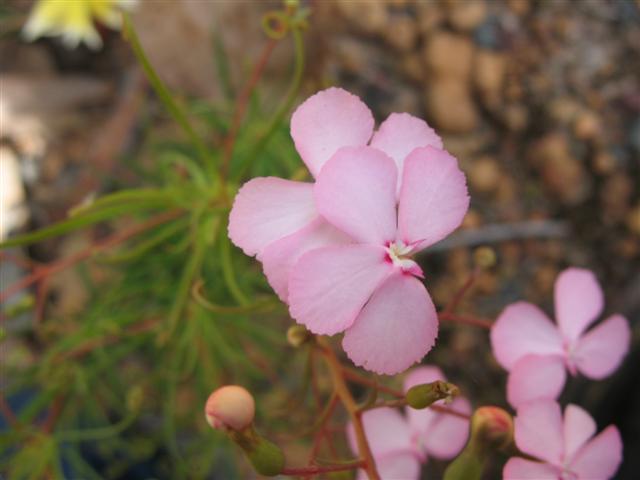
Stylidium scandens (the climbing triggerplant) is a dicotyledonous plant that belongs to the genus Stylidium (family Stylidiaceae). S. scandens is endemic to Australia and is found primarily in the southwestern region of Western Australia. This species, along with Stylidium nymphaeum,[1] has a unique characteristic among triggerplants in that its leaves, five centimetres (two inches) long, end in a recurved barb that can grab hold of other vegetation and scramble or climb up to 30–60 cm in height over other plants, which is how it obtained its common name. Its flowers are bright pink and about 15 mm wide.[2]
See also
[edit]References
[edit]- ^ Nuytsia 20:104-107, Figs 2e-g, 7 (2010) Stylidium miscellany 1: typifications and new taxa from south-west Western Australia
- ^ Darnowski, Douglas W. (2002). Triggerplants. Australia: Rosenberg Publishing.
 | This Western Australian plant article is a stub. You can help Wikipedia by expanding it. |
 | This Australian asterid article is a stub. You can help Wikipedia by expanding it. |
 | This Stylidiaceae article is a stub. You can help Wikipedia by expanding it. |