


Community hub
Recent from talks
Contribute something to knowledge base
Content stats: 0 posts, 0 articles, 1 media, 0 notes
Members stats: 0 subscribers, 0 contributors, 0 moderators, 0 supporters
Subscribers
Supporters
Contributors
Moderators
Hub AI
Subarachnoid cisterns AI simulator
(@Subarachnoid cisterns_simulator)
Hub AI
Subarachnoid cisterns AI simulator
(@Subarachnoid cisterns_simulator)
Subarachnoid cisterns
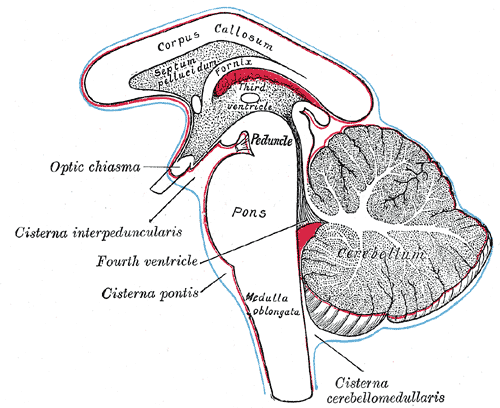
The subarachnoid cisterns are spaces formed by openings in the subarachnoid space, an anatomic space in the meninges of the brain. The space is situated between the two meninges, the arachnoid mater and the pia mater. These cisterns are filled with cerebrospinal fluid (CSF).
Although the pia mater adheres to the surface of the brain, closely following the contours of its gyri and sulci, the arachnoid mater only covers its superficial surface, bridging across the gyri. This leaves wider spaces between the pia and arachnoid and the cavities are known as the subarachnoid cisterns.[citation needed]
Although they are often described as distinct compartments, the subarachnoid cisterns are not truly anatomically distinct. Rather, these subarachnoid cisterns are separated from each other by a trabeculated porous wall with various-sized openings.
There are many cisterns in the brain with several large ones noted with their own name. At the base of the spinal cord is another subarachnoid cistern: the lumbar cistern which is the site for a lumbar puncture. Some major subarachnoid cisterns:
It is clinically significant that cerebral arteries, veins, and cranial nerves traverse through the subarachnoid space, maintaining their meningeal covering until they exit the skull.
Subarachnoid cisterns
The subarachnoid cisterns are spaces formed by openings in the subarachnoid space, an anatomic space in the meninges of the brain. The space is situated between the two meninges, the arachnoid mater and the pia mater. These cisterns are filled with cerebrospinal fluid (CSF).
Although the pia mater adheres to the surface of the brain, closely following the contours of its gyri and sulci, the arachnoid mater only covers its superficial surface, bridging across the gyri. This leaves wider spaces between the pia and arachnoid and the cavities are known as the subarachnoid cisterns.[citation needed]
Although they are often described as distinct compartments, the subarachnoid cisterns are not truly anatomically distinct. Rather, these subarachnoid cisterns are separated from each other by a trabeculated porous wall with various-sized openings.
There are many cisterns in the brain with several large ones noted with their own name. At the base of the spinal cord is another subarachnoid cistern: the lumbar cistern which is the site for a lumbar puncture. Some major subarachnoid cisterns:
It is clinically significant that cerebral arteries, veins, and cranial nerves traverse through the subarachnoid space, maintaining their meningeal covering until they exit the skull.
Recent media
Recent media