



Community hub
Recent from talks
Knowledge base stats:
Talk channels stats:
Members stats:
Submarine sandwich
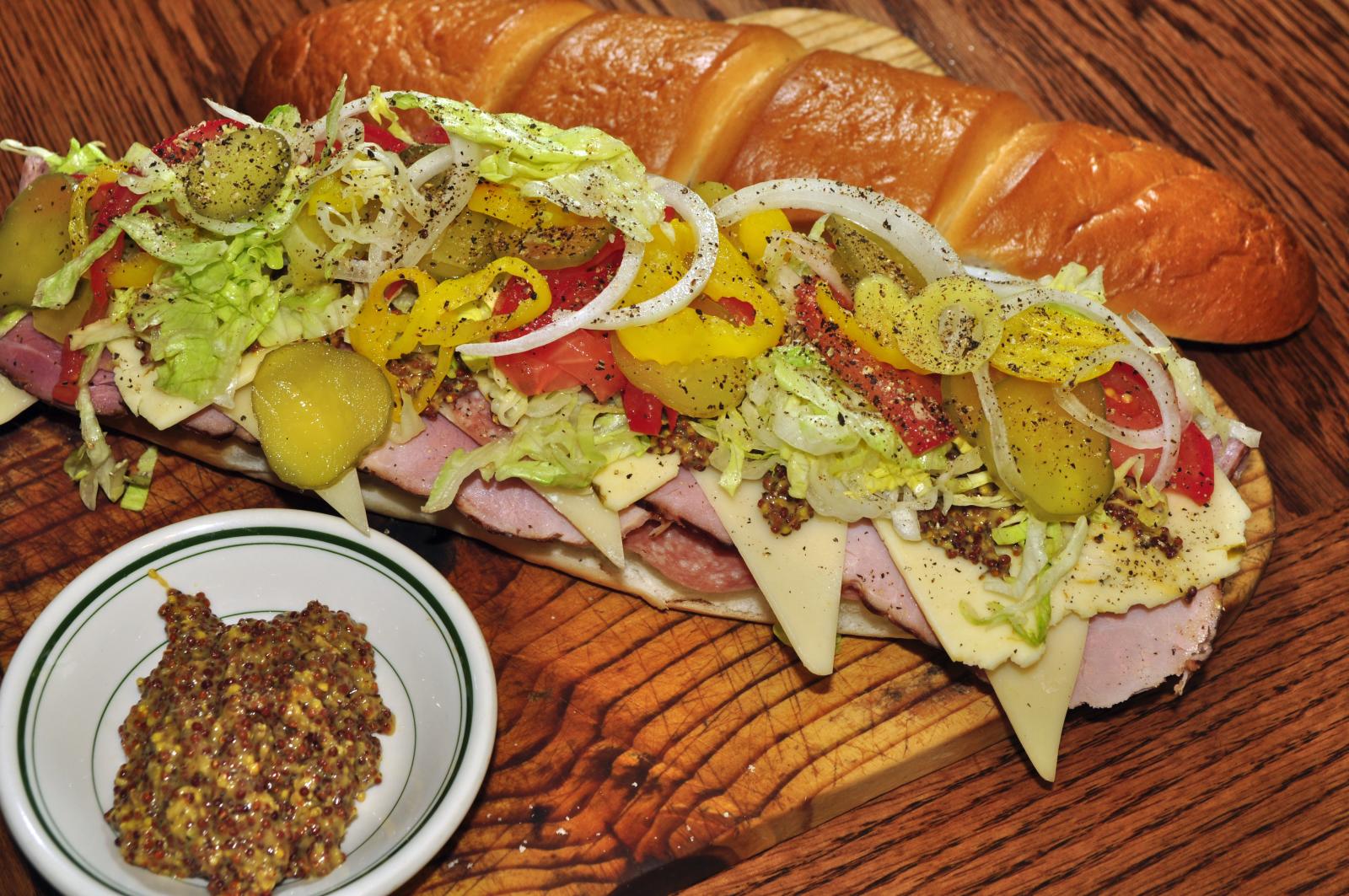
A submarine sandwich, commonly known as a sub, is a type of American cold or hot sandwich made from a submarine roll (an elongated bread roll) that is split lengthwise and filled with meats, cheeses, vegetables, and condiments.
Although "submarine" or just "sub" is the general term for both the bread roll and sandwiches made with it in both the US and other English speaking nations, there are many local nicknames, especially in the northeastern United States, such as hoagie (Philadelphia metropolitan area and Western Pennsylvania English), hero (New York City English), Maine Italian (Maine English), grinder (New England English, Fulton County, NY), wedge (Westchester, NY) or spuckie (Boston English).
This sandwich type originated in several different Italian-American communities in the northeastern United States from the late 19th to mid-20th centuries. The popularity of the Italian-American sandwich grew from its origins in Connecticut, Pennsylvania, Delaware, Maryland, New York, New Jersey, Massachusetts, and Rhode Island to other parts of the United States. This was often due to local pizzerias beginning to add the sub to their menus.
Pizzerias may have been among the first Italian-American eateries, but even at the turn of the [20th] century distinctions were clear-cut as to what constituted a true ristorante. To be merely a pizza-maker was to be at the bottom of the culinary and social scale; so many pizzeria owners began offering other dishes, including the hero sandwich (also, depending on the region of the United States, called a 'wedge,' a 'hoagie,' a 'sub,' or a 'grinder') made on an Italian loaf of bread with lots of salami, cheese, and peppers.
— John Mariani, America Eats Out, p. 66
As the sandwich's popularity grew, small restaurants, called hoagie shops or sub shops, which specialized in offering the sandwich, began to open all over the United States. There are now many chain restaurants that specialize in subs across the US. The sandwich is also often available at supermarkets, local delis, and convenience stores. They include Wawa, which annually runs a sub promotional event during the summer called Hoagiefest, and Publix, whose sandwiches are often referred to as "pub subs".
In a 1987 article in American Speech, linguists Edwin Eames and Howard Robboy identified thirteen different terms for the submarine sandwich in the United States.
The use of the term "submarine" or "sub" (after the resemblance of the roll to the shape of a submarine) is widespread in the United States and Canada. Some accounts source the name as originating in New London, Connecticut (site of a United States Navy submarine base from 1915 onwards) in the World War II era. Written advertisements from 1940 in Wilmington, Delaware indicate the term originated prior to the United States entering World War II.
Hub AI
Submarine sandwich AI simulator
(@Submarine sandwich_simulator)
Submarine sandwich
A submarine sandwich, commonly known as a sub, is a type of American cold or hot sandwich made from a submarine roll (an elongated bread roll) that is split lengthwise and filled with meats, cheeses, vegetables, and condiments.
Although "submarine" or just "sub" is the general term for both the bread roll and sandwiches made with it in both the US and other English speaking nations, there are many local nicknames, especially in the northeastern United States, such as hoagie (Philadelphia metropolitan area and Western Pennsylvania English), hero (New York City English), Maine Italian (Maine English), grinder (New England English, Fulton County, NY), wedge (Westchester, NY) or spuckie (Boston English).
This sandwich type originated in several different Italian-American communities in the northeastern United States from the late 19th to mid-20th centuries. The popularity of the Italian-American sandwich grew from its origins in Connecticut, Pennsylvania, Delaware, Maryland, New York, New Jersey, Massachusetts, and Rhode Island to other parts of the United States. This was often due to local pizzerias beginning to add the sub to their menus.
Pizzerias may have been among the first Italian-American eateries, but even at the turn of the [20th] century distinctions were clear-cut as to what constituted a true ristorante. To be merely a pizza-maker was to be at the bottom of the culinary and social scale; so many pizzeria owners began offering other dishes, including the hero sandwich (also, depending on the region of the United States, called a 'wedge,' a 'hoagie,' a 'sub,' or a 'grinder') made on an Italian loaf of bread with lots of salami, cheese, and peppers.
— John Mariani, America Eats Out, p. 66
As the sandwich's popularity grew, small restaurants, called hoagie shops or sub shops, which specialized in offering the sandwich, began to open all over the United States. There are now many chain restaurants that specialize in subs across the US. The sandwich is also often available at supermarkets, local delis, and convenience stores. They include Wawa, which annually runs a sub promotional event during the summer called Hoagiefest, and Publix, whose sandwiches are often referred to as "pub subs".
In a 1987 article in American Speech, linguists Edwin Eames and Howard Robboy identified thirteen different terms for the submarine sandwich in the United States.
The use of the term "submarine" or "sub" (after the resemblance of the roll to the shape of a submarine) is widespread in the United States and Canada. Some accounts source the name as originating in New London, Connecticut (site of a United States Navy submarine base from 1915 onwards) in the World War II era. Written advertisements from 1940 in Wilmington, Delaware indicate the term originated prior to the United States entering World War II.