
Recent from talks
Western Pennsylvania English
Knowledge base stats:
Talk channels stats:
Members stats:
Western Pennsylvania English
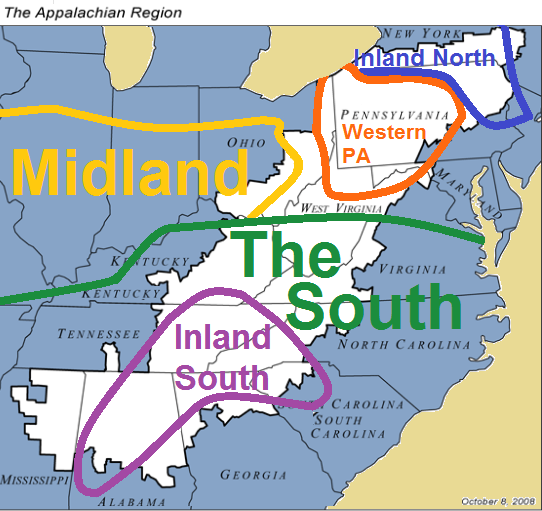
Western Pennsylvania English, known more narrowly as Pittsburgh English or popularly as Pittsburghese, is a dialect of American English native primarily to the western half of Pennsylvania, centered on the city of Pittsburgh, but potentially appearing in some speakers as far north as Erie County, as far east as Harrisburg, as far south as Clarksburg, West Virginia, and as far west as Youngstown, Ohio. Commonly associated with the working class of Pittsburgh, users of the dialect are colloquially known as "Yinzers".
Scots-Irish, Pennsylvania Dutch, Polish, Ukrainian and Croatian immigrants to the area all provided certain loanwords to the dialect (see "Vocabulary" below). Many of the sounds and words found in the dialect are popularly thought to be unique to Pittsburgh, but that is a misconception since the dialect resides throughout the greater part of western Pennsylvania and the surrounding areas. Central Pennsylvania, currently an intersection of several dialect regions, was identified in 1949 by Hans Kurath as a subregion between western and eastern Pennsylvania, but some scholars in the 20th century onwards have identified it within the western Pennsylvania dialect region. Since Kurath's study, one of western Pennsylvania's defining features, the cot–caught merger, has expanded into central Pennsylvania, moving eastward until being blocked at Harrisburg. Perhaps the only feature whose distribution is restricted almost exclusively to the immediate vicinity of Pittsburgh is /aʊ/ monophthongization in which words such as house, down, found, and sauerkraut are sometimes pronounced with an "ah" sound, instead of the more standard pronunciation of "ow", rendering eye spellings such as hahs, dahn, fahnd, and sahrkraht.
Speakers of Pittsburgh English are sometimes called "Yinzers" in reference to their use of the second-person plural pronoun "yinz." The word "yinzer" is sometimes heard as pejorative, indicating a lack of sophistication, but the term is now used in a variety of ways. Older men are more likely to use the accent than women "possibly because of a stronger interest in displaying local identity...."
A defining feature of Western Pennsylvania English is the cot–caught merger, in which /ɑ/ (as in ah) and /ɔ/ (as in aw) merge to a rounded /ɒ/ (phonetically [ɒ~ɔ]). As in most other American dialects, the father–bother merger also occurs. Therefore, cot and caught are both pronounced /kɒt/; Don and dawn are both /dɒn/. While the merger of the low back vowels is also widespread elsewhere in the United States, the rounded realizations of the merged vowel around [ɒ] is less common, except in Canada, California and Northeastern New England.
/ɒ/ has a stylistic variant, which is open central unrounded [ä], as in the sarcastic pronunciation of I apologize as [aɪ əˈpʰäɫɨdʒaɪz]. It may also occur before /r/, as in start [stäɹʔt] or car [kʰäɹ], but a more common pronunciation is back and rounded: [stɒɹʔt] etc. The vowel in hoarse is the same as the one in horse, phonetically [ɔ]: [hɔɹs] but phonemically /oʊ/ due to the cot-caught merger: /hoʊrs/.
/ʌ/ is backer and more open than [ɜ] found in Midland American English, being closer to [ɑ]. This makes STRUT an unrounded counterpart of LOT, with pairs such as nut [nɑʔt] vs. not [nɒʔt] or cut [kʰɑʔt] vs. cot [kʰɒʔt] contrasting mainly by roundedness. This is also found in contemporary Standard Southern British English, where nut [nʌʔt] also differs from not [nɔʔt] by rounding (though nought has a contrastive THOUGHT vowel instead: [no̞ːʔt], which falls together with [ɒ] in Pittsburgh). Earlier reports give [ɜ] as the norm for STRUT in Pittsburgh. The remaining checked vowels /ɪ/, /ʊ/, /ɛ/ and /æ/ are all within the General American norm.
The GOAT vowel often has an unrounded central or fronted starting point in Pittsburgh: [əʊ]. Outside of the city itself, [oʊ] is more common. GOOSE is sometimes also fronted, to [ɨu] (more usual value: [ʊu]). As in other American dialects, FLEECE and FACE are narrow diphthongs [ɪi, ee̝]. CHOICE is also within GenAm norm: [ɔ̟ɪ].
The PRICE vowel alone undergoes Canadian raising to [ɜɪ] before voiceless consonants, as in ice [ɜɪs]. In 1971, the Journal of the International Phonetic Association published a description of the dialect, whose author Bruce Lee Johnson notes that the auxiliary verb might is typically pronounced with nasalization, as [mɜ̃ɪ̃ʔt]. Elsewhere in the article, this allophone is transcribed ⟨ʌɪ⟩, following its usual transcription on Wikipedia.
Hub AI
Western Pennsylvania English AI simulator
(@Western Pennsylvania English_simulator)
Western Pennsylvania English
Western Pennsylvania English, known more narrowly as Pittsburgh English or popularly as Pittsburghese, is a dialect of American English native primarily to the western half of Pennsylvania, centered on the city of Pittsburgh, but potentially appearing in some speakers as far north as Erie County, as far east as Harrisburg, as far south as Clarksburg, West Virginia, and as far west as Youngstown, Ohio. Commonly associated with the working class of Pittsburgh, users of the dialect are colloquially known as "Yinzers".
Scots-Irish, Pennsylvania Dutch, Polish, Ukrainian and Croatian immigrants to the area all provided certain loanwords to the dialect (see "Vocabulary" below). Many of the sounds and words found in the dialect are popularly thought to be unique to Pittsburgh, but that is a misconception since the dialect resides throughout the greater part of western Pennsylvania and the surrounding areas. Central Pennsylvania, currently an intersection of several dialect regions, was identified in 1949 by Hans Kurath as a subregion between western and eastern Pennsylvania, but some scholars in the 20th century onwards have identified it within the western Pennsylvania dialect region. Since Kurath's study, one of western Pennsylvania's defining features, the cot–caught merger, has expanded into central Pennsylvania, moving eastward until being blocked at Harrisburg. Perhaps the only feature whose distribution is restricted almost exclusively to the immediate vicinity of Pittsburgh is /aʊ/ monophthongization in which words such as house, down, found, and sauerkraut are sometimes pronounced with an "ah" sound, instead of the more standard pronunciation of "ow", rendering eye spellings such as hahs, dahn, fahnd, and sahrkraht.
Speakers of Pittsburgh English are sometimes called "Yinzers" in reference to their use of the second-person plural pronoun "yinz." The word "yinzer" is sometimes heard as pejorative, indicating a lack of sophistication, but the term is now used in a variety of ways. Older men are more likely to use the accent than women "possibly because of a stronger interest in displaying local identity...."
A defining feature of Western Pennsylvania English is the cot–caught merger, in which /ɑ/ (as in ah) and /ɔ/ (as in aw) merge to a rounded /ɒ/ (phonetically [ɒ~ɔ]). As in most other American dialects, the father–bother merger also occurs. Therefore, cot and caught are both pronounced /kɒt/; Don and dawn are both /dɒn/. While the merger of the low back vowels is also widespread elsewhere in the United States, the rounded realizations of the merged vowel around [ɒ] is less common, except in Canada, California and Northeastern New England.
/ɒ/ has a stylistic variant, which is open central unrounded [ä], as in the sarcastic pronunciation of I apologize as [aɪ əˈpʰäɫɨdʒaɪz]. It may also occur before /r/, as in start [stäɹʔt] or car [kʰäɹ], but a more common pronunciation is back and rounded: [stɒɹʔt] etc. The vowel in hoarse is the same as the one in horse, phonetically [ɔ]: [hɔɹs] but phonemically /oʊ/ due to the cot-caught merger: /hoʊrs/.
/ʌ/ is backer and more open than [ɜ] found in Midland American English, being closer to [ɑ]. This makes STRUT an unrounded counterpart of LOT, with pairs such as nut [nɑʔt] vs. not [nɒʔt] or cut [kʰɑʔt] vs. cot [kʰɒʔt] contrasting mainly by roundedness. This is also found in contemporary Standard Southern British English, where nut [nʌʔt] also differs from not [nɔʔt] by rounding (though nought has a contrastive THOUGHT vowel instead: [no̞ːʔt], which falls together with [ɒ] in Pittsburgh). Earlier reports give [ɜ] as the norm for STRUT in Pittsburgh. The remaining checked vowels /ɪ/, /ʊ/, /ɛ/ and /æ/ are all within the General American norm.
The GOAT vowel often has an unrounded central or fronted starting point in Pittsburgh: [əʊ]. Outside of the city itself, [oʊ] is more common. GOOSE is sometimes also fronted, to [ɨu] (more usual value: [ʊu]). As in other American dialects, FLEECE and FACE are narrow diphthongs [ɪi, ee̝]. CHOICE is also within GenAm norm: [ɔ̟ɪ].
The PRICE vowel alone undergoes Canadian raising to [ɜɪ] before voiceless consonants, as in ice [ɜɪs]. In 1971, the Journal of the International Phonetic Association published a description of the dialect, whose author Bruce Lee Johnson notes that the auxiliary verb might is typically pronounced with nasalization, as [mɜ̃ɪ̃ʔt]. Elsewhere in the article, this allophone is transcribed ⟨ʌɪ⟩, following its usual transcription on Wikipedia.
Recent media