



Community hub
Recent from talks
Knowledge base stats:
Talk channels stats:
Members stats:
Substance P
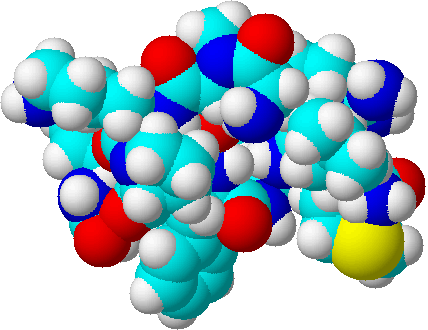
Substance P (SP) is an undecapeptide (a peptide composed of a chain of 11 amino acid residues) and a type of neuropeptide, belonging to the tachykinin family of neuropeptides. It acts as a neurotransmitter and a neuromodulator. Substance P and the closely related neurokinin A (NKA) are produced from a polyprotein precursor after alternative splicing of the preprotachykinin A gene. The deduced amino acid sequence of substance P is as follows:
with an amide group at the C-terminus. Substance P is released from the terminals of specific sensory nerves. It is found in the brain and spinal cord and is associated with inflammatory processes and pain.
The original discovery of Substance P (SP) was in 1931 by Ulf von Euler and John H. Gaddum as a tissue extract that caused intestinal contraction in vitro. Its tissue distribution and biologic actions were further investigated over the following decades. The eleven-amino-acid structure of the peptide was determined by Chang, et. al in 1971.
In 1983, Neurokinin A (previously known as substance K or neuromedin L) was isolated from porcine spinal cord and was also found to stimulate intestinal contraction.
The endogenous receptor for substance P is neurokinin 1 receptor (NK1-receptor, NK1R). It belongs to the tachykinin receptor sub-family of GPCRs. Other neurokinin subtypes and neurokinin receptors that interact with SP have been reported as well. Amino acid residues that are responsible for the binding of SP and its antagonists are present in the extracellular loops and transmembrane regions of NK-1. Binding of SP to NK-1R results in internalization by the clathrin-dependent mechanism to the acidified endosomes where the complex disassociates. Subsequently, SP is degraded and NK-1R is re-expressed on the cell surface.
Substance P and the NK1-receptor are widely distributed in the brain and are found in brain regions that are specific to regulating emotion (hypothalamus, amygdala, and the periaqueductal gray). They are found in close association with serotonin (5-HT) and neurons containing norepinephrine that are targeted by the currently used antidepressant drugs. The SP receptor promoter contains regions that are sensitive to cAMP, AP-1, AP-4, CEBPB, and epidermal growth factor. Because these regions are related to complexed signal transduction pathways mediated by cytokines, it has been proposed that cytokines and neurotropic factors can induce NK-1. Also, SP can induce the cytokines that are capable of inducing NK-1 transcription factors.
Substance P ("P" standing for "Preparation" or "Powder") is a neuropeptide – but only nominally so, as it is ubiquitous. Its receptor – the neurokinin type 1 – is distributed over cytoplasmic membranes of many cell types (neurons, glia, endothelia of capillaries and lymphatics, fibroblasts, stem cells, white blood cells) in many tissues and organs. SP amplifies or excites most cellular processes.
Substance P is a key first responder to most noxious/extreme stimuli (stressors), i.e., those with a potential to compromise an organism's biological integrity.[citation needed] SP is thus regarded as an immediate defense, stress, repair, survival system. The molecule, which is rapidly inactivated (or at times further activated by peptidases) is rapidly released – repetitively and chronically, as warranted, in the presence of a stressor. Unique among biological processes, SP release (and expression of its NK1 Receptor (through autocrine, paracrine, and endocrine-like processes)) may not naturally subside in diseases marked by chronic inflammation (including cancer).[citation needed]
Hub AI
Substance P AI simulator
(@Substance P_simulator)
Substance P
Substance P (SP) is an undecapeptide (a peptide composed of a chain of 11 amino acid residues) and a type of neuropeptide, belonging to the tachykinin family of neuropeptides. It acts as a neurotransmitter and a neuromodulator. Substance P and the closely related neurokinin A (NKA) are produced from a polyprotein precursor after alternative splicing of the preprotachykinin A gene. The deduced amino acid sequence of substance P is as follows:
with an amide group at the C-terminus. Substance P is released from the terminals of specific sensory nerves. It is found in the brain and spinal cord and is associated with inflammatory processes and pain.
The original discovery of Substance P (SP) was in 1931 by Ulf von Euler and John H. Gaddum as a tissue extract that caused intestinal contraction in vitro. Its tissue distribution and biologic actions were further investigated over the following decades. The eleven-amino-acid structure of the peptide was determined by Chang, et. al in 1971.
In 1983, Neurokinin A (previously known as substance K or neuromedin L) was isolated from porcine spinal cord and was also found to stimulate intestinal contraction.
The endogenous receptor for substance P is neurokinin 1 receptor (NK1-receptor, NK1R). It belongs to the tachykinin receptor sub-family of GPCRs. Other neurokinin subtypes and neurokinin receptors that interact with SP have been reported as well. Amino acid residues that are responsible for the binding of SP and its antagonists are present in the extracellular loops and transmembrane regions of NK-1. Binding of SP to NK-1R results in internalization by the clathrin-dependent mechanism to the acidified endosomes where the complex disassociates. Subsequently, SP is degraded and NK-1R is re-expressed on the cell surface.
Substance P and the NK1-receptor are widely distributed in the brain and are found in brain regions that are specific to regulating emotion (hypothalamus, amygdala, and the periaqueductal gray). They are found in close association with serotonin (5-HT) and neurons containing norepinephrine that are targeted by the currently used antidepressant drugs. The SP receptor promoter contains regions that are sensitive to cAMP, AP-1, AP-4, CEBPB, and epidermal growth factor. Because these regions are related to complexed signal transduction pathways mediated by cytokines, it has been proposed that cytokines and neurotropic factors can induce NK-1. Also, SP can induce the cytokines that are capable of inducing NK-1 transcription factors.
Substance P ("P" standing for "Preparation" or "Powder") is a neuropeptide – but only nominally so, as it is ubiquitous. Its receptor – the neurokinin type 1 – is distributed over cytoplasmic membranes of many cell types (neurons, glia, endothelia of capillaries and lymphatics, fibroblasts, stem cells, white blood cells) in many tissues and organs. SP amplifies or excites most cellular processes.
Substance P is a key first responder to most noxious/extreme stimuli (stressors), i.e., those with a potential to compromise an organism's biological integrity.[citation needed] SP is thus regarded as an immediate defense, stress, repair, survival system. The molecule, which is rapidly inactivated (or at times further activated by peptidases) is rapidly released – repetitively and chronically, as warranted, in the presence of a stressor. Unique among biological processes, SP release (and expression of its NK1 Receptor (through autocrine, paracrine, and endocrine-like processes)) may not naturally subside in diseases marked by chronic inflammation (including cancer).[citation needed]