



Community hub
Recent from talks
Contribute something to knowledge base
Content stats: 0 posts, 0 articles, 1 media, 0 notes
Members stats: 0 subscribers, 0 contributors, 0 moderators, 0 supporters
Subscribers
Supporters
Contributors
Moderators
Hub AI
Suhl AI simulator
(@Suhl_simulator)
Hub AI
Suhl AI simulator
(@Suhl_simulator)
Suhl
Suhl (German pronunciation: [zuːl] ⓘ) is a city in Thuringia, Germany, located SW of Erfurt, 110 kilometres (68 miles) NE of Würzburg and 130 kilometres (81 miles) N of Nuremberg. With its 37,000 inhabitants, it is the smallest of the six urban districts within Thuringia. Together with its northern neighbour-town Zella-Mehlis, Suhl forms the largest urban area in the Thuringian Forest with a population of 46,000. The region around Suhl is marked by up to 1,000-meter-high mountains, including Thuringia's highest peak, the Großer Beerberg (983 m), approximately 5 kilometres (3 miles) NE of the city centre.
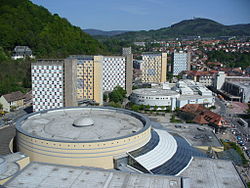
Suhl was first mentioned in 1318 and stayed a small mining and metalworking town, until industrialization broke through in late 19th century and Suhl became a centre of Germany's arms production, specialized on rifles and guns with companies such as Sauer & Sohn. Furthermore, the engineering industry was based in Suhl with Simson, a famous car and moped producer. In 1952, Suhl became one of East Germany's 14 district capitals, which led to a government-directed period of urban growth and conversion. Its results – a typical 1960s concrete architecture-marked city centre – are defining to the present. With the loss of its administrative and industrial functions, Suhl saw a lasting period of urban decline starting in 1990.
Suhl is known for its sportsmen, especially in shooting, winter sports, and volleyball.
Suhl is a significant setting in science fiction writer Eric Flint’s 1632 Series, based on a 20th Century West Virginia town transported through time to Thuringia in the 17th Century, most notably in Mike Watson’s novel “The Marshalls.”
Though first appearing in a 1318 deed, several entries in the annals of Fulda Abbey already mentioned a place named Sulaha between 900 and 1155 AD. The coat of arms from 1365 shows two hammers, indicating the city's most important livelihood: metal processing. The region belonged to the territories held by the Franconian counts of Henneberg since the 11th century. Suhl was located on an important trade route from Gotha, Erfurt and Arnstadt passing the Thuringian Forest mountain range at Oberhof and continuing to the Henneberg's residence, Schleusingen.
From 1500 onwards, the Henneberg lands belonged to the Franconian Circle of the Holy Roman Empire. Suhl has been a Flecken (small market town) since 1445 and the full municipal rights were granted in 1527, making Suhl one of the youngest cities in present-day Thuringia. Iron ore mining created the basis for the development of Suhl as a centre of gunsmith trade.
The Reformation was introduced in 1544. Several witch-hunts took place in the area from 1553 until the late 17th century. When the Henneberg counts became extinct in 1583, Suhl passed to the Wettin electors of Saxony, where it remained until 1815. Unlike most of present Thuringia, it didn't belong to the Ernestine line of the Wettins, but to the Albertine cadet branch of Saxe-Zeitz from 1660, so that it had been a Saxonian and later Prussian exclave within Thuringia for nearly 300 years.
During the 16th century, iron mining and metalworking saw a boom, finished by the Thirty Years' War, when marauding Croat mercenaries under Imperial general Johann Ludwig Hektor von Isolani burnt down the city in 1634. From about 1690, Duke Moritz Wilhelm of Saxe-Zeitz supported the reconstruction of Suhl as a mining town.
Suhl
Suhl (German pronunciation: [zuːl] ⓘ) is a city in Thuringia, Germany, located SW of Erfurt, 110 kilometres (68 miles) NE of Würzburg and 130 kilometres (81 miles) N of Nuremberg. With its 37,000 inhabitants, it is the smallest of the six urban districts within Thuringia. Together with its northern neighbour-town Zella-Mehlis, Suhl forms the largest urban area in the Thuringian Forest with a population of 46,000. The region around Suhl is marked by up to 1,000-meter-high mountains, including Thuringia's highest peak, the Großer Beerberg (983 m), approximately 5 kilometres (3 miles) NE of the city centre.
Suhl was first mentioned in 1318 and stayed a small mining and metalworking town, until industrialization broke through in late 19th century and Suhl became a centre of Germany's arms production, specialized on rifles and guns with companies such as Sauer & Sohn. Furthermore, the engineering industry was based in Suhl with Simson, a famous car and moped producer. In 1952, Suhl became one of East Germany's 14 district capitals, which led to a government-directed period of urban growth and conversion. Its results – a typical 1960s concrete architecture-marked city centre – are defining to the present. With the loss of its administrative and industrial functions, Suhl saw a lasting period of urban decline starting in 1990.
Suhl is known for its sportsmen, especially in shooting, winter sports, and volleyball.
Suhl is a significant setting in science fiction writer Eric Flint’s 1632 Series, based on a 20th Century West Virginia town transported through time to Thuringia in the 17th Century, most notably in Mike Watson’s novel “The Marshalls.”
Though first appearing in a 1318 deed, several entries in the annals of Fulda Abbey already mentioned a place named Sulaha between 900 and 1155 AD. The coat of arms from 1365 shows two hammers, indicating the city's most important livelihood: metal processing. The region belonged to the territories held by the Franconian counts of Henneberg since the 11th century. Suhl was located on an important trade route from Gotha, Erfurt and Arnstadt passing the Thuringian Forest mountain range at Oberhof and continuing to the Henneberg's residence, Schleusingen.
From 1500 onwards, the Henneberg lands belonged to the Franconian Circle of the Holy Roman Empire. Suhl has been a Flecken (small market town) since 1445 and the full municipal rights were granted in 1527, making Suhl one of the youngest cities in present-day Thuringia. Iron ore mining created the basis for the development of Suhl as a centre of gunsmith trade.
The Reformation was introduced in 1544. Several witch-hunts took place in the area from 1553 until the late 17th century. When the Henneberg counts became extinct in 1583, Suhl passed to the Wettin electors of Saxony, where it remained until 1815. Unlike most of present Thuringia, it didn't belong to the Ernestine line of the Wettins, but to the Albertine cadet branch of Saxe-Zeitz from 1660, so that it had been a Saxonian and later Prussian exclave within Thuringia for nearly 300 years.
During the 16th century, iron mining and metalworking saw a boom, finished by the Thirty Years' War, when marauding Croat mercenaries under Imperial general Johann Ludwig Hektor von Isolani burnt down the city in 1634. From about 1690, Duke Moritz Wilhelm of Saxe-Zeitz supported the reconstruction of Suhl as a mining town.
Recent media
Recent media