



Community hub
Recent from talks
Contribute something to knowledge base
Content stats: 0 posts, 0 articles, 1 media, 0 notes
Members stats: 0 subscribers, 0 contributors, 0 moderators, 0 supporters
Subscribers
Supporters
Contributors
Moderators
Hub AI
Sultanate of Darfur AI simulator
(@Sultanate of Darfur_simulator)
Hub AI
Sultanate of Darfur AI simulator
(@Sultanate of Darfur_simulator)
Sultanate of Darfur
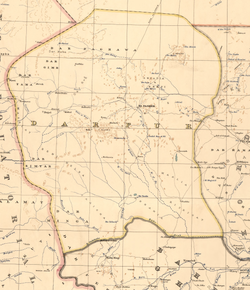
The Sultanate of Darfur (Arabic: سلطنة دارفور, romanized: Salṭanat Dārfūr) was a pre-colonial state in present-day Sudan. It existed from the 17th century to 24 October 1874, when it fell to the Sudanese warlord Al-Zubayr Rahma Mansur, and was reestablished again from 1898 to 1916, until it was conquered by the British. At its peak in the late 18th and early 19th century it stretched all the way from Darfur in the west to Kordofan and the western banks of the White Nile in the east, giving it the size of present-day Nigeria.
Darfur is composed mostly of semi-arid plains and small seasonal rivers that cannot support a dense population. The one exception is the area in and around the Marrah Mountains. It was from bases in these mountains that a series of groups expanded to control the region. According to written records the Daju and the 14th century migrants the Tunjur were the earliest powers in Darfur. The transition of power from the Daju to the Tunjur was facilitated through marriage.[citation needed] The Fur people had long interacted with the Fazara nomads and the Toubou.
Eventually the Tunjur began marrying amongst the Fur people producing Sultan Dali, a celebrated figure in traditional Darfur histories, said to be a Fur on his mother's side, and thus brought the dynasty closer to the people it ruled. Accordingly Dali divided the country into provinces and established a penal code which, under the title of Kitab Dali or "Dali's Book", is still preserved, and differs in some respects from Sharia law.[citation needed]
Suleiman, traditionally Dali's grandson (possibly an Arab immigrant from the east who married into the Fur royal family, owing to the application of the Fur epithet "Solon" meaning "the Arab/red"), reigned during the mid-17th century, and was a great warrior and a devoted Muslim. Suleiman Solon is considered the founder of the Keira dynasty and the Sultanate of Darfur. During the 17th century, the Keira sultans introduced the feudal hakura system into Darfur.
It was common for the Keira dynasty to intermarry with other ethnic groups as the region was very ethnically diverse, and the royal family was open to integrating strangers into the elite. Over the course of its existence, the expansion of the state was often done via integration and assimilation rather than by war.
While the Keira dynasty claimed an Arab lineage (in the Sudan the concept of "Arabism" was more fluid and could be applied to any who were culturally Arabised and spoke Arabic regardless of skin colour), it was likely intermarriages with Arabs from the Nile Valley and interactions with their holy men and merchants from the east and north which brought about the conversion of the royal court to Islam. Muslims making the hajj (pilgrimage to Mecca) often passed through Darfur, and settlement by West Africans could have also played a role. Soleiman's grandson, Ahmed Bukr (c.1682 – c.1722), made Islam the religion of the state, and increased the prosperity of the country by encouraging immigration from Bornu and Bagirmi.[citation needed] The sultanate benefited from incorporating outsiders who were literate and educated in Islamic law. Most Fur commoners continued to follow their traditional religion.
From the 17th century, the trans-Saharan trade route Darb El Arba'īn ("Forty Days Road") became busier, linking Kobbei to Asyut. The prosperity the sultanate enjoyed was largely down to the extensive trading relations and contacts they cultivated over the centuries. The sultan himself commissioned slave raids due to only the national army being strong enough, particularly into the land of the Baggara Arabs to the south, and profited greatly. While the state expanded north beyond the Jebal Marra mountains, they struggled to conquer the Baggara Arabs, and instead forged socio-economic relations with them. Wadai was a tributary of Darfur throughout the 17th century, however towards the end of the century they ceased paying tribute.
Succession struggles were common in the Keira dynasty. The death of Bukr initiated a long-running conflict over the succession. On his deathbed, Bukr stated that each of his many sons should rule in turn. Once on the throne, each of his sons instead hoped to make their own son heir, leading to an intermittent civil war that lasted until 1785/1786 (AH 1200).[citation needed] The sultans launched various campaigns against Wadai to their west in an attempt to reduce them to a tributary again, however were unsuccessful. The enlistment of slave soldiers from the south as an imperial guard proved unpopular. In the mid 18th century, the Musabb’at, an exiled faction from the royal family, lost control of the gold-producing region of Kordofan to the Funj Sultanate. By the 18th century, Islam became more influential in state and society, owing to the Sultanate recruiting holy men by granting them privileges and status. Holy men were also given land inhabited by the Fur from which they could receive income, furthering the economic, legal, and political complexity of the state. Also in the 18th century, trade with Egypt dramatically increased, as the sultanate began to pivot away from the west and towards the east.
Sultanate of Darfur
The Sultanate of Darfur (Arabic: سلطنة دارفور, romanized: Salṭanat Dārfūr) was a pre-colonial state in present-day Sudan. It existed from the 17th century to 24 October 1874, when it fell to the Sudanese warlord Al-Zubayr Rahma Mansur, and was reestablished again from 1898 to 1916, until it was conquered by the British. At its peak in the late 18th and early 19th century it stretched all the way from Darfur in the west to Kordofan and the western banks of the White Nile in the east, giving it the size of present-day Nigeria.
Darfur is composed mostly of semi-arid plains and small seasonal rivers that cannot support a dense population. The one exception is the area in and around the Marrah Mountains. It was from bases in these mountains that a series of groups expanded to control the region. According to written records the Daju and the 14th century migrants the Tunjur were the earliest powers in Darfur. The transition of power from the Daju to the Tunjur was facilitated through marriage.[citation needed] The Fur people had long interacted with the Fazara nomads and the Toubou.
Eventually the Tunjur began marrying amongst the Fur people producing Sultan Dali, a celebrated figure in traditional Darfur histories, said to be a Fur on his mother's side, and thus brought the dynasty closer to the people it ruled. Accordingly Dali divided the country into provinces and established a penal code which, under the title of Kitab Dali or "Dali's Book", is still preserved, and differs in some respects from Sharia law.[citation needed]
Suleiman, traditionally Dali's grandson (possibly an Arab immigrant from the east who married into the Fur royal family, owing to the application of the Fur epithet "Solon" meaning "the Arab/red"), reigned during the mid-17th century, and was a great warrior and a devoted Muslim. Suleiman Solon is considered the founder of the Keira dynasty and the Sultanate of Darfur. During the 17th century, the Keira sultans introduced the feudal hakura system into Darfur.
It was common for the Keira dynasty to intermarry with other ethnic groups as the region was very ethnically diverse, and the royal family was open to integrating strangers into the elite. Over the course of its existence, the expansion of the state was often done via integration and assimilation rather than by war.
While the Keira dynasty claimed an Arab lineage (in the Sudan the concept of "Arabism" was more fluid and could be applied to any who were culturally Arabised and spoke Arabic regardless of skin colour), it was likely intermarriages with Arabs from the Nile Valley and interactions with their holy men and merchants from the east and north which brought about the conversion of the royal court to Islam. Muslims making the hajj (pilgrimage to Mecca) often passed through Darfur, and settlement by West Africans could have also played a role. Soleiman's grandson, Ahmed Bukr (c.1682 – c.1722), made Islam the religion of the state, and increased the prosperity of the country by encouraging immigration from Bornu and Bagirmi.[citation needed] The sultanate benefited from incorporating outsiders who were literate and educated in Islamic law. Most Fur commoners continued to follow their traditional religion.
From the 17th century, the trans-Saharan trade route Darb El Arba'īn ("Forty Days Road") became busier, linking Kobbei to Asyut. The prosperity the sultanate enjoyed was largely down to the extensive trading relations and contacts they cultivated over the centuries. The sultan himself commissioned slave raids due to only the national army being strong enough, particularly into the land of the Baggara Arabs to the south, and profited greatly. While the state expanded north beyond the Jebal Marra mountains, they struggled to conquer the Baggara Arabs, and instead forged socio-economic relations with them. Wadai was a tributary of Darfur throughout the 17th century, however towards the end of the century they ceased paying tribute.
Succession struggles were common in the Keira dynasty. The death of Bukr initiated a long-running conflict over the succession. On his deathbed, Bukr stated that each of his many sons should rule in turn. Once on the throne, each of his sons instead hoped to make their own son heir, leading to an intermittent civil war that lasted until 1785/1786 (AH 1200).[citation needed] The sultans launched various campaigns against Wadai to their west in an attempt to reduce them to a tributary again, however were unsuccessful. The enlistment of slave soldiers from the south as an imperial guard proved unpopular. In the mid 18th century, the Musabb’at, an exiled faction from the royal family, lost control of the gold-producing region of Kordofan to the Funj Sultanate. By the 18th century, Islam became more influential in state and society, owing to the Sultanate recruiting holy men by granting them privileges and status. Holy men were also given land inhabited by the Fur from which they could receive income, furthering the economic, legal, and political complexity of the state. Also in the 18th century, trade with Egypt dramatically increased, as the sultanate began to pivot away from the west and towards the east.
Recent media
Recent media