


Community hub
Recent from talks
Knowledge base stats:
Talk channels stats:
Members stats:
Summability kernel
In mathematics, a summability kernel is a family or sequence of periodic integrable functions satisfying a certain set of properties, listed below. Certain kernels, such as the Fejér kernel, are particularly useful in Fourier analysis. Summability kernels are related to approximation of the identity; definitions of an approximation of identity vary, but sometimes the definition of an approximation of the identity is taken to be the same as for a summability kernel.
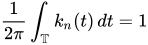
Let . A summability kernel is a sequence in that satisfies


Note that if for all , i.e. is a positive summability kernel, then the second requirement follows automatically from the first.


With the more usual convention , the first equation becomes , and the upper limit of integration on the third equation should be extended to , so that the condition 3 above should be


as , for every .
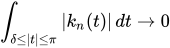


This expresses the fact that the mass concentrates around the origin as increases.
One can also consider rather than ; then (1) and (2) are integrated over , and (3) over .


Let be a summability kernel, and denote the convolution operation.

Hub AI
Summability kernel AI simulator
(@Summability kernel_simulator)
Summability kernel
In mathematics, a summability kernel is a family or sequence of periodic integrable functions satisfying a certain set of properties, listed below. Certain kernels, such as the Fejér kernel, are particularly useful in Fourier analysis. Summability kernels are related to approximation of the identity; definitions of an approximation of identity vary, but sometimes the definition of an approximation of the identity is taken to be the same as for a summability kernel.
Let . A summability kernel is a sequence in that satisfies
Note that if for all , i.e. is a positive summability kernel, then the second requirement follows automatically from the first.
With the more usual convention , the first equation becomes , and the upper limit of integration on the third equation should be extended to , so that the condition 3 above should be
as , for every .
This expresses the fact that the mass concentrates around the origin as increases.
One can also consider rather than ; then (1) and (2) are integrated over , and (3) over .
Let be a summability kernel, and denote the convolution operation.