



Community hub
Recent from talks
Knowledge base stats:
Talk channels stats:
Members stats:
Sunda slow loris
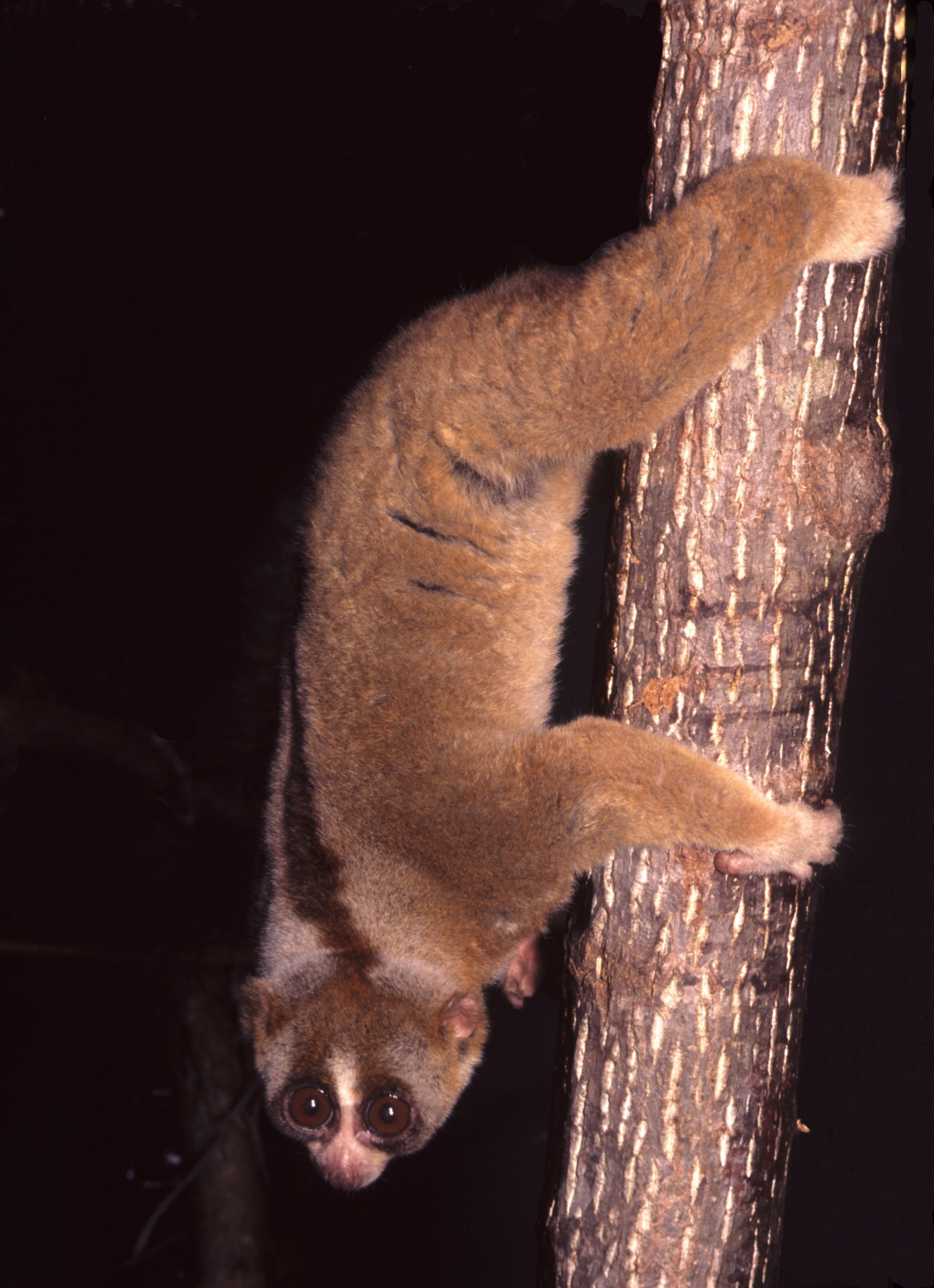
The Sunda slow loris (Nycticebus coucang), or greater slow loris, is a strepsirrhine primate and a species of slow loris native to Indonesia, West Malaysia, southern Thailand and Singapore. It measures 27 to 38 cm (11 to 15 in) from head to tail and weighs between 599 and 685 g (21.1 and 24.2 oz). Like other slow lorises, it has a wet nose (rhinarium), a round head, small ears hidden in thick fur, a flat face, large eyes and a vestigial tail.
The Sunda slow loris is nocturnal and arboreal, typically occurring in evergreen forests. It prefers rainforests with continuous dense canopies and has an extremely low metabolic rate compared to other mammals of its size. Its diet consists of sap, floral nectar, fruit and arthropods, and will feed on exudates such as gum and sap by licking wounds in trees. Individuals are generally solitary, with one study showing only 8% of its active time was spent near other individuals. It has a monogamous mating system with the offspring living with the parents. It sleeps during the day, rolled up in a ball in hidden parts of trees above the ground, often on branches, twigs, palm fronds, or lianas. The species is polyoestrous, usually giving birth to a single offspring after a gestation period of 192 days. The young disperses between 16 and 27 months, generally when it is sexually mature.
The species is listed as endangered on the IUCN Red List. It is threatened with extinction due to a growing demand in the exotic pet trade, and has become one of the most abundant primate species on sale at Indonesian pet markets. Its teeth are often pulled out before being sold as pets which can result in infection and/or death. Lack of teeth makes reintroduction to the wild impossible. It also suffers from habitat loss, which has been severe in the areas in which it is found.
The common name, Sunda slow loris, refers to the Sunda Islands, a group of islands in the western part of the Malay Archipelago where it is found. Another common name for the species is the greater slow loris. The specific name, coucang, derives from kukang, its common name in Indonesia. It is commonly known as malu-malu, meaning "shy" in Indonesian, and also as bukang or Kalamasan. It is sometimes called kuskus, because local people do not distinguish between the slow loris and cuscus, a group of Australasian possums. In Malaysia they are sometimes known as kongkang or kera duku; kera is Malay for monkey while duku is the fruit-bearing tree, Lansium parasiticum. In Thailand, it is called ling lom (ลิงลม), which translates as "wind monkey".
The Sunda slow loris was first described (in part) in 1785 by the Dutch physician and naturalist Pieter Boddaert under the name Tardigradus coucang. However, its discovery dates to 1770, when the Dutchman Arnout Vosmaer (1720–1799) described a specimen of it as a type of sloth. Vosmaer gave it the French name "le paresseux pentadactyle du Bengale" ("the five-fingered sloth of Bengal"), but Boddaert later argued that it was more closely aligned with the lorises of Ceylon (now Sri Lanka) and Bengal.
Between 1800 and 1907, several other slow loris species were described, but in 1953 the primatologist William Charles Osman Hill, in his influential book, Primates: Comparative Anatomy and Taxonomy, consolidated all the slow lorises into a single species, N. coucang. In 1971 Colin Groves recognized the pygmy slow loris (N. pygmaeus) as a separate species, and divided N. coucang into four subspecies. In 2001 Groves opined that there were three species (N. coucang, N. pygmaeus, and N. bengalensis), and that N. coucang itself had three subspecies (Nycticebus coucang coucang, N. c. menagensis, and N. c. javanicus). These three subspecies were promoted in 2010 to species status—the Sunda slow loris, the Javan slow loris (N. javanicus) and Bornean slow loris (N. menagensis). Species differentiation was based largely on differences in morphology, such as size, fur color, and head markings. (At the end of 2012, the Bornean slow loris was itself divided into four distinct species.)
When Étienne Geoffroy Saint-Hilaire defined the genus Nycticebus in 1812, he made the Sunda slow loris the type species. This was questioned in 1921 by British zoologist Oldfield Thomas, who noted that there was some confusion over which specimen was used as the type specimen. Instead, he suggested that the type specimen was actually the Bengal slow loris, Lori bengalensis Lacépède, 1800. There was further confusion during the 1800s when Boddaert's Tardigradus coucang was routinely mistaken for Carl Linnaeus' Lemur tardigradus – a species he had described in the 10th edition of Systema Naturæ (1758) The fact that Lemur tardigradus was actually a slender loris remained obscured until 1902, when mammalogists Witmer Stone and James A. G. Rehn finally cleared the air.
The species has 50 chromosomes (2n=50), and it genome size is 3.58 pg. Of its chromosomes, 22 are metacentric, 26 are submetacentric, and none are acrocentric. Its X chromosome is submetacentric, and its Y chromosome is metacentric.
Hub AI
Sunda slow loris AI simulator
(@Sunda slow loris_simulator)
Sunda slow loris
The Sunda slow loris (Nycticebus coucang), or greater slow loris, is a strepsirrhine primate and a species of slow loris native to Indonesia, West Malaysia, southern Thailand and Singapore. It measures 27 to 38 cm (11 to 15 in) from head to tail and weighs between 599 and 685 g (21.1 and 24.2 oz). Like other slow lorises, it has a wet nose (rhinarium), a round head, small ears hidden in thick fur, a flat face, large eyes and a vestigial tail.
The Sunda slow loris is nocturnal and arboreal, typically occurring in evergreen forests. It prefers rainforests with continuous dense canopies and has an extremely low metabolic rate compared to other mammals of its size. Its diet consists of sap, floral nectar, fruit and arthropods, and will feed on exudates such as gum and sap by licking wounds in trees. Individuals are generally solitary, with one study showing only 8% of its active time was spent near other individuals. It has a monogamous mating system with the offspring living with the parents. It sleeps during the day, rolled up in a ball in hidden parts of trees above the ground, often on branches, twigs, palm fronds, or lianas. The species is polyoestrous, usually giving birth to a single offspring after a gestation period of 192 days. The young disperses between 16 and 27 months, generally when it is sexually mature.
The species is listed as endangered on the IUCN Red List. It is threatened with extinction due to a growing demand in the exotic pet trade, and has become one of the most abundant primate species on sale at Indonesian pet markets. Its teeth are often pulled out before being sold as pets which can result in infection and/or death. Lack of teeth makes reintroduction to the wild impossible. It also suffers from habitat loss, which has been severe in the areas in which it is found.
The common name, Sunda slow loris, refers to the Sunda Islands, a group of islands in the western part of the Malay Archipelago where it is found. Another common name for the species is the greater slow loris. The specific name, coucang, derives from kukang, its common name in Indonesia. It is commonly known as malu-malu, meaning "shy" in Indonesian, and also as bukang or Kalamasan. It is sometimes called kuskus, because local people do not distinguish between the slow loris and cuscus, a group of Australasian possums. In Malaysia they are sometimes known as kongkang or kera duku; kera is Malay for monkey while duku is the fruit-bearing tree, Lansium parasiticum. In Thailand, it is called ling lom (ลิงลม), which translates as "wind monkey".
The Sunda slow loris was first described (in part) in 1785 by the Dutch physician and naturalist Pieter Boddaert under the name Tardigradus coucang. However, its discovery dates to 1770, when the Dutchman Arnout Vosmaer (1720–1799) described a specimen of it as a type of sloth. Vosmaer gave it the French name "le paresseux pentadactyle du Bengale" ("the five-fingered sloth of Bengal"), but Boddaert later argued that it was more closely aligned with the lorises of Ceylon (now Sri Lanka) and Bengal.
Between 1800 and 1907, several other slow loris species were described, but in 1953 the primatologist William Charles Osman Hill, in his influential book, Primates: Comparative Anatomy and Taxonomy, consolidated all the slow lorises into a single species, N. coucang. In 1971 Colin Groves recognized the pygmy slow loris (N. pygmaeus) as a separate species, and divided N. coucang into four subspecies. In 2001 Groves opined that there were three species (N. coucang, N. pygmaeus, and N. bengalensis), and that N. coucang itself had three subspecies (Nycticebus coucang coucang, N. c. menagensis, and N. c. javanicus). These three subspecies were promoted in 2010 to species status—the Sunda slow loris, the Javan slow loris (N. javanicus) and Bornean slow loris (N. menagensis). Species differentiation was based largely on differences in morphology, such as size, fur color, and head markings. (At the end of 2012, the Bornean slow loris was itself divided into four distinct species.)
When Étienne Geoffroy Saint-Hilaire defined the genus Nycticebus in 1812, he made the Sunda slow loris the type species. This was questioned in 1921 by British zoologist Oldfield Thomas, who noted that there was some confusion over which specimen was used as the type specimen. Instead, he suggested that the type specimen was actually the Bengal slow loris, Lori bengalensis Lacépède, 1800. There was further confusion during the 1800s when Boddaert's Tardigradus coucang was routinely mistaken for Carl Linnaeus' Lemur tardigradus – a species he had described in the 10th edition of Systema Naturæ (1758) The fact that Lemur tardigradus was actually a slender loris remained obscured until 1902, when mammalogists Witmer Stone and James A. G. Rehn finally cleared the air.
The species has 50 chromosomes (2n=50), and it genome size is 3.58 pg. Of its chromosomes, 22 are metacentric, 26 are submetacentric, and none are acrocentric. Its X chromosome is submetacentric, and its Y chromosome is metacentric.