
Recent from talks
Phalangeriformes
Knowledge base stats:
Talk channels stats:
Members stats:
Phalangeriformes
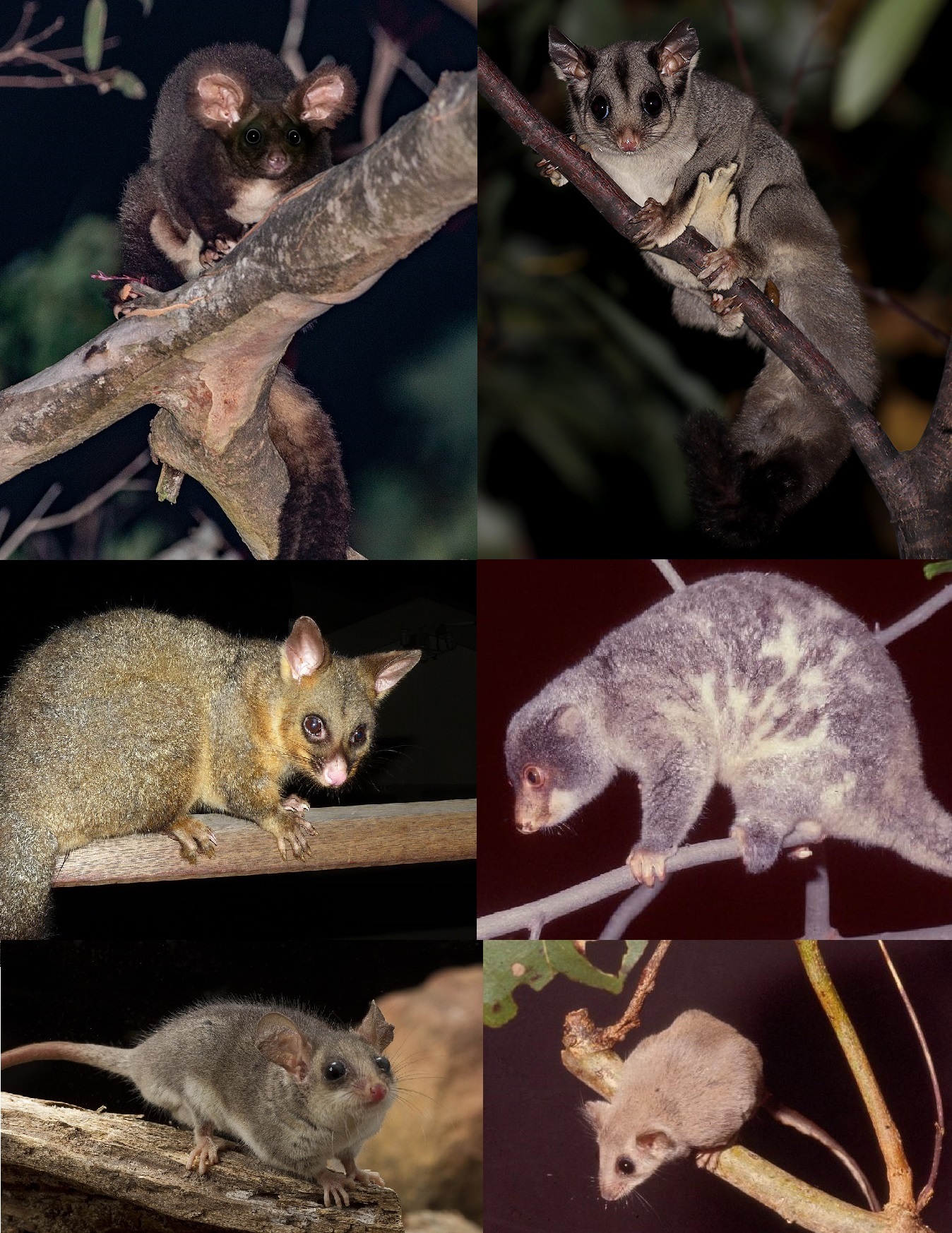
Phalangeriformes /fəˈlændʒərɪfɔːrmiːz/ are quadrupedal marsupials with long tails. They are a paraphyletic suborder of diprotodontia, consiting of about 70 species[clarification needed] of small to medium-sized marsupials native to Australia, New Guinea, and Sulawesi. It includes possums, gliders, and cuscus.
Phalangeriformes species are typically nocturnal and at least partially arboreal.[citation needed] They mostly inhabit vegetated habitats,[citation needed] and several species have adjusted well to urban settings.[citation needed] Diets range from generalist herbivores or omnivores (the common brushtail possum) to specialist browsers of eucalyptus (greater glider), insectivores (mountain pygmy possum) and nectar-feeders (honey possum).[citation needed]
The smallest phalangeriforme species[citation needed], indeed the smallest diprotodont marsupial[citation needed], is the Tasmanian pygmy possum, with an adult head-body length of 70 mm (2+3⁄4 in) and a weight of 10 g (3⁄8 oz). The largest are the two species of bear cuscus, which may exceed 7 kg (15 lb 7 oz).[citation needed]
The common name "possum" for various Phalangeriformes species derives from the creatures' resemblance to the opossums of the Americas (the term comes from Powhatan language aposoum "white animal", from Proto-Algonquian *wa·p-aʔɬemwa "white dog"). However, although opossums are also marsupials, Australasian possums are more closely related to other Australasian marsupials such as kangaroos.[citation needed]
About two-thirds of Australian marsupials belong to the order Diprotodontia, which is split into three suborders, namely the Vombatiformes (wombats and the koala, four species in total); the large and diverse Phalangeriformes (the possums and gliders) and Macropodiformes (kangaroos, potoroos, wallabies and the musky rat-kangaroo).
Note: this classification is based on Ruedas & Morales 2005.[clarification needed] However, Phalangeriformes has been recovered as paraphyletic with respect to Macropodiformes, rendering the latter a subset of the former if Phalangeriformes are to be considered a natural group.
Classification:
Hub AI
Phalangeriformes AI simulator
(@Phalangeriformes_simulator)
Phalangeriformes
Phalangeriformes /fəˈlændʒərɪfɔːrmiːz/ are quadrupedal marsupials with long tails. They are a paraphyletic suborder of diprotodontia, consiting of about 70 species[clarification needed] of small to medium-sized marsupials native to Australia, New Guinea, and Sulawesi. It includes possums, gliders, and cuscus.
Phalangeriformes species are typically nocturnal and at least partially arboreal.[citation needed] They mostly inhabit vegetated habitats,[citation needed] and several species have adjusted well to urban settings.[citation needed] Diets range from generalist herbivores or omnivores (the common brushtail possum) to specialist browsers of eucalyptus (greater glider), insectivores (mountain pygmy possum) and nectar-feeders (honey possum).[citation needed]
The smallest phalangeriforme species[citation needed], indeed the smallest diprotodont marsupial[citation needed], is the Tasmanian pygmy possum, with an adult head-body length of 70 mm (2+3⁄4 in) and a weight of 10 g (3⁄8 oz). The largest are the two species of bear cuscus, which may exceed 7 kg (15 lb 7 oz).[citation needed]
The common name "possum" for various Phalangeriformes species derives from the creatures' resemblance to the opossums of the Americas (the term comes from Powhatan language aposoum "white animal", from Proto-Algonquian *wa·p-aʔɬemwa "white dog"). However, although opossums are also marsupials, Australasian possums are more closely related to other Australasian marsupials such as kangaroos.[citation needed]
About two-thirds of Australian marsupials belong to the order Diprotodontia, which is split into three suborders, namely the Vombatiformes (wombats and the koala, four species in total); the large and diverse Phalangeriformes (the possums and gliders) and Macropodiformes (kangaroos, potoroos, wallabies and the musky rat-kangaroo).
Note: this classification is based on Ruedas & Morales 2005.[clarification needed] However, Phalangeriformes has been recovered as paraphyletic with respect to Macropodiformes, rendering the latter a subset of the former if Phalangeriformes are to be considered a natural group.
Classification:
Recent media