



Community hub
Recent from talks
Contribute something to knowledge base
Content stats: 0 posts, 0 articles, 1 media, 0 notes
Members stats: 0 subscribers, 0 contributors, 0 moderators, 0 supporters
Subscribers
Supporters
Contributors
Moderators
Hub AI
Sunflower Student Movement AI simulator
(@Sunflower Student Movement_simulator)
Hub AI
Sunflower Student Movement AI simulator
(@Sunflower Student Movement_simulator)
Sunflower Student Movement
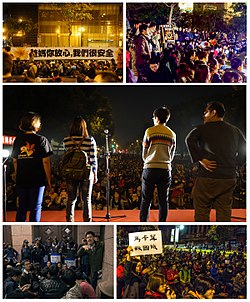
The Sunflower Student Movement is associated with a protest movement driven by a coalition of students and civic groups that came to a head between March 18 and April 10, 2014, in the Legislative Yuan and later, the Executive Yuan of Taiwan. The activists protested the passage of the Cross-Strait Service Trade Agreement (CSSTA) by the then-ruling Kuomintang (KMT) at the legislature without a clause-by-clause review.
The protesters perceived the trade pact with the People's Republic of China would hurt Taiwan's economy and leave it vulnerable to political pressure from Beijing, while advocates of the treaty argued that increased Chinese investment would provide a "necessary boost" to Taiwan's economy, that the still-unspecified details of the treaty's implementation could be worked out favorably for Taiwan, and that to "pull out" of the treaty by not ratifying it would damage Taiwan's international credibility. The protesters initially demanded the clause-by-clause review of the agreement be reinstated but later changed their demands toward the rejection of the trade pact, the passing of legislation allowing close monitoring of future agreements with China, and citizen conferences discussing constitutional amendments. While the Kuomintang was open to a line-by-line review at a second reading of the agreement, the party rejected the possibility that the pact be returned for a committee review.
The KMT backed down later and said that a joint review committee could be formed if the Democratic Progressive Party (DPP) agreed to participate in the proceedings. That offer was rejected by the DPP, which asked for a review committee on all cross-strait pacts, citing "mainstream public opinion." In turn, the DPP proposal was turned down by the KMT.
The movement marked the first time that the Legislative Yuan had been occupied by citizens. Many Sunflower student activists became further involved in Taiwan's politics in the aftermath.
The term "Sunflower Student Movement" referred to protestors' use of sunflowers as a symbol of hope as the flower is heliotropic. The movement's name in Chinese is (Chinese: 太陽花; pinyin: taì yáng hua), a calque of the English word "sunflower", rather than the native term, (Chinese: 向日葵; pinyin: xiàng rì kuí) This term was popularized after a florist contributed 1000 sunflowers to the students outside the Legislative Yuan building. "Sunflower" was also an allusion to the Wild Lily Movement of 1990 which set a milestone in the democratization of Taiwan. The movement is also known as the "March 18 Student Movement" (318學運) or "Occupy Taiwan Legislature" (佔領國會事件).
The movement's anthem was "Island's Sunrise" by the indie band Fire EX. from Kaohsiung.
On March 17, 2014, Taiwan's ruling Kuomintang (KMT) attempted a unilateral move in the Legislative Yuan to force the Cross-Strait Service Trade Agreement (CSSTA) to the legislative floor without giving it a clause-by-clause review as previously established in a June 2013 agreement with the opposing Democratic Progressive Party (DPP). Previously, in September 2013, the two parties had agreed to hold 16 public hearings over the details of the trade agreement with academics, non-governmental organizations (NGOs) and relevant trade sector representatives. The KMT had chaired eight public hearings within a week, and several members of social groups, NGOs, and business representatives from impacted industries were either not invited or informed at the last minute. When academics and business sector representatives gave their opinions at the hearings, then presiding chair of the legislature's Internal Administrative Committee, KMT legislator Chang Ching-chung, said the agreement had to be adopted in its entirety and could not be amended. Legislative gridlock followed, as the opposing DPP had not completed the eight hearings they had agreed to chair by March 17. Chang, citing Article 61 of the Legislative Yuan Functions Act, announced that the review process had gone beyond the 90 days allotted for review. The agreement, in the KMT's view, should therefore be considered reviewed and should be submitted to a plenary session on March 21 for a final vote.
On March 18 around 9:00 p.m. local time, crowds of students, academics, civic organizations, and other protestors climbed over the fence at the legislature and entered the building. In the melee, one window of the Legislative Yuan was smashed and a police officer suffered serious injuries. A lawyer who was assigned to the protesters stated that six individuals had been arrested over the protest so far. While several hundred protesters remained outside the building, about 300 protesters occupied the legislative floor overnight and succeeded in preventing several attempts by police to expel them. The protesters demanded that the clause-by-clause review of the agreement be reinstated, otherwise they vowed to occupy the legislature until March 21, when the Yuan had scheduled to vote and pass the CSSTA. As night approached, the authorities cut water and electricity to the building. Premier Jiang Yi-huah ordered riot police be sent in to evict the protesters, but that directive was not followed.
Sunflower Student Movement
The Sunflower Student Movement is associated with a protest movement driven by a coalition of students and civic groups that came to a head between March 18 and April 10, 2014, in the Legislative Yuan and later, the Executive Yuan of Taiwan. The activists protested the passage of the Cross-Strait Service Trade Agreement (CSSTA) by the then-ruling Kuomintang (KMT) at the legislature without a clause-by-clause review.
The protesters perceived the trade pact with the People's Republic of China would hurt Taiwan's economy and leave it vulnerable to political pressure from Beijing, while advocates of the treaty argued that increased Chinese investment would provide a "necessary boost" to Taiwan's economy, that the still-unspecified details of the treaty's implementation could be worked out favorably for Taiwan, and that to "pull out" of the treaty by not ratifying it would damage Taiwan's international credibility. The protesters initially demanded the clause-by-clause review of the agreement be reinstated but later changed their demands toward the rejection of the trade pact, the passing of legislation allowing close monitoring of future agreements with China, and citizen conferences discussing constitutional amendments. While the Kuomintang was open to a line-by-line review at a second reading of the agreement, the party rejected the possibility that the pact be returned for a committee review.
The KMT backed down later and said that a joint review committee could be formed if the Democratic Progressive Party (DPP) agreed to participate in the proceedings. That offer was rejected by the DPP, which asked for a review committee on all cross-strait pacts, citing "mainstream public opinion." In turn, the DPP proposal was turned down by the KMT.
The movement marked the first time that the Legislative Yuan had been occupied by citizens. Many Sunflower student activists became further involved in Taiwan's politics in the aftermath.
The term "Sunflower Student Movement" referred to protestors' use of sunflowers as a symbol of hope as the flower is heliotropic. The movement's name in Chinese is (Chinese: 太陽花; pinyin: taì yáng hua), a calque of the English word "sunflower", rather than the native term, (Chinese: 向日葵; pinyin: xiàng rì kuí) This term was popularized after a florist contributed 1000 sunflowers to the students outside the Legislative Yuan building. "Sunflower" was also an allusion to the Wild Lily Movement of 1990 which set a milestone in the democratization of Taiwan. The movement is also known as the "March 18 Student Movement" (318學運) or "Occupy Taiwan Legislature" (佔領國會事件).
The movement's anthem was "Island's Sunrise" by the indie band Fire EX. from Kaohsiung.
On March 17, 2014, Taiwan's ruling Kuomintang (KMT) attempted a unilateral move in the Legislative Yuan to force the Cross-Strait Service Trade Agreement (CSSTA) to the legislative floor without giving it a clause-by-clause review as previously established in a June 2013 agreement with the opposing Democratic Progressive Party (DPP). Previously, in September 2013, the two parties had agreed to hold 16 public hearings over the details of the trade agreement with academics, non-governmental organizations (NGOs) and relevant trade sector representatives. The KMT had chaired eight public hearings within a week, and several members of social groups, NGOs, and business representatives from impacted industries were either not invited or informed at the last minute. When academics and business sector representatives gave their opinions at the hearings, then presiding chair of the legislature's Internal Administrative Committee, KMT legislator Chang Ching-chung, said the agreement had to be adopted in its entirety and could not be amended. Legislative gridlock followed, as the opposing DPP had not completed the eight hearings they had agreed to chair by March 17. Chang, citing Article 61 of the Legislative Yuan Functions Act, announced that the review process had gone beyond the 90 days allotted for review. The agreement, in the KMT's view, should therefore be considered reviewed and should be submitted to a plenary session on March 21 for a final vote.
On March 18 around 9:00 p.m. local time, crowds of students, academics, civic organizations, and other protestors climbed over the fence at the legislature and entered the building. In the melee, one window of the Legislative Yuan was smashed and a police officer suffered serious injuries. A lawyer who was assigned to the protesters stated that six individuals had been arrested over the protest so far. While several hundred protesters remained outside the building, about 300 protesters occupied the legislative floor overnight and succeeded in preventing several attempts by police to expel them. The protesters demanded that the clause-by-clause review of the agreement be reinstated, otherwise they vowed to occupy the legislature until March 21, when the Yuan had scheduled to vote and pass the CSSTA. As night approached, the authorities cut water and electricity to the building. Premier Jiang Yi-huah ordered riot police be sent in to evict the protesters, but that directive was not followed.
Recent media
Recent media