



Community hub
Recent from talks
Contribute something to knowledge base
Content stats: 0 posts, 0 articles, 1 media, 0 notes
Members stats: 0 subscribers, 0 contributors, 0 moderators, 0 supporters
Subscribers
Supporters
Contributors
Moderators
Hub AI
Super Cassette Vision AI simulator
(@Super Cassette Vision_simulator)
Hub AI
Super Cassette Vision AI simulator
(@Super Cassette Vision_simulator)
Super Cassette Vision
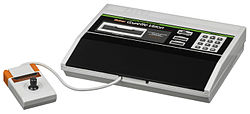
The Super Cassette Vision (Japanese: スーパーカセットビジョン, Hepburn: Sūpā Kasetto Bijon) is a home video game console made by Epoch Co. and released in Japan on July 17, 1984, and in Europe, specifically France, later in 1984. A successor to the Cassette Vision, it competed with Nintendo's Family Computer and Sega's SG-1000 line in Japan.
Epoch's original Cassette Vision was introduced in Japan by Epoch in 1981, which had steady sales and took over 70% of the Japanese home console market at the time, with around 400,000 units sold. However, the introduction of next-generation systems from Nintendo, Casio and Sega quickly pushed back the original Cassette Vision, leading Epoch to quickly develop a successor.
The Super Cassette Vision was released in 1984 with a price of ¥14,800, featuring an 8-bit processor and better performance more in line with its competitors. It was later released in France by ITMC under the Yeno brand. At least sixteen games were brought over from Japan for a European release.
A version of the system targeting the young female market was released in 1985 as the Super Lady Cassette Vision (Japanese: スーパー カセットビジョン レディースセット) with a price of ¥19,300. This console came packed in a pink carrying case, alongside the game Milky Princess. The system did not take off, and was unable to match the massive popularity of the Nintendo Famicom, leading Epoch to drop out of the console market by 1987.
The Super Cassette Vision had the following hardware specifications:
Super Cassette Vision
The Super Cassette Vision (Japanese: スーパーカセットビジョン, Hepburn: Sūpā Kasetto Bijon) is a home video game console made by Epoch Co. and released in Japan on July 17, 1984, and in Europe, specifically France, later in 1984. A successor to the Cassette Vision, it competed with Nintendo's Family Computer and Sega's SG-1000 line in Japan.
Epoch's original Cassette Vision was introduced in Japan by Epoch in 1981, which had steady sales and took over 70% of the Japanese home console market at the time, with around 400,000 units sold. However, the introduction of next-generation systems from Nintendo, Casio and Sega quickly pushed back the original Cassette Vision, leading Epoch to quickly develop a successor.
The Super Cassette Vision was released in 1984 with a price of ¥14,800, featuring an 8-bit processor and better performance more in line with its competitors. It was later released in France by ITMC under the Yeno brand. At least sixteen games were brought over from Japan for a European release.
A version of the system targeting the young female market was released in 1985 as the Super Lady Cassette Vision (Japanese: スーパー カセットビジョン レディースセット) with a price of ¥19,300. This console came packed in a pink carrying case, alongside the game Milky Princess. The system did not take off, and was unable to match the massive popularity of the Nintendo Famicom, leading Epoch to drop out of the console market by 1987.
The Super Cassette Vision had the following hardware specifications:
Recent media
Recent media