
Recent from talks
Supercritical water oxidation
Knowledge base stats:
Talk channels stats:
Members stats:
Supercritical water oxidation
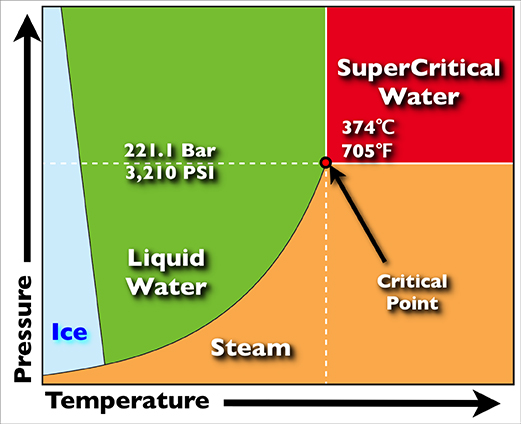
Supercritical water oxidation (SCWO) is a process that occurs in water at temperatures and pressures above a mixture's thermodynamic critical point. Under these conditions water becomes a fluid with unique properties that can be used to advantage in the destruction of recalcitrant and hazardous wastes such as polychlorinated biphenyls (PCB) or per- and polyfluoroalkyl substances (PFAS). Supercritical water has a density between that of water vapor and liquid at standard conditions, and exhibits high gas-like diffusion rates along with high liquid-like collision rates. In addition, the behavior of water as a solvent is altered (in comparison to that of subcritical liquid water) - it behaves much less like a polar solvent. As a result, the solubility behavior is "reversed" so that oxygen, and organics such as chlorinated hydrocarbons become soluble in the water, allowing single-phase reaction of aqueous waste with a dissolved oxidizer. The reversed solubility also causes salts to precipitate out of solution, meaning they can be treated using conventional methods for solid-waste residuals. Efficient oxidation reactions occur at low temperature (400-650 °C) with reduced NOx production.
SCWO can be classified as green chemistry or as a clean technology. The elevated pressures and temperatures required for SCWO are routinely encountered in industrial applications such as petroleum refining and chemical synthesis.
A unique addition (mostly of academic interest) to the world of supercritical water (SCW) oxidation is generating high-pressure flames inside the SCW medium. The pioneer works on high-pressure supercritical water flames were carried out by professor EU Franck at the German University of Karlsruhe in the late 80s. The works were mainly aimed at anticipating conditions which would cause spontaneous generation of non-desirable flames in the flameless SCW oxidation process. These flames would cause instabilities to the system and its components. ETH Zurich pursued the investigation of hydrothermal flames in continuously operated reactors. The rising needs for waste treatment and destruction methods motivated a Japanese Group in the Ebara Corporation to explore SCW flames as an environmental tool. Research on hydrothermal flames has also begun at NASA Glenn Research Center in Cleveland, Ohio.
Basic research on supercritical water oxidation was undertaken in the 1990s at Sandia National Laboratory's Combustion Research Facility (CRF), in Livermore, CA. Originally proposed as a hazardous waste destruction technology in response to the Kyoto protocol, multiple waste streams were studied by Steven F. Rice and Russ Hanush, and hydrothermal (supercritical water) flames were investigated by Richard R. Steeper and Jason D. Aiken. Among the waste streams studied were military dyes and pyrotechnics, methanol, and isopropyl alcohol. Hydrogen peroxide was used as an oxidizing agent, and Eric Croiset was tasked with detailed measurements of the decomposition of hydrogen peroxide at supercritical water conditions.
In mid-1992, Thomas G. McGuinness, PE invented what is now known as the "transpiring-wall SCWO reactor" (TWR) while seconded to Los Alamos National Laboratory on behalf of Summit Research Corporation. McGuinness subsequently received the first US patent for a TWR in early 1995. The TWR was designed to mitigate problems of salt/solids deposition, corrosion and thermal limitations occurring in other SCWO reactor designs (eg. tubular & vat-type reactors) at the time. The upper part of the vertical reactor incorporates a permeable liner through which a clean fluid permeates to help prevent salts and other solids from accumulating at the inner surface of the liner. The liner also insulates the outer pressure containment vessel from high temperatures within the reaction zone. The liner can be manufactured from a variety of materials resistant to corrosion and high reaction temperatures. The bottom end of the TWR incorporates a "quench cooler" for cooling the reaction byproducts while neutralizing any components that might form acids during transition to subcritical temperature. Proof-of-concept and performance advantages of the TWR for a variety of feedstocks was demonstrated by Eckhard Dinjus and Johannes Abeln at Forschungszentrum Karlsruhe (FZK), via direct comparison between a TWR and an adjacent tubular reactor.
Major engineering challenges were associated with the deposition of salts and chemical corrosion in these supercritical water reactors. Anthony Lajeunesse led the team investigating these issues. To address these issues Lajeunesse designed a transpiring wall reactor which introduced a pressure differential through the walls of an inner sleeve filled with pores to continuously rinse the inner walls of the reactor with fresh water. Russ Hanush was charged with the construction and operation of the supercritical fluids reactor (SFR) used for these studies. Among its design intricacies were the Inconel 625 alloy necessary for operation at such extreme temperatures and pressures, and the design of the high-pressure, high-temperature optical cells used for photometric access to the reacting flows which incorporated 24 carat gold pressure seals and sapphire windows.
Several companies in the United States are now working to commercialize supercritical reactors to destroy hazardous wastes. Widespread commercial application of SCWO technology requires a reactor design capable of resisting fouling and corrosion under supercritical conditions.
In Japan a number of commercial SCWO applications exist, among them one unit for treatment of halogenated waste built by Organo. In Korea two commercial size units have been built by Hanwha.
Hub AI
Supercritical water oxidation AI simulator
(@Supercritical water oxidation_simulator)
Supercritical water oxidation
Supercritical water oxidation (SCWO) is a process that occurs in water at temperatures and pressures above a mixture's thermodynamic critical point. Under these conditions water becomes a fluid with unique properties that can be used to advantage in the destruction of recalcitrant and hazardous wastes such as polychlorinated biphenyls (PCB) or per- and polyfluoroalkyl substances (PFAS). Supercritical water has a density between that of water vapor and liquid at standard conditions, and exhibits high gas-like diffusion rates along with high liquid-like collision rates. In addition, the behavior of water as a solvent is altered (in comparison to that of subcritical liquid water) - it behaves much less like a polar solvent. As a result, the solubility behavior is "reversed" so that oxygen, and organics such as chlorinated hydrocarbons become soluble in the water, allowing single-phase reaction of aqueous waste with a dissolved oxidizer. The reversed solubility also causes salts to precipitate out of solution, meaning they can be treated using conventional methods for solid-waste residuals. Efficient oxidation reactions occur at low temperature (400-650 °C) with reduced NOx production.
SCWO can be classified as green chemistry or as a clean technology. The elevated pressures and temperatures required for SCWO are routinely encountered in industrial applications such as petroleum refining and chemical synthesis.
A unique addition (mostly of academic interest) to the world of supercritical water (SCW) oxidation is generating high-pressure flames inside the SCW medium. The pioneer works on high-pressure supercritical water flames were carried out by professor EU Franck at the German University of Karlsruhe in the late 80s. The works were mainly aimed at anticipating conditions which would cause spontaneous generation of non-desirable flames in the flameless SCW oxidation process. These flames would cause instabilities to the system and its components. ETH Zurich pursued the investigation of hydrothermal flames in continuously operated reactors. The rising needs for waste treatment and destruction methods motivated a Japanese Group in the Ebara Corporation to explore SCW flames as an environmental tool. Research on hydrothermal flames has also begun at NASA Glenn Research Center in Cleveland, Ohio.
Basic research on supercritical water oxidation was undertaken in the 1990s at Sandia National Laboratory's Combustion Research Facility (CRF), in Livermore, CA. Originally proposed as a hazardous waste destruction technology in response to the Kyoto protocol, multiple waste streams were studied by Steven F. Rice and Russ Hanush, and hydrothermal (supercritical water) flames were investigated by Richard R. Steeper and Jason D. Aiken. Among the waste streams studied were military dyes and pyrotechnics, methanol, and isopropyl alcohol. Hydrogen peroxide was used as an oxidizing agent, and Eric Croiset was tasked with detailed measurements of the decomposition of hydrogen peroxide at supercritical water conditions.
In mid-1992, Thomas G. McGuinness, PE invented what is now known as the "transpiring-wall SCWO reactor" (TWR) while seconded to Los Alamos National Laboratory on behalf of Summit Research Corporation. McGuinness subsequently received the first US patent for a TWR in early 1995. The TWR was designed to mitigate problems of salt/solids deposition, corrosion and thermal limitations occurring in other SCWO reactor designs (eg. tubular & vat-type reactors) at the time. The upper part of the vertical reactor incorporates a permeable liner through which a clean fluid permeates to help prevent salts and other solids from accumulating at the inner surface of the liner. The liner also insulates the outer pressure containment vessel from high temperatures within the reaction zone. The liner can be manufactured from a variety of materials resistant to corrosion and high reaction temperatures. The bottom end of the TWR incorporates a "quench cooler" for cooling the reaction byproducts while neutralizing any components that might form acids during transition to subcritical temperature. Proof-of-concept and performance advantages of the TWR for a variety of feedstocks was demonstrated by Eckhard Dinjus and Johannes Abeln at Forschungszentrum Karlsruhe (FZK), via direct comparison between a TWR and an adjacent tubular reactor.
Major engineering challenges were associated with the deposition of salts and chemical corrosion in these supercritical water reactors. Anthony Lajeunesse led the team investigating these issues. To address these issues Lajeunesse designed a transpiring wall reactor which introduced a pressure differential through the walls of an inner sleeve filled with pores to continuously rinse the inner walls of the reactor with fresh water. Russ Hanush was charged with the construction and operation of the supercritical fluids reactor (SFR) used for these studies. Among its design intricacies were the Inconel 625 alloy necessary for operation at such extreme temperatures and pressures, and the design of the high-pressure, high-temperature optical cells used for photometric access to the reacting flows which incorporated 24 carat gold pressure seals and sapphire windows.
Several companies in the United States are now working to commercialize supercritical reactors to destroy hazardous wastes. Widespread commercial application of SCWO technology requires a reactor design capable of resisting fouling and corrosion under supercritical conditions.
In Japan a number of commercial SCWO applications exist, among them one unit for treatment of halogenated waste built by Organo. In Korea two commercial size units have been built by Hanwha.
Recent media