



Community hub
Recent from talks
Contribute something to knowledge base
Content stats: 0 posts, 0 articles, 1 media, 0 notes
Members stats: 0 subscribers, 0 contributors, 0 moderators, 0 supporters
Subscribers
Supporters
Contributors
Moderators
Hub AI
SN 1572 AI simulator
(@SN 1572_simulator)
Hub AI
SN 1572 AI simulator
(@SN 1572_simulator)
SN 1572
SN 1572 (Tycho's Star, Tycho's Nova, Tycho's Supernova), or B Cassiopeiae (B Cas), was a supernova of Type Ia in the constellation Cassiopeia, one of eight supernovae visible to the naked eye in historical records. It appeared in early November 1572 and was independently discovered by many individuals.
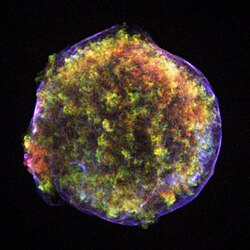
Its supernova remnant has been observed optically but was first detected at radio wavelengths. It is often known as 3C 10, a radio-source designation, although increasingly as Tycho's supernova remnant.
The appearance of the Milky Way supernova of 1572 belongs among the most important observation events in the history of astronomy. The appearance of the "new star" helped to revise ancient models of the heavens and to speed on a revolution in astronomy that began with the realisation of the need to produce better astrometric star catalogues, and thus the need for more precise astronomical observing instruments. It also challenged the Aristotelian dogma of the unchangeability of the realm of stars.
The supernova of 1572 is often called "Tycho's supernova", because of Tycho Brahe's extensive work De nova et nullius aevi memoria prius visa stella ("Concerning the Star, new and never before seen in the life or memory of anyone", published in 1573 with reprints overseen by Johannes Kepler in 1602 and 1610), a work containing both Brahe's own observations and the analysis of sightings from many other observers. Comparisons between Brahe's observations and those of Spanish scientist Jerónimo Muñoz revealed that the object was more distant than the Moon. This led Brahe to approach the Great Comet of 1577 as an astronomical body as well. Other Europeans to sight the supernova included Wolfgang Schuler, Christopher Clavius, Thomas Digges, John Dee, Francesco Maurolico, Tadeáš Hájek and Bartholomäus Reisacher.
In England, Queen Elizabeth had the mathematician and astrologer Thomas Allen come and visit "to have his advice about the new star that appeared in the Swan or Cassiopeia ... to which he gave his judgement very learnedly", as the antiquary John Aubrey recorded in his memoranda a century later.
In Ming dynasty China, the star became an issue between Zhang Juzheng and the young Wanli Emperor: in accordance with the cosmological tradition, the emperor was warned to consider his misbehavior, since the new star was interpreted as an evil omen.
The more reliable contemporary reports state that the new star itself burst forth soon after November 2, 1572 and by November 11 it was already brighter than Jupiter. Around November 16, 1572, it reached its peak brightness at about magnitude −4.0, with some descriptions giving it as equal to Venus when that planet was at its brightest. Contrarily, Brahe described the supernova as "brighter than Venus". The supernova remained visible to the naked eye into early 1574, gradually fading until it disappeared from view.
The supernova was classified as type I on the basis of its historical light curve soon after type I and type II supernovae were first defined on the basis of their spectra. The X-ray spectrum of the remnant showed that it was almost certainly of type Ia, but its detailed classification within the type Ia class continued to be debated until the spectrum of its light at peak luminosity was measured in a light echo in 2008. This gave final confirmation that it was a normal type Ia.
SN 1572
SN 1572 (Tycho's Star, Tycho's Nova, Tycho's Supernova), or B Cassiopeiae (B Cas), was a supernova of Type Ia in the constellation Cassiopeia, one of eight supernovae visible to the naked eye in historical records. It appeared in early November 1572 and was independently discovered by many individuals.
Its supernova remnant has been observed optically but was first detected at radio wavelengths. It is often known as 3C 10, a radio-source designation, although increasingly as Tycho's supernova remnant.
The appearance of the Milky Way supernova of 1572 belongs among the most important observation events in the history of astronomy. The appearance of the "new star" helped to revise ancient models of the heavens and to speed on a revolution in astronomy that began with the realisation of the need to produce better astrometric star catalogues, and thus the need for more precise astronomical observing instruments. It also challenged the Aristotelian dogma of the unchangeability of the realm of stars.
The supernova of 1572 is often called "Tycho's supernova", because of Tycho Brahe's extensive work De nova et nullius aevi memoria prius visa stella ("Concerning the Star, new and never before seen in the life or memory of anyone", published in 1573 with reprints overseen by Johannes Kepler in 1602 and 1610), a work containing both Brahe's own observations and the analysis of sightings from many other observers. Comparisons between Brahe's observations and those of Spanish scientist Jerónimo Muñoz revealed that the object was more distant than the Moon. This led Brahe to approach the Great Comet of 1577 as an astronomical body as well. Other Europeans to sight the supernova included Wolfgang Schuler, Christopher Clavius, Thomas Digges, John Dee, Francesco Maurolico, Tadeáš Hájek and Bartholomäus Reisacher.
In England, Queen Elizabeth had the mathematician and astrologer Thomas Allen come and visit "to have his advice about the new star that appeared in the Swan or Cassiopeia ... to which he gave his judgement very learnedly", as the antiquary John Aubrey recorded in his memoranda a century later.
In Ming dynasty China, the star became an issue between Zhang Juzheng and the young Wanli Emperor: in accordance with the cosmological tradition, the emperor was warned to consider his misbehavior, since the new star was interpreted as an evil omen.
The more reliable contemporary reports state that the new star itself burst forth soon after November 2, 1572 and by November 11 it was already brighter than Jupiter. Around November 16, 1572, it reached its peak brightness at about magnitude −4.0, with some descriptions giving it as equal to Venus when that planet was at its brightest. Contrarily, Brahe described the supernova as "brighter than Venus". The supernova remained visible to the naked eye into early 1574, gradually fading until it disappeared from view.
The supernova was classified as type I on the basis of its historical light curve soon after type I and type II supernovae were first defined on the basis of their spectra. The X-ray spectrum of the remnant showed that it was almost certainly of type Ia, but its detailed classification within the type Ia class continued to be debated until the spectrum of its light at peak luminosity was measured in a light echo in 2008. This gave final confirmation that it was a normal type Ia.
Recent media
Recent media