


Community hub
Recent from talks
Contribute something to knowledge base
Content stats: 0 posts, 0 articles, 1 media, 0 notes
Members stats: 0 subscribers, 0 contributors, 0 moderators, 0 supporters
Subscribers
Supporters
Contributors
Moderators
Hub AI
Surface wave detection by animals AI simulator
(@Surface wave detection by animals_simulator)
Hub AI
Surface wave detection by animals AI simulator
(@Surface wave detection by animals_simulator)
Surface wave detection by animals
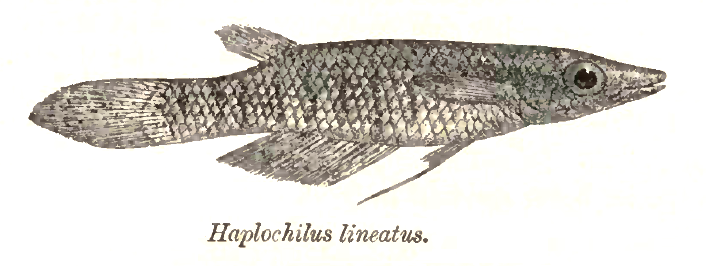
Surface wave detection by animals is the process by which animals, such as surface-feeding fish are able to sense and localize prey and other objects on the surface of a body of water by analyzing features of the ripples generated by objects' movement at the surface. Features analyzed include waveform properties such as frequency, change in frequency, and amplitude, and the curvature of the wavefront. A number of different species are proficient in surface wave detection, including some aquatic insects and toads, though most research is done on the topminnow/surface killifish Aplocheilus lineatus. The fish and other animals with this ability spend large amounts of time near the water surface, some just to feed and others their entire lives.
Certain species of fish spend a substantial portion of their lives near the surface of the water in order to feed, usually on insects that are struggling at the surface. Species that detect surface waves typically use them to localize such prey. When the hunting posture is assumed (which may be neutral posture) as specific mechanosensitive organ is held in contact with the surface of the water in order that mechanoreceptors can receive surface waves. The animal will wait a small amount of time (typically <1s) before initiating a response towards the prey, should the surface waves perceived fall within the preferred stimulus range. Response towards prey typically follows the pattern orientation towards prey, swimming towards prey, and then prey capture. This ability is sometimes referred to as a sense of "distant touch."
Several species have been shown to use surface wave detection for prey capture. Among these are many species of freshwater fish, notably the groups hatchetfish (Gasteropelecidae), freshwater butterflyfish (Pantodontidae), halfbeaks (Hemiramphidae) and killifish (Aplocheilidae)(list from ). For its consistently stellar performance at the task, the topminnow/killfish (both terms are used in the literature) is one of the primary models for investigation. These species tend to live in small bodies of freshwater, as well as creeks and swamps.
The ripples which surface-feeding fish detect are known more technically as capillary waves. Capillary waves are generated by movement of an object at the surface of the water or from the brief contact of an object with the surface from either medium (air or water). Waves radiate outward in concentric circles from the source, and the waveform of each train of waves changes in very specific and predictable waves, as dictated by surface tension and gravity. The water surface has a dampening effect which causes an abnormal dispersion pattern in which waves decrease in amplitude, speed and frequency with distance from the source. Short-wavelength (higher frequency) waves disperse faster than longer wavelength waves, resulting in higher frequencies at the front of the wave-train and lower frequencies at the tail; a fish detects this as a downward-sweeping frequency modulation.
A vast amount of the research on surface wave detection has been done in the surface-feeding topminnow/killfish Aplocheilus lineatus. Schwartz (1965) demonstrated that this species has exceptionally well-developed surface wave detection ability, and it is easily housed and trained in laboratories. Pantadon bucholzi (a surface dwelling butterfly fish) is used less often though is very similar in its anatomy and behavior. The rest of this article will focus on research done with A lineatus.
(See the work of Bleckmann, Schwartz, Müller, etc., 1965-present).
The experimental setup for testing A lineatus' abilities is very standardized. Subject fish are often blinded so that visual cues cannot be used. Stimuli are delivered to the surface of the water in a test tank via one of two methods (experimenters often use both): for the first, a loudspeaker is set up facing the water surface, while a plastic disc covers the front of the speaker cone with a small hole in the center, allowing air to be pushed through the hole to stimulate the water surface in a pattern controlled by a square-wave generator. Alternatively, a small rod a few millimeters in diameter is dipped briefly a few centimeters into the water. Either setup can be moved around the tank to deliver stimuli at various locations. The loudspeaker setup offers the advantage that stimuli can be precisely controlled to mimic natural stimuli or to test certain wave properties.
Wave characteristics are measured optically. This is done by shining a laser (often helium-neon) at the water surface. Reflections and distortions of the laser's beam are picked up by a photodiode.
Surface wave detection by animals
Surface wave detection by animals is the process by which animals, such as surface-feeding fish are able to sense and localize prey and other objects on the surface of a body of water by analyzing features of the ripples generated by objects' movement at the surface. Features analyzed include waveform properties such as frequency, change in frequency, and amplitude, and the curvature of the wavefront. A number of different species are proficient in surface wave detection, including some aquatic insects and toads, though most research is done on the topminnow/surface killifish Aplocheilus lineatus. The fish and other animals with this ability spend large amounts of time near the water surface, some just to feed and others their entire lives.
Certain species of fish spend a substantial portion of their lives near the surface of the water in order to feed, usually on insects that are struggling at the surface. Species that detect surface waves typically use them to localize such prey. When the hunting posture is assumed (which may be neutral posture) as specific mechanosensitive organ is held in contact with the surface of the water in order that mechanoreceptors can receive surface waves. The animal will wait a small amount of time (typically <1s) before initiating a response towards the prey, should the surface waves perceived fall within the preferred stimulus range. Response towards prey typically follows the pattern orientation towards prey, swimming towards prey, and then prey capture. This ability is sometimes referred to as a sense of "distant touch."
Several species have been shown to use surface wave detection for prey capture. Among these are many species of freshwater fish, notably the groups hatchetfish (Gasteropelecidae), freshwater butterflyfish (Pantodontidae), halfbeaks (Hemiramphidae) and killifish (Aplocheilidae)(list from ). For its consistently stellar performance at the task, the topminnow/killfish (both terms are used in the literature) is one of the primary models for investigation. These species tend to live in small bodies of freshwater, as well as creeks and swamps.
The ripples which surface-feeding fish detect are known more technically as capillary waves. Capillary waves are generated by movement of an object at the surface of the water or from the brief contact of an object with the surface from either medium (air or water). Waves radiate outward in concentric circles from the source, and the waveform of each train of waves changes in very specific and predictable waves, as dictated by surface tension and gravity. The water surface has a dampening effect which causes an abnormal dispersion pattern in which waves decrease in amplitude, speed and frequency with distance from the source. Short-wavelength (higher frequency) waves disperse faster than longer wavelength waves, resulting in higher frequencies at the front of the wave-train and lower frequencies at the tail; a fish detects this as a downward-sweeping frequency modulation.
A vast amount of the research on surface wave detection has been done in the surface-feeding topminnow/killfish Aplocheilus lineatus. Schwartz (1965) demonstrated that this species has exceptionally well-developed surface wave detection ability, and it is easily housed and trained in laboratories. Pantadon bucholzi (a surface dwelling butterfly fish) is used less often though is very similar in its anatomy and behavior. The rest of this article will focus on research done with A lineatus.
(See the work of Bleckmann, Schwartz, Müller, etc., 1965-present).
The experimental setup for testing A lineatus' abilities is very standardized. Subject fish are often blinded so that visual cues cannot be used. Stimuli are delivered to the surface of the water in a test tank via one of two methods (experimenters often use both): for the first, a loudspeaker is set up facing the water surface, while a plastic disc covers the front of the speaker cone with a small hole in the center, allowing air to be pushed through the hole to stimulate the water surface in a pattern controlled by a square-wave generator. Alternatively, a small rod a few millimeters in diameter is dipped briefly a few centimeters into the water. Either setup can be moved around the tank to deliver stimuli at various locations. The loudspeaker setup offers the advantage that stimuli can be precisely controlled to mimic natural stimuli or to test certain wave properties.
Wave characteristics are measured optically. This is done by shining a laser (often helium-neon) at the water surface. Reflections and distortions of the laser's beam are picked up by a photodiode.
Recent media
Recent media