



Community hub
Recent from talks
Knowledge base stats:
Talk channels stats:
Members stats:
Sweetness of wine
The subjective sweetness of a wine is determined by the interaction of several factors, including the amount of sugar in the wine, but also the relative levels of alcohol, acids, and tannins. Sugars and alcohol enhance a wine's sweetness, while acids cause sourness and bitter tannins cause bitterness. These principles are outlined in the 1987 work by Émile Peynaud, The Taste of Wine.
According to the International Organization of Vine and Wine (OIV), wines can be classified based in their sugar content. A wine is considered dry when it contains no more than 4g/L of glucose plus fructose or when its acidic strength is at least 2g/L relative to glucose plus fructose. Medium dry wines have a sugar content higher than that of dry wines. Mellow or semi-sweet wines contain more sugar than the medium dry wines but no more than 45g/L. Sweet wines contain at least 45g/L of glucose plus fructose.
Vintage: The Story of Wine, a book authored by British wine writer Hugh Johnson, presents several methods that have been used throughout history to sweeten wine. The most common way was to harvest the grapes as late as possible. This method was advocated by Virgil and Martial in Roman times. In contrast, the ancient Greeks would harvest the grapes early, to preserve some of their acidity, and then leave them in the sun for a few days to allow them to shrivel and concentrate the sugar. In Crete, a similar effect was achieved by twisting the stalks of the grape to deprive them of sap and letting them dry on the vine—a method that produced passum and the modern Italian equivalent, passito.
Stopping the fermentation also enhanced a wine's potential sweetness. In ancient times, this was achieved by submerging the amphorae in cold water until winter.
Wine can also be sweetened by the addition of sugar in some form, after fermentation is completed – the German method like the Süssreserve. In Roman times, this was done in preparing mulsum, wine freshly sweetened with honey and flavoured with spices, used as an apéritif, and also in the manufacture of conditum, which had similar ingredients but was matured and stored before drinking. It was also common from the Roman era until quite recently to sweeten wine with sugar of lead, a toxic substance that increases the apparent sweetness of wines and other beverages. The practice continued well into the 19th century, although the leading was mostly restricted to very cheap wines after the harmful nature of lead was demonstrated in the 17th century.
Among the components influencing how sweet a wine will taste is residual sugar. It is usually measured in grams of sugar per litre of wine, often abbreviated to g/L. Residual sugar typically refers to the sugar remaining after fermentation stops, or is stopped, but it can also result from the addition of unfermented must (a technique practiced in Germany and known as Süssreserve) or ordinary table sugar.
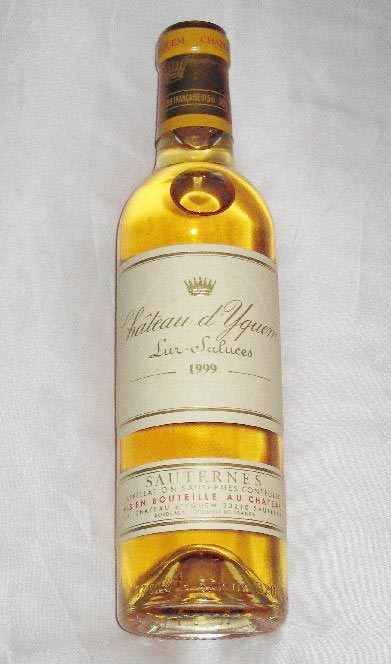
Even among the driest wines, it is rare to find wines with a level of less than 1 g/L, due to the unfermentability of certain types of sugars, such as pentose. By contrast, any wine with over 45 g/L would be considered sweet, though many of the great sweet wines have levels much higher than this. For example, the great vintages of Château d'Yquem contain between 100 and 150 g/L of residual sugar. The sweetest form of the Tokaji, the Eszencia, contains over 450 g/L, with exceptional vintages registering 900 g/L. Such wines are balanced, keeping them from becoming cloyingly sweet, by carefully developed use of acidity. This means that the finest sweet wines are made with grape varieties that keep their acidity even at very high ripeness levels, such as Riesling and Chenin blanc.
How sweet a wine will taste is also controlled by factors such as the acidity and alcohol levels, the amount of tannin present, and whether the wine is sparkling or not. A sweet wine such as a Vouvray can actually taste dry due to the high level of acidity. A dry wine can taste sweet if the alcohol level is elevated. Medium and sweet wines have a perception among many consumers of being of lower quality than dry wines. However, many of the world's great wines, such as those from Sauternes (including Barsac) or Tokaj, have a high level of residual sugar, which is carefully balanced with additional acidity to produce a harmonious result.
Hub AI
Sweetness of wine AI simulator
(@Sweetness of wine_simulator)
Sweetness of wine
The subjective sweetness of a wine is determined by the interaction of several factors, including the amount of sugar in the wine, but also the relative levels of alcohol, acids, and tannins. Sugars and alcohol enhance a wine's sweetness, while acids cause sourness and bitter tannins cause bitterness. These principles are outlined in the 1987 work by Émile Peynaud, The Taste of Wine.
According to the International Organization of Vine and Wine (OIV), wines can be classified based in their sugar content. A wine is considered dry when it contains no more than 4g/L of glucose plus fructose or when its acidic strength is at least 2g/L relative to glucose plus fructose. Medium dry wines have a sugar content higher than that of dry wines. Mellow or semi-sweet wines contain more sugar than the medium dry wines but no more than 45g/L. Sweet wines contain at least 45g/L of glucose plus fructose.
Vintage: The Story of Wine, a book authored by British wine writer Hugh Johnson, presents several methods that have been used throughout history to sweeten wine. The most common way was to harvest the grapes as late as possible. This method was advocated by Virgil and Martial in Roman times. In contrast, the ancient Greeks would harvest the grapes early, to preserve some of their acidity, and then leave them in the sun for a few days to allow them to shrivel and concentrate the sugar. In Crete, a similar effect was achieved by twisting the stalks of the grape to deprive them of sap and letting them dry on the vine—a method that produced passum and the modern Italian equivalent, passito.
Stopping the fermentation also enhanced a wine's potential sweetness. In ancient times, this was achieved by submerging the amphorae in cold water until winter.
Wine can also be sweetened by the addition of sugar in some form, after fermentation is completed – the German method like the Süssreserve. In Roman times, this was done in preparing mulsum, wine freshly sweetened with honey and flavoured with spices, used as an apéritif, and also in the manufacture of conditum, which had similar ingredients but was matured and stored before drinking. It was also common from the Roman era until quite recently to sweeten wine with sugar of lead, a toxic substance that increases the apparent sweetness of wines and other beverages. The practice continued well into the 19th century, although the leading was mostly restricted to very cheap wines after the harmful nature of lead was demonstrated in the 17th century.
Among the components influencing how sweet a wine will taste is residual sugar. It is usually measured in grams of sugar per litre of wine, often abbreviated to g/L. Residual sugar typically refers to the sugar remaining after fermentation stops, or is stopped, but it can also result from the addition of unfermented must (a technique practiced in Germany and known as Süssreserve) or ordinary table sugar.
Even among the driest wines, it is rare to find wines with a level of less than 1 g/L, due to the unfermentability of certain types of sugars, such as pentose. By contrast, any wine with over 45 g/L would be considered sweet, though many of the great sweet wines have levels much higher than this. For example, the great vintages of Château d'Yquem contain between 100 and 150 g/L of residual sugar. The sweetest form of the Tokaji, the Eszencia, contains over 450 g/L, with exceptional vintages registering 900 g/L. Such wines are balanced, keeping them from becoming cloyingly sweet, by carefully developed use of acidity. This means that the finest sweet wines are made with grape varieties that keep their acidity even at very high ripeness levels, such as Riesling and Chenin blanc.
How sweet a wine will taste is also controlled by factors such as the acidity and alcohol levels, the amount of tannin present, and whether the wine is sparkling or not. A sweet wine such as a Vouvray can actually taste dry due to the high level of acidity. A dry wine can taste sweet if the alcohol level is elevated. Medium and sweet wines have a perception among many consumers of being of lower quality than dry wines. However, many of the world's great wines, such as those from Sauternes (including Barsac) or Tokaj, have a high level of residual sugar, which is carefully balanced with additional acidity to produce a harmonious result.