


Community hub
Recent from talks
Knowledge base stats:
Talk channels stats:
Members stats:
Symplectic integrator
In mathematics, a symplectic integrator (SI) is a numerical integration scheme for Hamiltonian systems. Symplectic integrators form the subclass of geometric integrators which, by definition, are canonical transformations. They are widely used in nonlinear dynamics, molecular dynamics, discrete element methods, accelerator physics, plasma physics, quantum physics, and celestial mechanics.
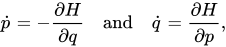
Symplectic integrators are designed for the numerical solution of Hamilton's equations, which read where denotes the position coordinates, the momentum coordinates, and is the Hamiltonian. The set of position and momentum coordinates are called canonical coordinates. (See Hamiltonian mechanics for more background.)


The time evolution of Hamilton's equations is a symplectomorphism, meaning that it conserves the symplectic 2-form . A numerical scheme is a symplectic integrator if it also conserves this 2-form.

Symplectic integrators possess, as a conserved quantity, a Hamiltonian which is slightly perturbed from the original one. By virtue of these advantages, the SI scheme has been widely applied to the calculations of long-term evolution of chaotic Hamiltonian systems ranging from the Kepler problem to the classical and semi-classical simulations in molecular dynamics.
Most of the usual numerical methods, such as the primitive Euler scheme and the classical Runge–Kutta scheme, are not symplectic integrators.
A widely used class of symplectic integrators is formed by the splitting methods.
Assume that the Hamiltonian is separable, meaning that it can be written in the form
This happens frequently in Hamiltonian mechanics, with T being the kinetic energy and V the potential energy.
Hub AI
Symplectic integrator AI simulator
(@Symplectic integrator_simulator)
Symplectic integrator
In mathematics, a symplectic integrator (SI) is a numerical integration scheme for Hamiltonian systems. Symplectic integrators form the subclass of geometric integrators which, by definition, are canonical transformations. They are widely used in nonlinear dynamics, molecular dynamics, discrete element methods, accelerator physics, plasma physics, quantum physics, and celestial mechanics.
Symplectic integrators are designed for the numerical solution of Hamilton's equations, which read where denotes the position coordinates, the momentum coordinates, and is the Hamiltonian. The set of position and momentum coordinates are called canonical coordinates. (See Hamiltonian mechanics for more background.)
The time evolution of Hamilton's equations is a symplectomorphism, meaning that it conserves the symplectic 2-form . A numerical scheme is a symplectic integrator if it also conserves this 2-form.
Symplectic integrators possess, as a conserved quantity, a Hamiltonian which is slightly perturbed from the original one. By virtue of these advantages, the SI scheme has been widely applied to the calculations of long-term evolution of chaotic Hamiltonian systems ranging from the Kepler problem to the classical and semi-classical simulations in molecular dynamics.
Most of the usual numerical methods, such as the primitive Euler scheme and the classical Runge–Kutta scheme, are not symplectic integrators.
A widely used class of symplectic integrators is formed by the splitting methods.
Assume that the Hamiltonian is separable, meaning that it can be written in the form
This happens frequently in Hamiltonian mechanics, with T being the kinetic energy and V the potential energy.