
Recent from talks
Canonical transformation
Knowledge base stats:
Talk channels stats:
Members stats:
Canonical transformation
In Hamiltonian mechanics, a canonical transformation is a change of canonical coordinates (q, p) → (Q, P) that preserves the form of Hamilton's equations. This is sometimes known as form invariance. Although Hamilton's equations are preserved, it need not preserve the explicit form of the Hamiltonian itself. Canonical transformations are useful in their own right, and also form the basis for the Hamilton–Jacobi equations (a useful method for calculating conserved quantities) and Liouville's theorem (itself the basis for classical statistical mechanics).
Since Lagrangian mechanics is based on generalized coordinates, transformations of the coordinates q → Q do not affect the form of Lagrange's equations and, hence, do not affect the form of Hamilton's equations if the momentum is simultaneously changed by a Legendre transformation into where are the new co‑ordinates, grouped in canonical conjugate pairs of momenta and corresponding positions for with being the number of degrees of freedom in both co‑ordinate systems.






Therefore, coordinate transformations (also called point transformations) are a type of canonical transformation. However, the class of canonical transformations is much broader, since the old generalized coordinates, momenta and even time may be combined to form the new generalized coordinates and momenta. Canonical transformations that do not include the time explicitly are called restricted canonical transformations (many textbooks consider only this type).
Modern mathematical descriptions of canonical transformations are considered under the broader topic of symplectomorphism which covers the subject with advanced mathematical prerequisites such as cotangent bundles, exterior derivatives and symplectic manifolds.
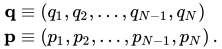
Boldface variables such as q represent a list of N generalized coordinates that need not transform like a vector under rotation and similarly p represents the corresponding generalized momentum, e.g.,
A dot over a variable or list signifies the time derivative, e.g., and the equalities are read to be satisfied for all coordinates, for example:


The dot product notation between two lists of the same number of coordinates is a shorthand for the sum of the products of corresponding components, e.g.,
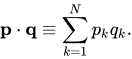
The dot product (also known as an "inner product") maps the two coordinate lists into one variable representing a single numerical value. The coordinates after transformation are similarly labelled with Q for transformed generalized coordinates and P for transformed generalized momentum.
Hub AI
Canonical transformation AI simulator
(@Canonical transformation_simulator)
Canonical transformation
In Hamiltonian mechanics, a canonical transformation is a change of canonical coordinates (q, p) → (Q, P) that preserves the form of Hamilton's equations. This is sometimes known as form invariance. Although Hamilton's equations are preserved, it need not preserve the explicit form of the Hamiltonian itself. Canonical transformations are useful in their own right, and also form the basis for the Hamilton–Jacobi equations (a useful method for calculating conserved quantities) and Liouville's theorem (itself the basis for classical statistical mechanics).
Since Lagrangian mechanics is based on generalized coordinates, transformations of the coordinates q → Q do not affect the form of Lagrange's equations and, hence, do not affect the form of Hamilton's equations if the momentum is simultaneously changed by a Legendre transformation into where are the new co‑ordinates, grouped in canonical conjugate pairs of momenta and corresponding positions for with being the number of degrees of freedom in both co‑ordinate systems.
Therefore, coordinate transformations (also called point transformations) are a type of canonical transformation. However, the class of canonical transformations is much broader, since the old generalized coordinates, momenta and even time may be combined to form the new generalized coordinates and momenta. Canonical transformations that do not include the time explicitly are called restricted canonical transformations (many textbooks consider only this type).
Modern mathematical descriptions of canonical transformations are considered under the broader topic of symplectomorphism which covers the subject with advanced mathematical prerequisites such as cotangent bundles, exterior derivatives and symplectic manifolds.
Boldface variables such as q represent a list of N generalized coordinates that need not transform like a vector under rotation and similarly p represents the corresponding generalized momentum, e.g.,
A dot over a variable or list signifies the time derivative, e.g., and the equalities are read to be satisfied for all coordinates, for example:
The dot product notation between two lists of the same number of coordinates is a shorthand for the sum of the products of corresponding components, e.g.,
The dot product (also known as an "inner product") maps the two coordinate lists into one variable representing a single numerical value. The coordinates after transformation are similarly labelled with Q for transformed generalized coordinates and P for transformed generalized momentum.