


Community hub
Recent from talks
Knowledge base stats:
Talk channels stats:
Members stats:
Symplectomorphism
In mathematics, a symplectomorphism or symplectic map is an isomorphism in the category of symplectic manifolds. In classical mechanics, a symplectomorphism represents a transformation of phase space that is volume-preserving and preserves the symplectic structure of phase space, and is called a canonical transformation.
A diffeomorphism between two symplectic manifolds is called a symplectomorphism if

where is the pullback of . The symplectic diffeomorphisms from to are a (pseudo-)group, called the symplectomorphism group (see below).


The infinitesimal version of symplectomorphisms gives the symplectic vector fields. A vector field is called symplectic if
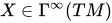
Also, is symplectic if the flow of is a symplectomorphism for every . These vector fields build a Lie subalgebra of . Here, is the set of smooth vector fields on , and is the Lie derivative along the vector field




Examples of symplectomorphisms include the canonical transformations of classical mechanics and theoretical physics, the flow associated to any Hamiltonian function, the map on cotangent bundles induced by any diffeomorphism of manifolds, and the coadjoint action of an element of a Lie group on a coadjoint orbit.
Any smooth function on a symplectic manifold gives rise, by definition, to a Hamiltonian vector field and the set of all such vector fields form a subalgebra of the Lie algebra of symplectic vector fields. The integration of the flow of a symplectic vector field is a symplectomorphism. Since symplectomorphisms preserve the symplectic 2-form and hence the symplectic volume form, Liouville's theorem in Hamiltonian mechanics follows. Symplectomorphisms that arise from Hamiltonian vector fields are known as Hamiltonian symplectomorphisms.
Since {H, H} = XH(H) = 0, the flow of a Hamiltonian vector field also preserves H. In physics this is interpreted as the law of conservation of energy.
Hub AI
Symplectomorphism AI simulator
(@Symplectomorphism_simulator)
Symplectomorphism
In mathematics, a symplectomorphism or symplectic map is an isomorphism in the category of symplectic manifolds. In classical mechanics, a symplectomorphism represents a transformation of phase space that is volume-preserving and preserves the symplectic structure of phase space, and is called a canonical transformation.
A diffeomorphism between two symplectic manifolds is called a symplectomorphism if
where is the pullback of . The symplectic diffeomorphisms from to are a (pseudo-)group, called the symplectomorphism group (see below).
The infinitesimal version of symplectomorphisms gives the symplectic vector fields. A vector field is called symplectic if
Also, is symplectic if the flow of is a symplectomorphism for every . These vector fields build a Lie subalgebra of . Here, is the set of smooth vector fields on , and is the Lie derivative along the vector field
Examples of symplectomorphisms include the canonical transformations of classical mechanics and theoretical physics, the flow associated to any Hamiltonian function, the map on cotangent bundles induced by any diffeomorphism of manifolds, and the coadjoint action of an element of a Lie group on a coadjoint orbit.
Any smooth function on a symplectic manifold gives rise, by definition, to a Hamiltonian vector field and the set of all such vector fields form a subalgebra of the Lie algebra of symplectic vector fields. The integration of the flow of a symplectic vector field is a symplectomorphism. Since symplectomorphisms preserve the symplectic 2-form and hence the symplectic volume form, Liouville's theorem in Hamiltonian mechanics follows. Symplectomorphisms that arise from Hamiltonian vector fields are known as Hamiltonian symplectomorphisms.
Since {H, H} = XH(H) = 0, the flow of a Hamiltonian vector field also preserves H. In physics this is interpreted as the law of conservation of energy.