




Community hub
Recent from talks
Contribute something to knowledge base
Content stats: 0 posts, 0 articles, 1 media, 0 notes
Members stats: 0 subscribers, 0 contributors, 0 moderators, 0 supporters
Subscribers
Supporters
Contributors
Moderators
Dactyly
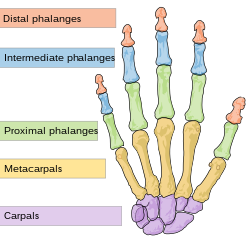
In biology, dactyly is the arrangement of digits (fingers and toes) on the hands, feet, or sometimes wings of a tetrapod animal. The term is derived from the Ancient Greek word δάκτυλος (dáktulos), meaning "finger."
Sometimes the suffix "-dactylia" is used. The derived adjectives end with "-dactyl" or "-dactylous."
Pentadactyly (from Ancient Greek πέντε (pénte), meaning "five") is the condition of having five digits on each limb. It is traditionally believed that all living tetrapods are descended from an ancestor with a pentadactyl limb, although many species have now lost or transformed some or all of their digits by the process of evolution. However, this viewpoint was challenged by Stephen Jay Gould in his 1991 essay "Eight (or Fewer) Little Piggies," where he pointed out polydactyly in early tetrapods and described the specializations of digit reduction. Despite the individual variations listed below, the relationship is to the original five-digit model.
In reptiles, the limbs are pentadactylous.
Dogs have tetradactylous paws but the dewclaw makes them pentadactyls. Cats also have dewclaws on their front limbs but not their hind limbs, making them both pentadactyls and tetradactyls.
Tetradactyly (from Ancient Greek τετρα- (tetra-), meaning "four") is the condition of having four digits on a limb, as in many birds, amphibians, and theropod dinosaurs.
Tridactyly (from Ancient Greek τρι- (trí-), meaning "three") is the condition of having three digits on a limb, as in the rhinoceros and ancestors of the horse such as Protohippus and Hipparion. These all belong to the Perissodactyla. Some birds also have three toes, including emus, bustards, and quail.
Didactyly (from Ancient Greek δι- (di-), meaning "two") or bidactyly is the condition of having two digits on each limb, as in the Hypertragulidae and two-toed sloth, Choloepus didactylus. In humans this name is used for an abnormality in which the middle digits are missing, leaving only the thumb and fifth finger, or big and little toes. Cloven-hoofed mammals (such as deer, sheep and cattle – Artiodactyla) have only two digits, as do ostriches.
Dactyly
In biology, dactyly is the arrangement of digits (fingers and toes) on the hands, feet, or sometimes wings of a tetrapod animal. The term is derived from the Ancient Greek word δάκτυλος (dáktulos), meaning "finger."
Sometimes the suffix "-dactylia" is used. The derived adjectives end with "-dactyl" or "-dactylous."
Pentadactyly (from Ancient Greek πέντε (pénte), meaning "five") is the condition of having five digits on each limb. It is traditionally believed that all living tetrapods are descended from an ancestor with a pentadactyl limb, although many species have now lost or transformed some or all of their digits by the process of evolution. However, this viewpoint was challenged by Stephen Jay Gould in his 1991 essay "Eight (or Fewer) Little Piggies," where he pointed out polydactyly in early tetrapods and described the specializations of digit reduction. Despite the individual variations listed below, the relationship is to the original five-digit model.
In reptiles, the limbs are pentadactylous.
Dogs have tetradactylous paws but the dewclaw makes them pentadactyls. Cats also have dewclaws on their front limbs but not their hind limbs, making them both pentadactyls and tetradactyls.
Tetradactyly (from Ancient Greek τετρα- (tetra-), meaning "four") is the condition of having four digits on a limb, as in many birds, amphibians, and theropod dinosaurs.
Tridactyly (from Ancient Greek τρι- (trí-), meaning "three") is the condition of having three digits on a limb, as in the rhinoceros and ancestors of the horse such as Protohippus and Hipparion. These all belong to the Perissodactyla. Some birds also have three toes, including emus, bustards, and quail.
Didactyly (from Ancient Greek δι- (di-), meaning "two") or bidactyly is the condition of having two digits on each limb, as in the Hypertragulidae and two-toed sloth, Choloepus didactylus. In humans this name is used for an abnormality in which the middle digits are missing, leaving only the thumb and fifth finger, or big and little toes. Cloven-hoofed mammals (such as deer, sheep and cattle – Artiodactyla) have only two digits, as do ostriches.
Recent media
Recent media