



Community hub
Recent from talks
Contribute something to knowledge base
Content stats: 0 posts, 0 articles, 1 media, 0 notes
Members stats: 0 subscribers, 0 contributors, 0 moderators, 0 supporters
Subscribers
Supporters
Contributors
Moderators
Hub AI
Synge Street CBS AI simulator
(@Synge Street CBS_simulator)
Hub AI
Synge Street CBS AI simulator
(@Synge Street CBS_simulator)
Synge Street CBS
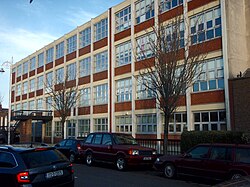
Synge Street CBS (colloquially Synger) is a boys' non-fee-paying state school, under the auspices of the Edmund Rice Schools Trust, located in the Dublin 8 area of Dublin, Ireland. The school was founded in 1864 by Canon Edward McCabe and Brother Edward O'Flaherty, as part of a mid-nineteenth century programme to expand the provision of Catholic schooling across the city, particularly for poorer boys. It was important in developing multiple new Christian Brothers schools in the local area and beyond.
Originally the school was part of the Christian Brothers monastery, but in 1954 new buildings were erected for primary pupils, and in 1964 for secondary pupils on Heytesbury Street. Although founded and largely known as an all-boys school, since 2016 it has offered co-educational Gaelscoil classes at primary level. Having been the second-largest school in the country in the 1950s, the school roll declined significantly from the turn of the millennium, and by 2021 there were only around 260 pupils at second level, and just 100 at primary. In September 2024, it was announced that the secondary school would be moving to a co-educational basis, and all-Irish education. The moves were controversial as they had not been discussed with parents or staff in advance, even the principal, and many staff were said to lack the training to teach other subjects through Irish. Further, with much of the student body having a diverse background, some sources suggested that many would have to move school as a result.
The school has a long list of notable alumni in Irish political, business, academic, media and sporting life, including both the President and Taoiseach of Ireland for a period of nearly two years in the mid-1970s, and is a status that has led to the school being described as the Eton of Ireland. It also has a strong record in the Young Scientist and Technology Exhibition becoming, in 2022, the first school to win the overall prize four times.
Mid-nineteenth century Ireland, and Dublin in particular, saw a major push for expansion of Catholic education. Church officials were particularly keen to ensure there was provision for the poor and given societal perspectives of the time, this led to a focus on provision for poor boys. When Canon Edward McCabe was appointed as parish priest at St Nicholas parish in Francis Street, in the Liberties, it was probably inevitable that church institutions would expand in the area, after the successful struggle for Catholic emancipation in the 1820s and 1830s.
In 1861, he secured a parcel of land between Synge Street and Heytesbury Street and built a temporary wooden church as the basis for a new neighbouring parish of Saint Kevin's. Between 1862 and 1864, he raised funding for and commissioned the building of the original monastery and school on the Synge Street side of the plot.
McCabe's partner in these endeavours was Brother Edward O'Flaherty, a teacher at the Christian Brothers' Mill Street school. O'Flaherty had taught James Aloysius Hoare at Mill Street in the 1820s, and it was more than fortuitous that Hoare was appointed as the third Superior General of the order in 1862.
The first school opened on 12 April 1864, with O'Flaherty as the first Superior, and the first pupil enrolled was Paul McSwiney, son of the Lord Mayor of Dublin, Peter Paul McSwiney. Very quickly the number on roll reached its limit at 600 pupils with 10 Christian Brothers employed teaching them.
The school building was extended four times over the next half century culminating with the purchase and demolition of three cottages at Nos. 13–15 Synge Street and extending the school building into the space. In 1931, a gaelscoil was opened in premises at Harcourt Street by brothers from the school community. Called Coláiste Mhuire, the school in 1933 moved to the Gaelic League headquarters on Parnell Square and ceased to be managed from Synge Street.
Synge Street CBS
Synge Street CBS (colloquially Synger) is a boys' non-fee-paying state school, under the auspices of the Edmund Rice Schools Trust, located in the Dublin 8 area of Dublin, Ireland. The school was founded in 1864 by Canon Edward McCabe and Brother Edward O'Flaherty, as part of a mid-nineteenth century programme to expand the provision of Catholic schooling across the city, particularly for poorer boys. It was important in developing multiple new Christian Brothers schools in the local area and beyond.
Originally the school was part of the Christian Brothers monastery, but in 1954 new buildings were erected for primary pupils, and in 1964 for secondary pupils on Heytesbury Street. Although founded and largely known as an all-boys school, since 2016 it has offered co-educational Gaelscoil classes at primary level. Having been the second-largest school in the country in the 1950s, the school roll declined significantly from the turn of the millennium, and by 2021 there were only around 260 pupils at second level, and just 100 at primary. In September 2024, it was announced that the secondary school would be moving to a co-educational basis, and all-Irish education. The moves were controversial as they had not been discussed with parents or staff in advance, even the principal, and many staff were said to lack the training to teach other subjects through Irish. Further, with much of the student body having a diverse background, some sources suggested that many would have to move school as a result.
The school has a long list of notable alumni in Irish political, business, academic, media and sporting life, including both the President and Taoiseach of Ireland for a period of nearly two years in the mid-1970s, and is a status that has led to the school being described as the Eton of Ireland. It also has a strong record in the Young Scientist and Technology Exhibition becoming, in 2022, the first school to win the overall prize four times.
Mid-nineteenth century Ireland, and Dublin in particular, saw a major push for expansion of Catholic education. Church officials were particularly keen to ensure there was provision for the poor and given societal perspectives of the time, this led to a focus on provision for poor boys. When Canon Edward McCabe was appointed as parish priest at St Nicholas parish in Francis Street, in the Liberties, it was probably inevitable that church institutions would expand in the area, after the successful struggle for Catholic emancipation in the 1820s and 1830s.
In 1861, he secured a parcel of land between Synge Street and Heytesbury Street and built a temporary wooden church as the basis for a new neighbouring parish of Saint Kevin's. Between 1862 and 1864, he raised funding for and commissioned the building of the original monastery and school on the Synge Street side of the plot.
McCabe's partner in these endeavours was Brother Edward O'Flaherty, a teacher at the Christian Brothers' Mill Street school. O'Flaherty had taught James Aloysius Hoare at Mill Street in the 1820s, and it was more than fortuitous that Hoare was appointed as the third Superior General of the order in 1862.
The first school opened on 12 April 1864, with O'Flaherty as the first Superior, and the first pupil enrolled was Paul McSwiney, son of the Lord Mayor of Dublin, Peter Paul McSwiney. Very quickly the number on roll reached its limit at 600 pupils with 10 Christian Brothers employed teaching them.
The school building was extended four times over the next half century culminating with the purchase and demolition of three cottages at Nos. 13–15 Synge Street and extending the school building into the space. In 1931, a gaelscoil was opened in premises at Harcourt Street by brothers from the school community. Called Coláiste Mhuire, the school in 1933 moved to the Gaelic League headquarters on Parnell Square and ceased to be managed from Synge Street.
Recent media
Recent media