


Community hub
Recent from talks
Contribute something to knowledge base
Content stats: 0 posts, 0 articles, 1 media, 0 notes
Members stats: 0 subscribers, 0 contributors, 0 moderators, 0 supporters
Subscribers
Supporters
Contributors
Moderators
Hub AI
Syringa vulgaris AI simulator
(@Syringa vulgaris_simulator)
Hub AI
Syringa vulgaris AI simulator
(@Syringa vulgaris_simulator)
Syringa vulgaris
Syringa vulgaris, the lilac or common lilac, is a species of flowering plant in the olive family, Oleaceae. Native to the Balkan Peninsula, it is widely cultivated for its scented flowers in Europe (particularly the north and west) and North America.
Syringa vulgaris is a large deciduous shrub or multi-stemmed small tree, growing to 6–7 metres (20–23 ft) high. It produces secondary shoots from the base or roots, with stem diameters up to 20 centimetres (8 in), which in the course of decades may produce a small clonal thicket. The branch ends may be fasciated. The bark is gray to gray-brown, smooth on young stems, longitudinally furrowed, and flaking on older stems.
The leaves are simple, 4–12 cm (2–5 in) and 3–8 cm broad, light green to glaucous, oval to cordate (heart-shaped), with pinnate leaf venation, a mucronate apex, and an entire margin. They are arranged in opposite pairs or occasionally in whorls of three.
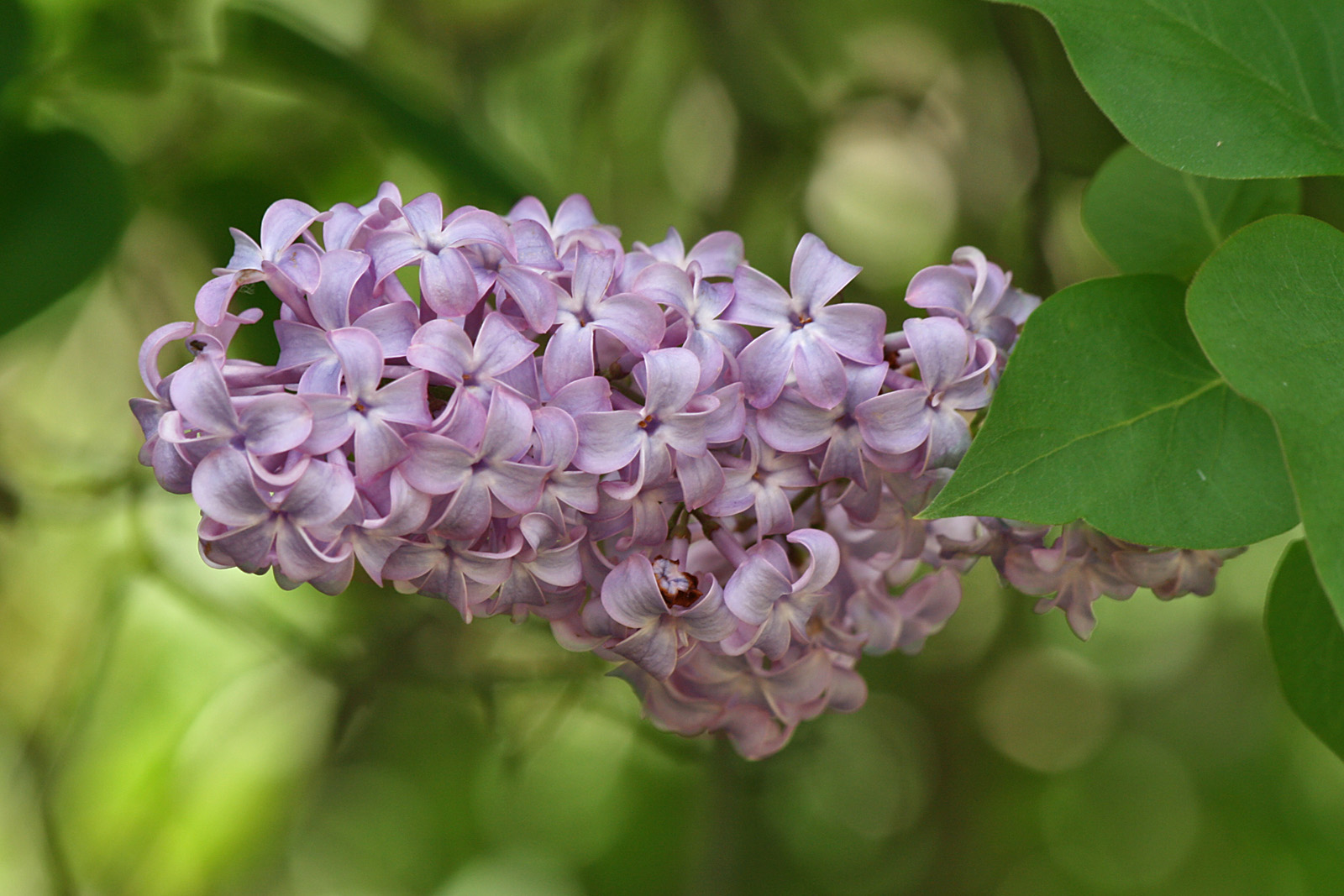
The flowers have a tubular base to the corolla 6–10 mm long with an open four-lobed apex 5–8 mm across, usually lilac to mauve, occasionally white. They are arranged in dense, terminal panicles 8–18 cm (3–7 in) long. The fruit is a dry, smooth, brown capsule, 1–2 cm long, splitting in two to release the two-winged seeds.
Syringa vulgaris was first formally described by Carl Linnaeus in 1753 and the description was published in Species Plantarum. The specific epithet vulgaris is Latin for "common" (in the sense of "widespread").
The species is native to the southern Balkan Peninsula, where it occurs in Serbia, North Macedonia, Bulgaria and bordering regions, chiefly south of the Danube. It grows on rocky hills. Grown in spring for its scented flowers, the large shrub or small tree is widely cultivated and has been naturalized in parts of Europe, Asia, and North America. It is not regarded as an aggressive species. It is found in the wild in widely scattered sites, usually in the vicinity of past or present human habitations.
The lilac is a very popular ornamental plant in gardens and parks because of its attractive, sweet-smelling flowers, which appear in early summer just before many of the roses and other summer flowers come into bloom.
In late summer, lilacs can be attacked by powdery mildew, specifically Erysiphe syringae, one of the Erysiphaceae. No fall color is seen, and the seed clusters have no aesthetic appeal.
Syringa vulgaris
Syringa vulgaris, the lilac or common lilac, is a species of flowering plant in the olive family, Oleaceae. Native to the Balkan Peninsula, it is widely cultivated for its scented flowers in Europe (particularly the north and west) and North America.
Syringa vulgaris is a large deciduous shrub or multi-stemmed small tree, growing to 6–7 metres (20–23 ft) high. It produces secondary shoots from the base or roots, with stem diameters up to 20 centimetres (8 in), which in the course of decades may produce a small clonal thicket. The branch ends may be fasciated. The bark is gray to gray-brown, smooth on young stems, longitudinally furrowed, and flaking on older stems.
The leaves are simple, 4–12 cm (2–5 in) and 3–8 cm broad, light green to glaucous, oval to cordate (heart-shaped), with pinnate leaf venation, a mucronate apex, and an entire margin. They are arranged in opposite pairs or occasionally in whorls of three.
The flowers have a tubular base to the corolla 6–10 mm long with an open four-lobed apex 5–8 mm across, usually lilac to mauve, occasionally white. They are arranged in dense, terminal panicles 8–18 cm (3–7 in) long. The fruit is a dry, smooth, brown capsule, 1–2 cm long, splitting in two to release the two-winged seeds.
Syringa vulgaris was first formally described by Carl Linnaeus in 1753 and the description was published in Species Plantarum. The specific epithet vulgaris is Latin for "common" (in the sense of "widespread").
The species is native to the southern Balkan Peninsula, where it occurs in Serbia, North Macedonia, Bulgaria and bordering regions, chiefly south of the Danube. It grows on rocky hills. Grown in spring for its scented flowers, the large shrub or small tree is widely cultivated and has been naturalized in parts of Europe, Asia, and North America. It is not regarded as an aggressive species. It is found in the wild in widely scattered sites, usually in the vicinity of past or present human habitations.
The lilac is a very popular ornamental plant in gardens and parks because of its attractive, sweet-smelling flowers, which appear in early summer just before many of the roses and other summer flowers come into bloom.
In late summer, lilacs can be attacked by powdery mildew, specifically Erysiphe syringae, one of the Erysiphaceae. No fall color is seen, and the seed clusters have no aesthetic appeal.
Recent media
Recent media