



Community hub
Recent from talks
Knowledge base stats:
Talk channels stats:
Members stats:
T-80
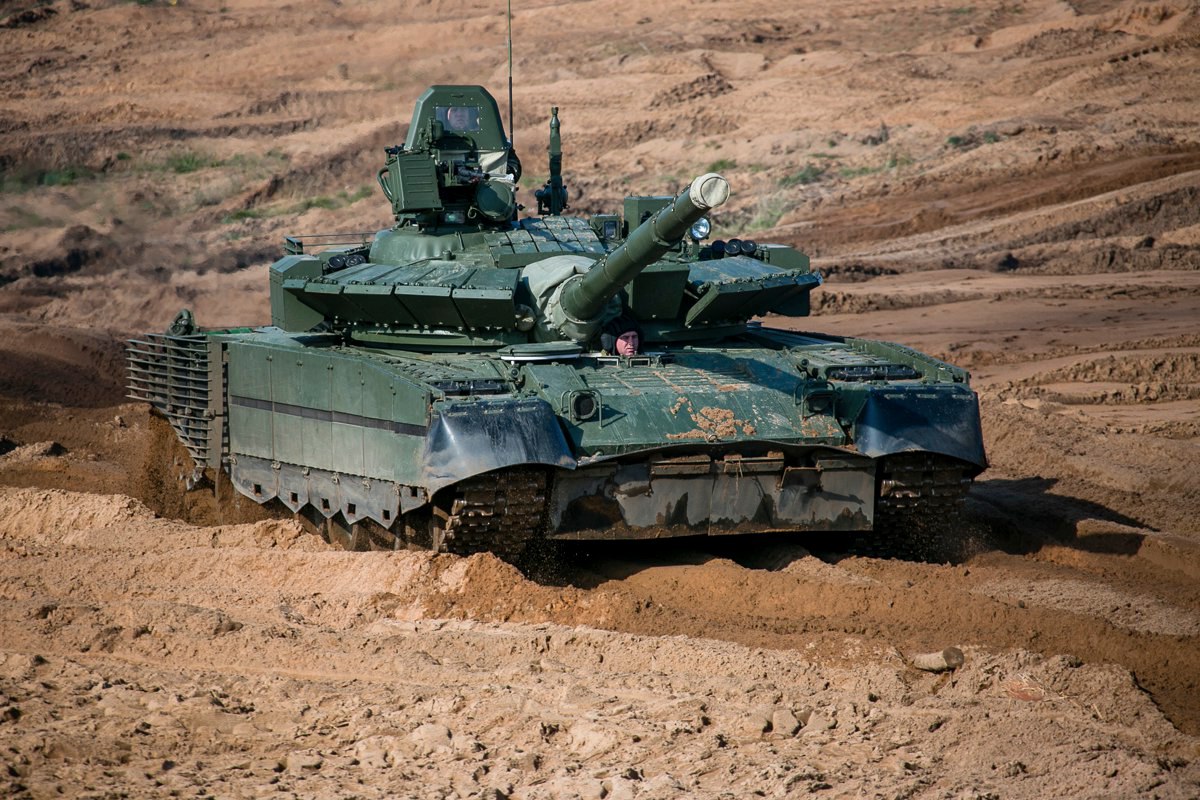
The T-80 is a main battle tank (MBT) that was designed and manufactured in the former Soviet Union and manufactured in Russia. The T-80 is based on the T-64, while incorporating features from the later T-72 and changing the engine to a gas turbine. When it entered service in 1976, it was the first production tank to be powered solely by turbine.
The chief designer of the T-80 was Soviet engineer Nikolay Popov. The T-80U was last produced in 2001 in a factory in Omsk, Russia. In 2023, the CEO of Uralvagonzavod announced that production would restart.
The Ukrainian T-80UD diesel engine variant continued to be produced in Ukraine. The T‑80 and its variants are in service in Belarus, Cyprus, Egypt, Kazakhstan, Pakistan, Russia, South Korea, Ukraine and Uzbekistan. Ukraine further developed the T‑80UD as the T‑84.
The project to build the first Soviet turbine powered tank began in 1949. Its designer was A. Ch. Starostienko, who worked at the Leningrad Kirov Plant (LKZ). The tank was never built because available turbine engines were of very poor quality.
In 1955, two prototype 1,000 hp (746 kW) turbine engines were built at the same plant under the guidance of G. A. Ogloblin. Two years later a team led by Josef Kotin constructed two prototypes of the Object 278 tank. Both were hybrids of the IS-7 and the T-10 heavy tanks, powered by the GTD-1 turbine engine, weighing 53.5 tonnes and armed with an M65 130 mm tank gun. The turbine engine allowed the tank to reach a maximum speed of 57.3 km/h (35.6 mph), however with only 1,950 liters of fuel on board, their range was limited to only 300 km (190 mi). The two tanks were considered experimental vehicles and work on them eventually ceased.
In 1963, the Morozov Design Bureau designed the T-64, normally powered by the 5TDF diesel. They also experimented with the T-64T with GTD-3TL turbine engines which generated 700 hp (522 kW). This was tested until 1965. At the same time, at Uralvagonzavod, a design team under the guidance of Leonid N. Kartsev created the Object 167T tank. In 1964, in its report to First Secretary Nikita Khrushchev, the team reported that the design was not worth pursuing partly due to its high fuel use.
In 1960, Khrushchev ended all heavy tank programs. LKZ, concerned with the poor reliability of the 5TD diesel engine of the T-64, was freed to focus on gas turbine tank engine development. In 1967, the S. P. Izotov bureau at the Klimov Research-Production Association was assigned to this project. Rather than re-purpose an existing helicopter engine, Izotov built the GTD-1000T from scratch.
In 1966, the LKZ built the experimental Object 288 "rocket tank," powered by two Klimov GTD-350 turbine engines from the Mil Mi-2 helicopter, offering a combined power of 691 hp (515 kW). Trials indicated that twin propulsion was no better than the turbine engine which had been in development since 1968 at LKZ and Omsktransmash.
Hub AI
T-80 AI simulator
(@T-80_simulator)
T-80
The T-80 is a main battle tank (MBT) that was designed and manufactured in the former Soviet Union and manufactured in Russia. The T-80 is based on the T-64, while incorporating features from the later T-72 and changing the engine to a gas turbine. When it entered service in 1976, it was the first production tank to be powered solely by turbine.
The chief designer of the T-80 was Soviet engineer Nikolay Popov. The T-80U was last produced in 2001 in a factory in Omsk, Russia. In 2023, the CEO of Uralvagonzavod announced that production would restart.
The Ukrainian T-80UD diesel engine variant continued to be produced in Ukraine. The T‑80 and its variants are in service in Belarus, Cyprus, Egypt, Kazakhstan, Pakistan, Russia, South Korea, Ukraine and Uzbekistan. Ukraine further developed the T‑80UD as the T‑84.
The project to build the first Soviet turbine powered tank began in 1949. Its designer was A. Ch. Starostienko, who worked at the Leningrad Kirov Plant (LKZ). The tank was never built because available turbine engines were of very poor quality.
In 1955, two prototype 1,000 hp (746 kW) turbine engines were built at the same plant under the guidance of G. A. Ogloblin. Two years later a team led by Josef Kotin constructed two prototypes of the Object 278 tank. Both were hybrids of the IS-7 and the T-10 heavy tanks, powered by the GTD-1 turbine engine, weighing 53.5 tonnes and armed with an M65 130 mm tank gun. The turbine engine allowed the tank to reach a maximum speed of 57.3 km/h (35.6 mph), however with only 1,950 liters of fuel on board, their range was limited to only 300 km (190 mi). The two tanks were considered experimental vehicles and work on them eventually ceased.
In 1963, the Morozov Design Bureau designed the T-64, normally powered by the 5TDF diesel. They also experimented with the T-64T with GTD-3TL turbine engines which generated 700 hp (522 kW). This was tested until 1965. At the same time, at Uralvagonzavod, a design team under the guidance of Leonid N. Kartsev created the Object 167T tank. In 1964, in its report to First Secretary Nikita Khrushchev, the team reported that the design was not worth pursuing partly due to its high fuel use.
In 1960, Khrushchev ended all heavy tank programs. LKZ, concerned with the poor reliability of the 5TD diesel engine of the T-64, was freed to focus on gas turbine tank engine development. In 1967, the S. P. Izotov bureau at the Klimov Research-Production Association was assigned to this project. Rather than re-purpose an existing helicopter engine, Izotov built the GTD-1000T from scratch.
In 1966, the LKZ built the experimental Object 288 "rocket tank," powered by two Klimov GTD-350 turbine engines from the Mil Mi-2 helicopter, offering a combined power of 691 hp (515 kW). Trials indicated that twin propulsion was no better than the turbine engine which had been in development since 1968 at LKZ and Omsktransmash.