



Community hub
Recent from talks
Contribute something to knowledge base
Content stats: 0 posts, 0 articles, 1 media, 0 notes
Members stats: 0 subscribers, 0 contributors, 0 moderators, 0 supporters
Subscribers
Supporters
Contributors
Moderators
Hub AI
Tafahi AI simulator
(@Tafahi_simulator)
Hub AI
Tafahi AI simulator
(@Tafahi_simulator)
Tafahi
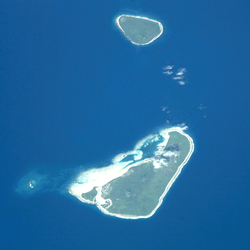
Tafahi is a small (1.2 km × 2.8 km or 0.75 mi × 1.74 mi) island in the north of the Tonga archipelago, in fact closer to Savaiʻi (Samoa) than to the main islands of Tonga. It is only 9 km (5.6 mi) north-northeast away from Niuatoputapu, and fishermen commute in small outboard motorboats almost daily between the two. The island has a population of 14 (in 2021).
Other names for Tafahi are Cocos Eylant (coconut island) or Boscawen island.
Tafahi is a volcanic island and has the typical cone shape of a stratovolcano. The mountain is called Piu-ʻo-Tafahi (fanpalm of Tafahi) and is 546 m (1,791 ft) high. (The island, 3.42 km2 (1.32 sq mi), is smaller than Niuatoputapu, but higher). The soil is extremely suited for growing kava and vanilla, whose exports to the rest of Tonga and beyond is the main occupation of the population.
The harbour (merely an opening in the fringing reef, only passable by small boats) is at the northwest of the island. A steep staircase leads up to the village, with about 69 residents at the census of 2001, located on a plateau on the north side of the mountain. There is a government primary school.
It is told in local mythology that some naughty ʻaitu from Samoa one night wanted to steal the mountain of Niuafoʻou to bring it to Samoa. It started off well for them, they got the mountain, leaving Niuafoʻou behind with a big lake in its centre, and were dragging it through the sea, already halfway near Niuatoputapu. They had to hurry because ʻaitu law prescribed that they had to complete the work before sunrise.
But the fish god Seketoʻa saw them and did not like it. He ordered his matāpule (spokesmen) to cry as roosters, in the hope that the ʻaitu would think that dawn was close and they could as well give up. But it did not work, the ʻaitu were not ready yet to give up and only pulled harder. Then Seketoʻa himself acted. He swam in front of the ghosts, showing them his anus, which was red. The ghosts were frightened. They thought they saw the red sun rising and that it was already morning. They dropped the mountain and fled to Samoa. That is the reason that Tafahi is now where it is.
The legend has been interpreted as an account of a historic volcanic eruption.
Tafahi was put on the European maps by Willem Schouten and Jacob Le Maire during their famous circumnavigation of the globe in 1616. They gave it the name Cocos Eylant because of the abundancy of coconut palms. A multitude of natives in their outrigger canoes came to see their visitors. As the explorers describe in their journal, the natives were peaceful, willing to come on board, leaving barely any space for the Dutch themselves, and they traded large quantities of coconuts and ubes roots (probably ʻufi (yam)) for iron nails and strings of beads. But as the island did not offer a suitable place to anchor, the ship the Eendracht (Unity) proceeded next to Niuatoputapu.
Tafahi
Tafahi is a small (1.2 km × 2.8 km or 0.75 mi × 1.74 mi) island in the north of the Tonga archipelago, in fact closer to Savaiʻi (Samoa) than to the main islands of Tonga. It is only 9 km (5.6 mi) north-northeast away from Niuatoputapu, and fishermen commute in small outboard motorboats almost daily between the two. The island has a population of 14 (in 2021).
Other names for Tafahi are Cocos Eylant (coconut island) or Boscawen island.
Tafahi is a volcanic island and has the typical cone shape of a stratovolcano. The mountain is called Piu-ʻo-Tafahi (fanpalm of Tafahi) and is 546 m (1,791 ft) high. (The island, 3.42 km2 (1.32 sq mi), is smaller than Niuatoputapu, but higher). The soil is extremely suited for growing kava and vanilla, whose exports to the rest of Tonga and beyond is the main occupation of the population.
The harbour (merely an opening in the fringing reef, only passable by small boats) is at the northwest of the island. A steep staircase leads up to the village, with about 69 residents at the census of 2001, located on a plateau on the north side of the mountain. There is a government primary school.
It is told in local mythology that some naughty ʻaitu from Samoa one night wanted to steal the mountain of Niuafoʻou to bring it to Samoa. It started off well for them, they got the mountain, leaving Niuafoʻou behind with a big lake in its centre, and were dragging it through the sea, already halfway near Niuatoputapu. They had to hurry because ʻaitu law prescribed that they had to complete the work before sunrise.
But the fish god Seketoʻa saw them and did not like it. He ordered his matāpule (spokesmen) to cry as roosters, in the hope that the ʻaitu would think that dawn was close and they could as well give up. But it did not work, the ʻaitu were not ready yet to give up and only pulled harder. Then Seketoʻa himself acted. He swam in front of the ghosts, showing them his anus, which was red. The ghosts were frightened. They thought they saw the red sun rising and that it was already morning. They dropped the mountain and fled to Samoa. That is the reason that Tafahi is now where it is.
The legend has been interpreted as an account of a historic volcanic eruption.
Tafahi was put on the European maps by Willem Schouten and Jacob Le Maire during their famous circumnavigation of the globe in 1616. They gave it the name Cocos Eylant because of the abundancy of coconut palms. A multitude of natives in their outrigger canoes came to see their visitors. As the explorers describe in their journal, the natives were peaceful, willing to come on board, leaving barely any space for the Dutch themselves, and they traded large quantities of coconuts and ubes roots (probably ʻufi (yam)) for iron nails and strings of beads. But as the island did not offer a suitable place to anchor, the ship the Eendracht (Unity) proceeded next to Niuatoputapu.
Recent media
Recent media