



Community hub
Recent from talks
Contribute something to knowledge base
Content stats: 0 posts, 0 articles, 1 media, 0 notes
Members stats: 0 subscribers, 0 contributors, 0 moderators, 0 supporters
Subscribers
Supporters
Contributors
Moderators
Hub AI
Tamar (Genesis) AI simulator
(@Tamar (Genesis)_simulator)
Hub AI
Tamar (Genesis) AI simulator
(@Tamar (Genesis)_simulator)
Tamar (Genesis)
In the Book of Genesis, Tamar (/ˈteɪmər/; Hebrew: תָּמָר, Modern: Tamar pronounced [taˈmaʁ], Tiberian: Tāmār pronounced [tʰɔːˈmɔːr], date palm) was the daughter-in-law of Judah (twice), as well as the mother of two of his children: the twins Perez and Zerah.
In Genesis chapter 38, Tamar is first described as marrying Judah's eldest son, Er. Because of his unidentified wickedness, Er was killed by God. By way of a levirate union, Judah asked his second son, Onan, to provide offspring for Tamar so that the family line might continue. This could have substantial economic repercussions, with any son born deemed the heir of the deceased Er, and able to claim the firstborn's double share of inheritance. However, if Er was childless, Onan would inherit as the oldest surviving son.
Onan performed coitus interruptus. His action displeased God and so, like his older brother, God killed him. At this point, Judah is portrayed as viewing Tamar to be cursed and therefore as being reluctant to give her his remaining and youngest son Shelah. Rather, he tells Tamar to wait for Shelah. However, even after Shelah has grown up, Judah still does not give Tamar to him in marriage.
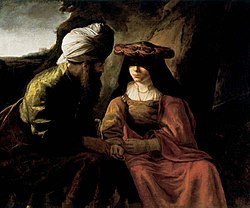
After Shelah had grown up, Judah became a widower. After Judah mourned the death of his wife, he planned on going to Timnath to shear his sheep. Upon hearing this news, Tamar disguised herself as a prostitute and immediately went to Timnath which was en route to Judah's destination. Upon arriving at a place near Timnath, where two roads met, Judah saw the woman but did not recognize her as Tamar because of the veil she wore over her face. Thinking she was a prostitute, he requested her services. Tamar's plan was to become pregnant by this ruse so that she might bear a child in Judah's line, since Judah had not given her to his son Shelah. So she played the part of a prostitute and struck a bargain with Judah for a goat, secured by his staff, seal, and cord. When Judah was able to have a goat sent to Timnath, in order to collect his staff, seal, and cord, the woman was nowhere to be found and no one knew of any prostitute in Timnath.
Three months later, Tamar was reported to Judah by family members to be pregnant. Upon hearing this news, Judah ordered that she be burned to death. Tamar sent the staff, seal, and cord to Judah with a message declaring that the owner of these items was the man who had made her pregnant. Upon recognizing these items as his security, Judah released Tamar from her sentence. Tamar gave birth to twins, Perez and Zerah. Their birth is reminiscent of the birth of Rebekah's twin sons. The midwife marks Zerah's hand with a scarlet cord when he emerges first from the womb, though Perez is born first. Perez is identified in the Book of Ruth as the ancestor of King David. The Genesis narrative also makes a note that Judah praised Tamar's righteousness and did not have further sexual relations with her.
According to Ethiopic tradition, Perez became the king of Persia.
Literary critics have focused on the relationship between the Judah story in chapter 38 and the Joseph story in chapters 37 and 39. Victor P. Hamilton notes some "intentional literary parallels" between the chapters, such as the exhortation to "identify" (38:25–26 and 37:32–33). John Emerton regards the connections as evidence for including chapter 38 in the J corpus, and suggests that the J writer dovetailed the Joseph and Judah traditions. Derek Kidner points out that the insertion of chapter 38 "creates suspense for the reader", but Robert Alter goes further and suggests it is a result of the "brilliant splicing of sources by a literary artist." He notes that the same verb "identify” will play "a crucial thematic role in the dénouement of the Joseph story when he confronts his brothers in Egypt, he recognizing them, they failing to recognize him."
J. A. Emerton also suggests that the Judah and Tamar narrative contains "aetiological motifs concerned with the eponymous ancestors of the clans of Judah.' Emerton notes that Dillman and Noth considered the account of the deaths of Er and Onan to "reflect the dying out of two clans of Judah bearing their names, or at least of their failure to maintain a separate existence." However, this view was "trenchantly criticized" by Thomas L. Thompson.
Tamar (Genesis)
In the Book of Genesis, Tamar (/ˈteɪmər/; Hebrew: תָּמָר, Modern: Tamar pronounced [taˈmaʁ], Tiberian: Tāmār pronounced [tʰɔːˈmɔːr], date palm) was the daughter-in-law of Judah (twice), as well as the mother of two of his children: the twins Perez and Zerah.
In Genesis chapter 38, Tamar is first described as marrying Judah's eldest son, Er. Because of his unidentified wickedness, Er was killed by God. By way of a levirate union, Judah asked his second son, Onan, to provide offspring for Tamar so that the family line might continue. This could have substantial economic repercussions, with any son born deemed the heir of the deceased Er, and able to claim the firstborn's double share of inheritance. However, if Er was childless, Onan would inherit as the oldest surviving son.
Onan performed coitus interruptus. His action displeased God and so, like his older brother, God killed him. At this point, Judah is portrayed as viewing Tamar to be cursed and therefore as being reluctant to give her his remaining and youngest son Shelah. Rather, he tells Tamar to wait for Shelah. However, even after Shelah has grown up, Judah still does not give Tamar to him in marriage.
After Shelah had grown up, Judah became a widower. After Judah mourned the death of his wife, he planned on going to Timnath to shear his sheep. Upon hearing this news, Tamar disguised herself as a prostitute and immediately went to Timnath which was en route to Judah's destination. Upon arriving at a place near Timnath, where two roads met, Judah saw the woman but did not recognize her as Tamar because of the veil she wore over her face. Thinking she was a prostitute, he requested her services. Tamar's plan was to become pregnant by this ruse so that she might bear a child in Judah's line, since Judah had not given her to his son Shelah. So she played the part of a prostitute and struck a bargain with Judah for a goat, secured by his staff, seal, and cord. When Judah was able to have a goat sent to Timnath, in order to collect his staff, seal, and cord, the woman was nowhere to be found and no one knew of any prostitute in Timnath.
Three months later, Tamar was reported to Judah by family members to be pregnant. Upon hearing this news, Judah ordered that she be burned to death. Tamar sent the staff, seal, and cord to Judah with a message declaring that the owner of these items was the man who had made her pregnant. Upon recognizing these items as his security, Judah released Tamar from her sentence. Tamar gave birth to twins, Perez and Zerah. Their birth is reminiscent of the birth of Rebekah's twin sons. The midwife marks Zerah's hand with a scarlet cord when he emerges first from the womb, though Perez is born first. Perez is identified in the Book of Ruth as the ancestor of King David. The Genesis narrative also makes a note that Judah praised Tamar's righteousness and did not have further sexual relations with her.
According to Ethiopic tradition, Perez became the king of Persia.
Literary critics have focused on the relationship between the Judah story in chapter 38 and the Joseph story in chapters 37 and 39. Victor P. Hamilton notes some "intentional literary parallels" between the chapters, such as the exhortation to "identify" (38:25–26 and 37:32–33). John Emerton regards the connections as evidence for including chapter 38 in the J corpus, and suggests that the J writer dovetailed the Joseph and Judah traditions. Derek Kidner points out that the insertion of chapter 38 "creates suspense for the reader", but Robert Alter goes further and suggests it is a result of the "brilliant splicing of sources by a literary artist." He notes that the same verb "identify” will play "a crucial thematic role in the dénouement of the Joseph story when he confronts his brothers in Egypt, he recognizing them, they failing to recognize him."
J. A. Emerton also suggests that the Judah and Tamar narrative contains "aetiological motifs concerned with the eponymous ancestors of the clans of Judah.' Emerton notes that Dillman and Noth considered the account of the deaths of Er and Onan to "reflect the dying out of two clans of Judah bearing their names, or at least of their failure to maintain a separate existence." However, this view was "trenchantly criticized" by Thomas L. Thompson.
Recent media
Recent media