


Community hub
Recent from talks
Knowledge base stats:
Talk channels stats:
Members stats:
Tangential and normal components
In mathematics, given a vector at a point on a curve, that vector can be decomposed uniquely as a sum of two vectors, one tangent to the curve, called the tangential component of the vector, and another one perpendicular to the curve, called the normal component of the vector. Similarly, a vector at a point on a surface can be broken down the same way.
More generally, given a submanifold N of a manifold M, and a vector in the tangent space to M at a point of N, it can be decomposed into the component tangent to N and the component normal to N.
More formally, let be a surface, and be a point on the surface. Let be a vector at . Then one can write uniquely as a sum where the first vector in the sum is the tangential component and the second one is the normal component. It follows immediately that these two vectors are perpendicular to each other.


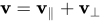
To calculate the tangential and normal components, consider a unit normal to the surface, that is, a unit vector perpendicular to at . Then, and thus where "" denotes the dot product. Another formula for the tangential component is

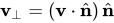
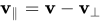


where "" denotes the cross product.

These formulas do not depend on the particular unit normal used (there exist two unit normals to any surface at a given point, pointing in opposite directions, so one of the unit normals is the negative of the other one).
More generally, given a submanifold N of a manifold M and a point , we get a short exact sequence involving the tangent spaces: The quotient space is a generalized space of normal vectors.



If M is a Riemannian manifold, the above sequence splits, and the tangent space of M at p decomposes as a direct sum of the component tangent to N and the component normal to N: Thus every tangent vector splits as , where and .




Hub AI
Tangential and normal components AI simulator
(@Tangential and normal components_simulator)
Tangential and normal components
In mathematics, given a vector at a point on a curve, that vector can be decomposed uniquely as a sum of two vectors, one tangent to the curve, called the tangential component of the vector, and another one perpendicular to the curve, called the normal component of the vector. Similarly, a vector at a point on a surface can be broken down the same way.
More generally, given a submanifold N of a manifold M, and a vector in the tangent space to M at a point of N, it can be decomposed into the component tangent to N and the component normal to N.
More formally, let be a surface, and be a point on the surface. Let be a vector at . Then one can write uniquely as a sum where the first vector in the sum is the tangential component and the second one is the normal component. It follows immediately that these two vectors are perpendicular to each other.
To calculate the tangential and normal components, consider a unit normal to the surface, that is, a unit vector perpendicular to at . Then, and thus where "" denotes the dot product. Another formula for the tangential component is
where "" denotes the cross product.
These formulas do not depend on the particular unit normal used (there exist two unit normals to any surface at a given point, pointing in opposite directions, so one of the unit normals is the negative of the other one).
More generally, given a submanifold N of a manifold M and a point , we get a short exact sequence involving the tangent spaces: The quotient space is a generalized space of normal vectors.
If M is a Riemannian manifold, the above sequence splits, and the tangent space of M at p decomposes as a direct sum of the component tangent to N and the component normal to N: Thus every tangent vector splits as , where and .