



Community hub
Recent from talks
Knowledge base stats:
Talk channels stats:
Members stats:
Landing craft tank
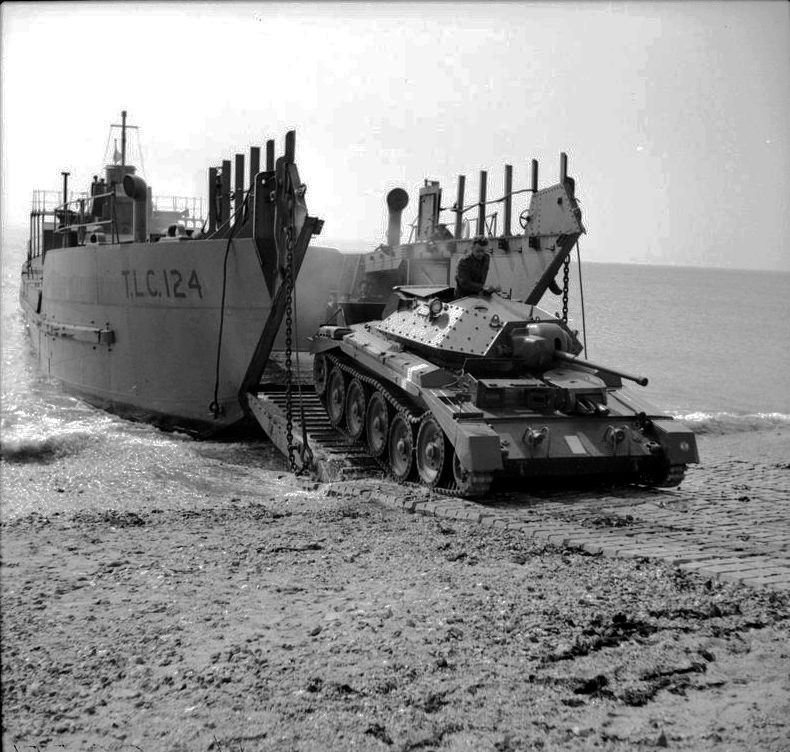
The Landing Craft, Tank (LCT) (or tank landing craft, TLC) was an amphibious assault craft for landing tanks on beachheads. They were initially developed by the Royal Navy and later by the United States Navy during World War II in a series of versions. Initially known as the "tank landing craft" (TLC) by the British, they later adopted the U.S. nomenclature "landing craft, tank" (LCT). The United States continued to build LCTs post-war, and used them under different designations in the Korean and Vietnam Wars.
In 1926, the first motor landing craft (MLC1) was built by the Royal Navy. It weighed 16 tons, with a draught of 6 feet 6 inches (1.98 m), and was capable of about 6 knots (11 km/h; 6.9 mph). It was later developed into the Landing Craft, Mechanised.
Let there be built great ships which can cast upon a beach, in any weather, large numbers of the heaviest tanks.
— Winston Churchill, Memo to War Department, 1940
It was at the insistence of the British prime minister Winston Churchill in mid-1940 that the LCT was created. Its speed was 10 knots (19 km/h; 12 mph) on engines delivering about 700 hp (520 kW). Designated the LCT Mark 1, 20 were ordered in July 1940 and a further 10 in October 1940.)
The first LCT Mark 1 was launched by Hawthorn Leslie, Hebburn on Tyne, in November 1940. It was designed to land three of the heaviest tanks (40t) then envisaged for the British Army in 2 ft 6ins of water on a 1:35 gradient beach. The load capacity was three 40-ton tanks, six 25-ton tanks or six 16-ton tanks. The forward draught was 3 feet forward and 5 feet 9 inches aft. They were designed on the same principle as a floating dock, with watertight side pontoons on each side joined by a tank deck set below the waterline. The tank deck swept up above the waterline near the bow before falling away again to the ramp. Engines were two Hall Scott Defender petrol engines of 500 hp each. The craft were arranged in four sections so they could be shipped to the Eastern Mediterranean as deck cargo on merchant ships. Thirty of these craft were ordered.
The LCT Mark 2 was longer and wider than the Mark 1, with three Napier Lion petrol engines replacing the Hall-Scotts as these were required for Coastal Forces craft. At 2,700 nautical miles (5,000 km; 3,100 mi), it had three times the range of its predecessor. Seventy-three Mk.2s were built. Increasing the beam of the Mk2 by 2 ft (0.61 m) allowed a much greater cargo capacity of lighter vehicles, where the Mk1 could only carry three Valentine tanks the Mark 2 could carry 7. The first craft were ordered in December 1940 and completed in March 1941. The craft was a little faster but three sets of running gear strained the supply position so later Mk2 had two Paxman diesel engines of 500 hp each. It was apparent now that LCTs would be required in huge numbers and ship builders would not have the capacity so structural steelwork firms were added to the program to prefabricate the structure and former shipyards reopened to assemble the craft. Like the Mark 1 the Mark 2 was assembled in four sections to facilitate shipping to Eastern Mediterranean.
At 192 feet (59 m) the Mark 3 was 32 feet (9.8 m) longer than the Mark 2. Although this meant extra weight, the vessel was slightly faster than the Mark 1. Two hundred and thirty-five Mk. 3s were built. The 32 ft section was added in May 1941 to the Mark 2 as a fifth building section, parallel sided. This meant the capacity went to 11 Valentines or 11 M4 Sherman medium tanks or 5 Churchill infantry tanks. 166 craft were built using two Paxman diesels, 71 were built in the winter of 1943-1944 to a slightly revised pattern using two Sterling Admiral petrol engines. These are usually referred to as Mark 3* or 7000 series as they had pennant numbers from 7000 upwards. LCT7074, currently preserved in Portsmouth, UK, is of this type.
Hub AI
Landing craft tank AI simulator
(@Landing craft tank_simulator)
Landing craft tank
The Landing Craft, Tank (LCT) (or tank landing craft, TLC) was an amphibious assault craft for landing tanks on beachheads. They were initially developed by the Royal Navy and later by the United States Navy during World War II in a series of versions. Initially known as the "tank landing craft" (TLC) by the British, they later adopted the U.S. nomenclature "landing craft, tank" (LCT). The United States continued to build LCTs post-war, and used them under different designations in the Korean and Vietnam Wars.
In 1926, the first motor landing craft (MLC1) was built by the Royal Navy. It weighed 16 tons, with a draught of 6 feet 6 inches (1.98 m), and was capable of about 6 knots (11 km/h; 6.9 mph). It was later developed into the Landing Craft, Mechanised.
Let there be built great ships which can cast upon a beach, in any weather, large numbers of the heaviest tanks.
— Winston Churchill, Memo to War Department, 1940
It was at the insistence of the British prime minister Winston Churchill in mid-1940 that the LCT was created. Its speed was 10 knots (19 km/h; 12 mph) on engines delivering about 700 hp (520 kW). Designated the LCT Mark 1, 20 were ordered in July 1940 and a further 10 in October 1940.)
The first LCT Mark 1 was launched by Hawthorn Leslie, Hebburn on Tyne, in November 1940. It was designed to land three of the heaviest tanks (40t) then envisaged for the British Army in 2 ft 6ins of water on a 1:35 gradient beach. The load capacity was three 40-ton tanks, six 25-ton tanks or six 16-ton tanks. The forward draught was 3 feet forward and 5 feet 9 inches aft. They were designed on the same principle as a floating dock, with watertight side pontoons on each side joined by a tank deck set below the waterline. The tank deck swept up above the waterline near the bow before falling away again to the ramp. Engines were two Hall Scott Defender petrol engines of 500 hp each. The craft were arranged in four sections so they could be shipped to the Eastern Mediterranean as deck cargo on merchant ships. Thirty of these craft were ordered.
The LCT Mark 2 was longer and wider than the Mark 1, with three Napier Lion petrol engines replacing the Hall-Scotts as these were required for Coastal Forces craft. At 2,700 nautical miles (5,000 km; 3,100 mi), it had three times the range of its predecessor. Seventy-three Mk.2s were built. Increasing the beam of the Mk2 by 2 ft (0.61 m) allowed a much greater cargo capacity of lighter vehicles, where the Mk1 could only carry three Valentine tanks the Mark 2 could carry 7. The first craft were ordered in December 1940 and completed in March 1941. The craft was a little faster but three sets of running gear strained the supply position so later Mk2 had two Paxman diesel engines of 500 hp each. It was apparent now that LCTs would be required in huge numbers and ship builders would not have the capacity so structural steelwork firms were added to the program to prefabricate the structure and former shipyards reopened to assemble the craft. Like the Mark 1 the Mark 2 was assembled in four sections to facilitate shipping to Eastern Mediterranean.
At 192 feet (59 m) the Mark 3 was 32 feet (9.8 m) longer than the Mark 2. Although this meant extra weight, the vessel was slightly faster than the Mark 1. Two hundred and thirty-five Mk. 3s were built. The 32 ft section was added in May 1941 to the Mark 2 as a fifth building section, parallel sided. This meant the capacity went to 11 Valentines or 11 M4 Sherman medium tanks or 5 Churchill infantry tanks. 166 craft were built using two Paxman diesels, 71 were built in the winter of 1943-1944 to a slightly revised pattern using two Sterling Admiral petrol engines. These are usually referred to as Mark 3* or 7000 series as they had pennant numbers from 7000 upwards. LCT7074, currently preserved in Portsmouth, UK, is of this type.