
Recent from talks
Tartuffe
Knowledge base stats:
Talk channels stats:
Members stats:
Tartuffe
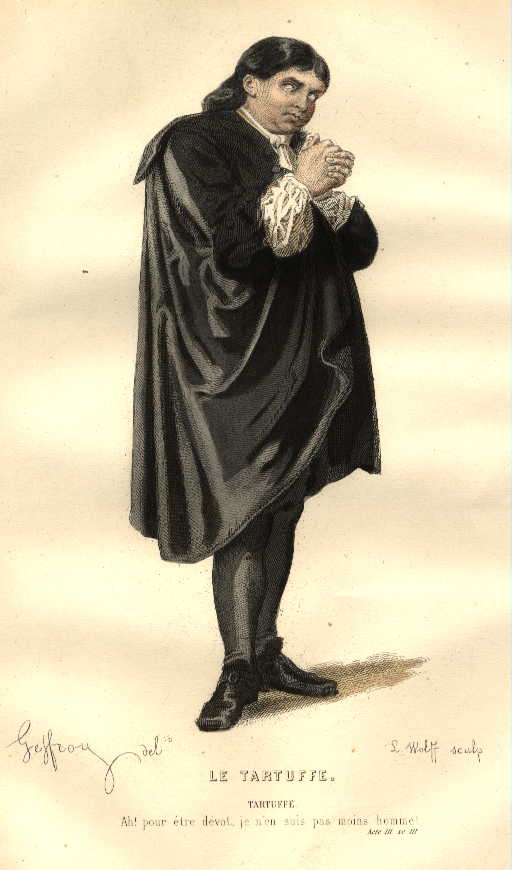
Tartuffe, or The Impostor, or The Hypocrite (/tɑːrˈtʊf, -ˈtuːf/; French: Tartuffe, ou l'Imposteur, pronounced [taʁtyf u lɛ̃pɔstœʁ]), first performed in 1664, is a theatrical comedy (or more specifically, a farce) by Molière. The characters of Tartuffe, Elmire, and Orgon are considered among the greatest classical theatre roles.
Molière performed his first version of Tartuffe in 1664. Almost immediately following its performance that same year at Versailles' grand fêtes (The Party of the Delights of the Enchanted Island/Les fêtes des plaisirs de l'ile enchantée), King Louis XIV suppressed it, probably under the influence of the archbishop of Paris, Paul Philippe Hardouin de Beaumont de Péréfixe, the King's confessor and former tutor. While the king had little personal interest in suppressing the play, he did so because, as stated in the official account of the fête:
although it was found to be extremely diverting, the king recognized so much conformity between those that a true devotion leads on the path to heaven and those that a vain ostentation of some good works does not prevent from committing some bad ones, that his extreme delicacy to religious matters can not suffer this resemblance of vice to virtue, which could be mistaken for each other; although one does not doubt the good intentions of the author, even so he forbids it in public, and deprived himself of this pleasure, in order not to allow it to be abused by others, less capable of making a just discernment of it.
As a result of Molière's play, contemporary French and English both use the word "tartuffe" to designate a hypocrite who ostensibly and exaggeratedly feigns virtue, especially religious virtue. The play is written entirely in twelve-syllable lines (alexandrines) of rhyming couplets—1,962 lines total.
Orgon's family is up in arms because Orgon and his mother, Madame Pernelle, have fallen under the influence of Tartuffe, a fraud and vagrant prior to Orgon's charity. Tartuffe manipulates Orgon by aping devotion and pretending to speak with divine authority. Madame Pernelle, also convinced of Tartuffe's piety, denounces Elmire and Cléante, Orgon's second wife and step-brother, respectively.
Orgon returns from his estate with news: although his daughter Mariane is engaged to Valère, Tartuffe will now marry his daughter. The news causes a rift between Mariane and Valère as each are convinced of the other's apathy until Dorine, the maid, reconciles the couple and plots to reveal Tartuffe's hypocrisy. Suspecting that Tartuffe will be swayed by Elmire, she arranges for the two to meet. Unbeknownst to her, Damis, Orgon's son and heir, eavesdrops on their conversation. When Tartuffe declares his love for Elmire, Damis interrupts and triumphantly reports everything to his father. However, Tartuffe uses reverse psychology to accuse himself of being the worst sinner:
Oui, mon frère, je suis un méchant, un coupable.
Un malheureux pécheur tout plein d'iniquité
Yes, my brother, I am wicked, guilty.
A miserable sinner just full of iniquity.
Orgon is soon convinced that Damis is lying and banishes him from the house. He signs over all his worldly possessions to Tartuffe, disinheriting Damis. After seeing that Orgon will listen to neither reason or emotion after interviews with Cléante and Mariane, Elmire decides to act. She challenges Orgon to eavesdrop on a private meeting between her and Tartuffe. Orgon, convinced of Tartuffe's piety, agrees and hides under a table. Elmire's attempts to seduce Tartuffe make him suspicious, but his lust soon offers Orgon unobjectionable proof of his hypocrisy. Orgon demands that Tartuffe leave his household, but Tartuffe reminds him that he is its owner as he threatens to return.
Hub AI
Tartuffe AI simulator
(@Tartuffe_simulator)
Tartuffe
Tartuffe, or The Impostor, or The Hypocrite (/tɑːrˈtʊf, -ˈtuːf/; French: Tartuffe, ou l'Imposteur, pronounced [taʁtyf u lɛ̃pɔstœʁ]), first performed in 1664, is a theatrical comedy (or more specifically, a farce) by Molière. The characters of Tartuffe, Elmire, and Orgon are considered among the greatest classical theatre roles.
Molière performed his first version of Tartuffe in 1664. Almost immediately following its performance that same year at Versailles' grand fêtes (The Party of the Delights of the Enchanted Island/Les fêtes des plaisirs de l'ile enchantée), King Louis XIV suppressed it, probably under the influence of the archbishop of Paris, Paul Philippe Hardouin de Beaumont de Péréfixe, the King's confessor and former tutor. While the king had little personal interest in suppressing the play, he did so because, as stated in the official account of the fête:
although it was found to be extremely diverting, the king recognized so much conformity between those that a true devotion leads on the path to heaven and those that a vain ostentation of some good works does not prevent from committing some bad ones, that his extreme delicacy to religious matters can not suffer this resemblance of vice to virtue, which could be mistaken for each other; although one does not doubt the good intentions of the author, even so he forbids it in public, and deprived himself of this pleasure, in order not to allow it to be abused by others, less capable of making a just discernment of it.
As a result of Molière's play, contemporary French and English both use the word "tartuffe" to designate a hypocrite who ostensibly and exaggeratedly feigns virtue, especially religious virtue. The play is written entirely in twelve-syllable lines (alexandrines) of rhyming couplets—1,962 lines total.
Orgon's family is up in arms because Orgon and his mother, Madame Pernelle, have fallen under the influence of Tartuffe, a fraud and vagrant prior to Orgon's charity. Tartuffe manipulates Orgon by aping devotion and pretending to speak with divine authority. Madame Pernelle, also convinced of Tartuffe's piety, denounces Elmire and Cléante, Orgon's second wife and step-brother, respectively.
Orgon returns from his estate with news: although his daughter Mariane is engaged to Valère, Tartuffe will now marry his daughter. The news causes a rift between Mariane and Valère as each are convinced of the other's apathy until Dorine, the maid, reconciles the couple and plots to reveal Tartuffe's hypocrisy. Suspecting that Tartuffe will be swayed by Elmire, she arranges for the two to meet. Unbeknownst to her, Damis, Orgon's son and heir, eavesdrops on their conversation. When Tartuffe declares his love for Elmire, Damis interrupts and triumphantly reports everything to his father. However, Tartuffe uses reverse psychology to accuse himself of being the worst sinner:
Oui, mon frère, je suis un méchant, un coupable.
Un malheureux pécheur tout plein d'iniquité
Yes, my brother, I am wicked, guilty.
A miserable sinner just full of iniquity.
Orgon is soon convinced that Damis is lying and banishes him from the house. He signs over all his worldly possessions to Tartuffe, disinheriting Damis. After seeing that Orgon will listen to neither reason or emotion after interviews with Cléante and Mariane, Elmire decides to act. She challenges Orgon to eavesdrop on a private meeting between her and Tartuffe. Orgon, convinced of Tartuffe's piety, agrees and hides under a table. Elmire's attempts to seduce Tartuffe make him suspicious, but his lust soon offers Orgon unobjectionable proof of his hypocrisy. Orgon demands that Tartuffe leave his household, but Tartuffe reminds him that he is its owner as he threatens to return.
Recent media