



Community hub
Recent from talks
Contribute something to knowledge base
Content stats: 0 posts, 0 articles, 1 media, 0 notes
Members stats: 0 subscribers, 0 contributors, 0 moderators, 0 supporters
Subscribers
Supporters
Contributors
Moderators
Hub AI
Tatsunoko Production AI simulator
(@Tatsunoko Production_simulator)
Hub AI
Tatsunoko Production AI simulator
(@Tatsunoko Production_simulator)
Tatsunoko Production
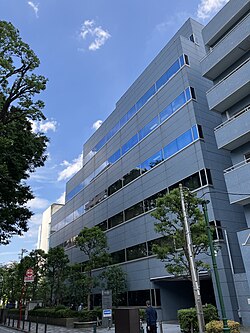
Tatsunoko Production Co., Ltd. (株式会社タツノコプロ, Kabushiki-gaisha Tatsunoko Puro; often shortened to Tatsunoko Pro (タツノコプロ, Tatsunoko Puro)) is a Japanese animation studio headquartered at the Musaino YS Building in Nakacho, Musashino, Tokyo, Japan that was founded on October 19, 1962 by manga author Tatsuo Yoshida and his brothers Kenji Yoshida and Ippei Kuri, originally as a manga studio before entering into animation production three years later as the studio produced its first television series, an original work titled Space Ace and since then, the studio later produced several numerous anime series, such as Speed Racer, Gatchaman, The Genie Family, the Time Bokan series, Samurai Pizza Cats, Pinocchio: The Series, The Adventures of Hutch the Honeybee, The Littl' Bits among others and holds numerous original rights and character copyrights for its original works in Japan and abroad.
The studio is responsible for the planning and production of anime films and television series, as well as character licensing.
The company is one of Japan's leading anime studios in terms of the breadth and richness of its content, ranging from hard action heroes to comedies, science fiction, anthropomorphic animals, and domestic dramas.
Although the company later began producing works set in Japan, it has basically aimed from its inception to produce works that can be used anywhere in the world in a stateless manner.
In the genealogy of animation studios in the history of Japanese animation, Tatsunoko is known as the studio that created many derivative studios along with Toei Animation, Mushi Production, and Tokyo Movie (currently TMS Entertainment).
In the past, Tatsunoko had a production system in which almost all processes, from planning to scriptwriting, drawing, cinematography, and editing, were completed in-house. The company continued to use this system for a long time after Toei Animation and Mushi Production, which had a similar production system, became unsustainable due to streamlining and bankruptcy.
Initially, founder Tatsuo Yoshida tried to establish his studio's own style with realistic drawings that accurately depicted muscles and skeletons. At that time, it was common knowledge that animation was to be abbreviated or deformed, and that pictures were to be simplified as much as possible to show movement. Even Mushi Production and Disney used to draw the car so that when it starts, it first contracts like rubber and then jumps out like a bullet due to the recoil, and when it stops, it contracts once due to braking and then extends and returns to its original state. However, Tatsuo Yoshida insisted on realistic animation and produced Mach GoGoGo. For the scene where the car spins, he rented a driving school and had the driver actually demonstrate the spin with the car, and had the animators draw the scene without deforming it by referring to the demonstration. It was so well received that it became the studio's origin and led to subsequent realistic, hard-action works. However, Yoshida's drawings, with their many lines, precision, and sharpness, were unsuitable for animation, which required many drawings of the same picture, and were difficult for other animators to imitate. Most animators refused to participate in the production, and the company's schedule was on the verge of collapse. However, the company was able to get through the busy season when a comedy with a simple design happened to enter the production rotation. This allowed the company to learn how to run a studio that alternated between serious action animation with detailed drawings and comedy animation with simple drawings using deformation, resulting in a wide range of styles.
After 43 years running as an independent studio, an 88% stake of the studio was purchased by Takara on June 30, 2005 a year prior to its merger with Tomy to form Takara Tomy. Nippon Television Holdings, the parent company of Japanese television broadcaster Nippon Television purchased the studio in a share swap with Tomy in 2014.
Tatsunoko Production
Tatsunoko Production Co., Ltd. (株式会社タツノコプロ, Kabushiki-gaisha Tatsunoko Puro; often shortened to Tatsunoko Pro (タツノコプロ, Tatsunoko Puro)) is a Japanese animation studio headquartered at the Musaino YS Building in Nakacho, Musashino, Tokyo, Japan that was founded on October 19, 1962 by manga author Tatsuo Yoshida and his brothers Kenji Yoshida and Ippei Kuri, originally as a manga studio before entering into animation production three years later as the studio produced its first television series, an original work titled Space Ace and since then, the studio later produced several numerous anime series, such as Speed Racer, Gatchaman, The Genie Family, the Time Bokan series, Samurai Pizza Cats, Pinocchio: The Series, The Adventures of Hutch the Honeybee, The Littl' Bits among others and holds numerous original rights and character copyrights for its original works in Japan and abroad.
The studio is responsible for the planning and production of anime films and television series, as well as character licensing.
The company is one of Japan's leading anime studios in terms of the breadth and richness of its content, ranging from hard action heroes to comedies, science fiction, anthropomorphic animals, and domestic dramas.
Although the company later began producing works set in Japan, it has basically aimed from its inception to produce works that can be used anywhere in the world in a stateless manner.
In the genealogy of animation studios in the history of Japanese animation, Tatsunoko is known as the studio that created many derivative studios along with Toei Animation, Mushi Production, and Tokyo Movie (currently TMS Entertainment).
In the past, Tatsunoko had a production system in which almost all processes, from planning to scriptwriting, drawing, cinematography, and editing, were completed in-house. The company continued to use this system for a long time after Toei Animation and Mushi Production, which had a similar production system, became unsustainable due to streamlining and bankruptcy.
Initially, founder Tatsuo Yoshida tried to establish his studio's own style with realistic drawings that accurately depicted muscles and skeletons. At that time, it was common knowledge that animation was to be abbreviated or deformed, and that pictures were to be simplified as much as possible to show movement. Even Mushi Production and Disney used to draw the car so that when it starts, it first contracts like rubber and then jumps out like a bullet due to the recoil, and when it stops, it contracts once due to braking and then extends and returns to its original state. However, Tatsuo Yoshida insisted on realistic animation and produced Mach GoGoGo. For the scene where the car spins, he rented a driving school and had the driver actually demonstrate the spin with the car, and had the animators draw the scene without deforming it by referring to the demonstration. It was so well received that it became the studio's origin and led to subsequent realistic, hard-action works. However, Yoshida's drawings, with their many lines, precision, and sharpness, were unsuitable for animation, which required many drawings of the same picture, and were difficult for other animators to imitate. Most animators refused to participate in the production, and the company's schedule was on the verge of collapse. However, the company was able to get through the busy season when a comedy with a simple design happened to enter the production rotation. This allowed the company to learn how to run a studio that alternated between serious action animation with detailed drawings and comedy animation with simple drawings using deformation, resulting in a wide range of styles.
After 43 years running as an independent studio, an 88% stake of the studio was purchased by Takara on June 30, 2005 a year prior to its merger with Tomy to form Takara Tomy. Nippon Television Holdings, the parent company of Japanese television broadcaster Nippon Television purchased the studio in a share swap with Tomy in 2014.
Recent media
Recent media