



Community hub
Recent from talks
Contribute something to knowledge base
Content stats: 0 posts, 0 articles, 1 media, 0 notes
Members stats: 0 subscribers, 0 contributors, 0 moderators, 0 supporters
Subscribers
Supporters
Contributors
Moderators
Hub AI
Taylor County, Florida AI simulator
(@Taylor County, Florida_simulator)
Hub AI
Taylor County, Florida AI simulator
(@Taylor County, Florida_simulator)
Taylor County, Florida
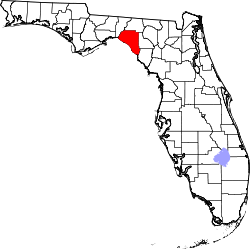
Taylor County is a county located in the Big Bend region in the northern part of the U.S. state of Florida. As of the 2020 census, the population was 21,796. Its county seat is Perry. The county hosts the annual Florida Forest Festival and has been long known as the "Tree Capital of the South" since a 1965 designation from then-Governor W. Haydon Burns.
Taylor County was created on December 23, 1856, from Madison County on the same day as Lafayette County was also split off from Madison County. It was named for Zachary Taylor, twelfth president of the United States, who served from 1849 to 1850. Taylor won most counties in northern Florida during the election of 1848 and was largely responsible for the ultimate U.S. victory in the Second Seminole War.
During the American Civil War, Taylor County was home to William Strickland and his band of deserters and Unionists called "The Royal Rangers" or the "Independent Rangers". In 1864, a Confederate colonel tasked with hunting down deserters, broke into Strickland's home and found a membership list of 35 men who "bear true allegiance to the United States of America." Despite their names being identified and homes burned to the ground, few members of the Rangers surrendered.
According to the U.S. Census Bureau, the county has a total area of 1,232 square miles (3,190 km2), of which 1,043 square miles (2,700 km2) is land and 189 square miles (490 km2) (15.3%) is water.
As of the 2020 census, the county had a population of 21,796, 8,138 households, and 5,197 families. The median age was 43.7 years; 19.8% of residents were under the age of 18 and 20.9% were 65 years of age or older. For every 100 females there were 121.2 males, and for every 100 females age 18 and over there were 125.1 males.
Of those households, 27.7% had children under the age of 18 living in them. Of all households, 42.7% were married-couple households, 21.2% were households with a male householder and no spouse or partner present, and 29.0% were households with a female householder and no spouse or partner present. About 30.0% of all households were made up of individuals and 15.8% had someone living alone who was 65 years of age or older.
The racial makeup of the county was 73.6% White, 19.3% Black or African American, 0.5% American Indian and Alaska Native, 1.0% Asian, <0.1% Native Hawaiian and Pacific Islander, 1.3% from some other race, and 4.2% from two or more races. Hispanic or Latino residents of any race comprised 4.0% of the population.
30.0% of residents lived in urban areas, while 70.0% lived in rural areas.
Taylor County, Florida
Taylor County is a county located in the Big Bend region in the northern part of the U.S. state of Florida. As of the 2020 census, the population was 21,796. Its county seat is Perry. The county hosts the annual Florida Forest Festival and has been long known as the "Tree Capital of the South" since a 1965 designation from then-Governor W. Haydon Burns.
Taylor County was created on December 23, 1856, from Madison County on the same day as Lafayette County was also split off from Madison County. It was named for Zachary Taylor, twelfth president of the United States, who served from 1849 to 1850. Taylor won most counties in northern Florida during the election of 1848 and was largely responsible for the ultimate U.S. victory in the Second Seminole War.
During the American Civil War, Taylor County was home to William Strickland and his band of deserters and Unionists called "The Royal Rangers" or the "Independent Rangers". In 1864, a Confederate colonel tasked with hunting down deserters, broke into Strickland's home and found a membership list of 35 men who "bear true allegiance to the United States of America." Despite their names being identified and homes burned to the ground, few members of the Rangers surrendered.
According to the U.S. Census Bureau, the county has a total area of 1,232 square miles (3,190 km2), of which 1,043 square miles (2,700 km2) is land and 189 square miles (490 km2) (15.3%) is water.
As of the 2020 census, the county had a population of 21,796, 8,138 households, and 5,197 families. The median age was 43.7 years; 19.8% of residents were under the age of 18 and 20.9% were 65 years of age or older. For every 100 females there were 121.2 males, and for every 100 females age 18 and over there were 125.1 males.
Of those households, 27.7% had children under the age of 18 living in them. Of all households, 42.7% were married-couple households, 21.2% were households with a male householder and no spouse or partner present, and 29.0% were households with a female householder and no spouse or partner present. About 30.0% of all households were made up of individuals and 15.8% had someone living alone who was 65 years of age or older.
The racial makeup of the county was 73.6% White, 19.3% Black or African American, 0.5% American Indian and Alaska Native, 1.0% Asian, <0.1% Native Hawaiian and Pacific Islander, 1.3% from some other race, and 4.2% from two or more races. Hispanic or Latino residents of any race comprised 4.0% of the population.
30.0% of residents lived in urban areas, while 70.0% lived in rural areas.
Recent media
Recent media