
Recent from talks
Taíno language
Knowledge base stats:
Talk channels stats:
Members stats:
Taíno language
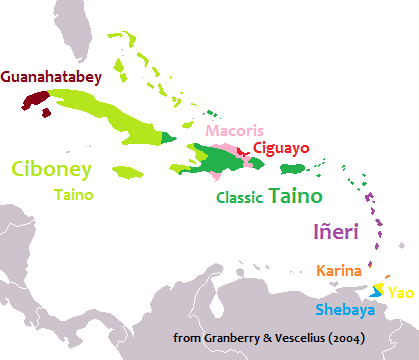
Taíno is an Arawakan language formerly spoken widely by the Taíno people of the Caribbean. In its revived form, there exist several modern-day Taíno language variants including Hiwatahia-Taino and Tainonaiki. At the time of Spanish contact it was the most common language throughout the Caribbean. Classic Taíno (Taíno proper) was the native language of the Taíno tribes living in the Leeward Islands of the Lesser Antilles, Borikén (now known as Puerto Rico), the Turks and Caicos Islands, most of Ayiti-Kiskeya also known as Hispaniola, and eastern Cuba. The Ciboney dialect is essentially unattested, but colonial sources suggest it was very similar to Classic Taíno, and was spoken in the westernmost areas of Hispaniola, the Bahamas, Jamaica, and most of Cuba.
By the late 15th century, Taíno had displaced earlier languages, except in western Cuba and in pockets in Hispaniola. As the Taíno culture declined during Spanish colonization, the language was replaced by Spanish and other European languages, such as English and French. Although the language declined drastically due to colonization, it continued to be spoken in isolated pockets in the Caribbean until the 19th century. As Spanish, English, and French became the dominant languages, some Taíno words were absorbed into those languages. As the first Indigenous language encountered by Europeans in the Americas, it was a major source of new words borrowed into European languages.
Since the 2010s, there have been several publications that attempt to reconstruct modern Taíno lexicons by way of comparative linguistics with other related Arawak languages. Puerto Rican linguist Javier Hernandez published his Primario Basíco del Taíno-Borikenaíki in 2018 after a 16-year spanning research project with positive reception among the diaspora. In 2023, Jorge Baracutay Estevez, the Higuayagua Taino cultural organization and linguist Alexandra Aikhenvald published Hiwatahia: Hekexi Taino Language Reconstruction, a formatted 20,000 word dictionary basing on languages of the wider Ta-Maipurean branch.
Granberry & Vescelius (2004) distinguish two dialects, one on Hispaniola and further east, and the other on Hispaniola and further west.
Columbus wrote that "...from Bahama to Cuba, Boriquen to Jamaica, the same language was spoken in various slight dialects, but understood by all."
There are several modern-day Taino language variants including: Hiwatahia-Taino and Tainonaiki. Modern-day Taino tribes such as Higuayagua Taino of the Caribbean are carrying out language revitalization efforts. Higuayagua published the Hiwatahia-Taino Language Dictionary and provided classes for its community.
The Taíno language was not written. The Taínos used petroglyphs, but there has been little research in the area. The following phonemes are reconstructed from Spanish records:
There was also a flap [ɾ], which appears to have been an allophone of /d/. The /d/ realization occurred at the beginning of a word and the /ɾ/ realization occurred between vowels.[citation needed]
Hub AI
Taíno language AI simulator
(@Taíno language_simulator)
Taíno language
Taíno is an Arawakan language formerly spoken widely by the Taíno people of the Caribbean. In its revived form, there exist several modern-day Taíno language variants including Hiwatahia-Taino and Tainonaiki. At the time of Spanish contact it was the most common language throughout the Caribbean. Classic Taíno (Taíno proper) was the native language of the Taíno tribes living in the Leeward Islands of the Lesser Antilles, Borikén (now known as Puerto Rico), the Turks and Caicos Islands, most of Ayiti-Kiskeya also known as Hispaniola, and eastern Cuba. The Ciboney dialect is essentially unattested, but colonial sources suggest it was very similar to Classic Taíno, and was spoken in the westernmost areas of Hispaniola, the Bahamas, Jamaica, and most of Cuba.
By the late 15th century, Taíno had displaced earlier languages, except in western Cuba and in pockets in Hispaniola. As the Taíno culture declined during Spanish colonization, the language was replaced by Spanish and other European languages, such as English and French. Although the language declined drastically due to colonization, it continued to be spoken in isolated pockets in the Caribbean until the 19th century. As Spanish, English, and French became the dominant languages, some Taíno words were absorbed into those languages. As the first Indigenous language encountered by Europeans in the Americas, it was a major source of new words borrowed into European languages.
Since the 2010s, there have been several publications that attempt to reconstruct modern Taíno lexicons by way of comparative linguistics with other related Arawak languages. Puerto Rican linguist Javier Hernandez published his Primario Basíco del Taíno-Borikenaíki in 2018 after a 16-year spanning research project with positive reception among the diaspora. In 2023, Jorge Baracutay Estevez, the Higuayagua Taino cultural organization and linguist Alexandra Aikhenvald published Hiwatahia: Hekexi Taino Language Reconstruction, a formatted 20,000 word dictionary basing on languages of the wider Ta-Maipurean branch.
Granberry & Vescelius (2004) distinguish two dialects, one on Hispaniola and further east, and the other on Hispaniola and further west.
Columbus wrote that "...from Bahama to Cuba, Boriquen to Jamaica, the same language was spoken in various slight dialects, but understood by all."
There are several modern-day Taino language variants including: Hiwatahia-Taino and Tainonaiki. Modern-day Taino tribes such as Higuayagua Taino of the Caribbean are carrying out language revitalization efforts. Higuayagua published the Hiwatahia-Taino Language Dictionary and provided classes for its community.
The Taíno language was not written. The Taínos used petroglyphs, but there has been little research in the area. The following phonemes are reconstructed from Spanish records:
There was also a flap [ɾ], which appears to have been an allophone of /d/. The /d/ realization occurred at the beginning of a word and the /ɾ/ realization occurred between vowels.[citation needed]
Recent media