


Community hub
Recent from talks
Contribute something to knowledge base
Content stats: 0 posts, 0 articles, 1 media, 0 notes
Members stats: 0 subscribers, 0 contributors, 0 moderators, 0 supporters
Subscribers
Supporters
Contributors
Moderators
Hub AI
Technology acceptance model AI simulator
(@Technology acceptance model_simulator)
Hub AI
Technology acceptance model AI simulator
(@Technology acceptance model_simulator)
Technology acceptance model
The technology acceptance model (TAM) is an information systems theory that models how users come to accept and use a technology.
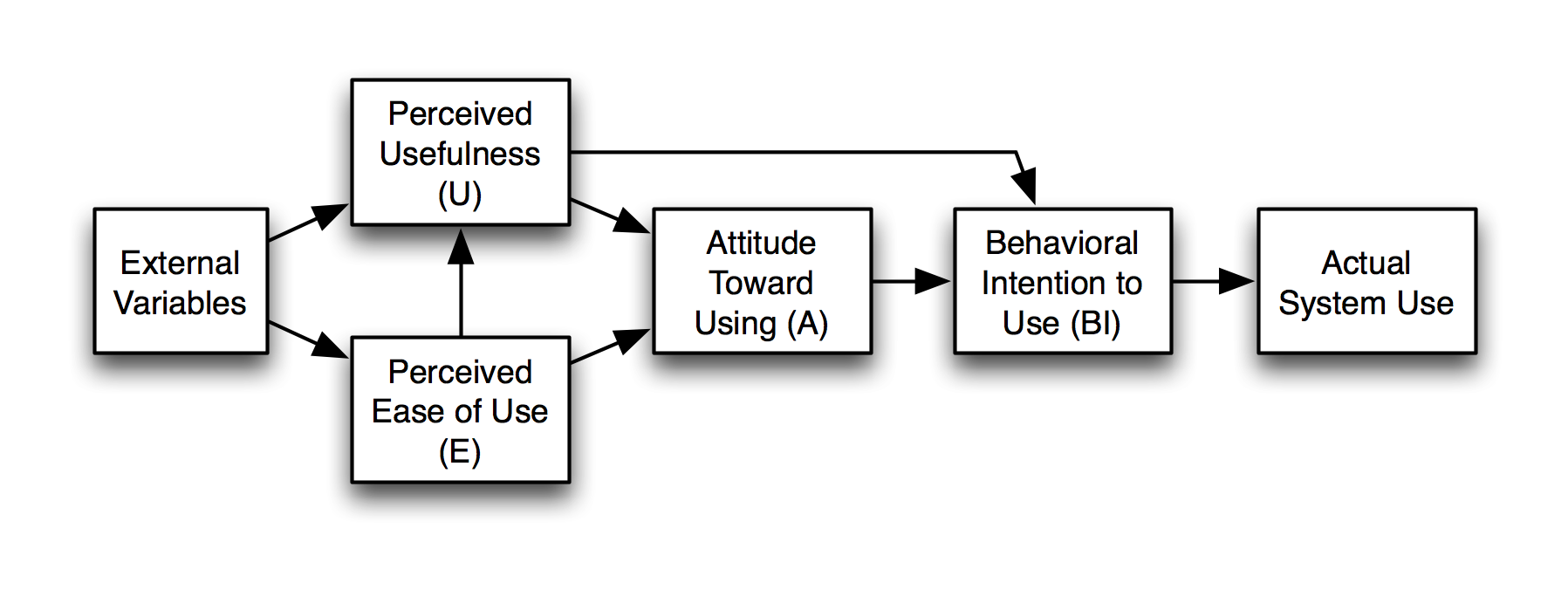
The actual system use is the end-point where people use the technology. Behavioral intention is a factor that leads people to use the technology. The behavioral intention (BI) is influenced by the attitude (A) which is the general impression of the technology.
The model suggests that when users are presented with a new technology, a number of factors influence their decision about how and when they will use it, notably:
External variables such as social influence is an important factor to determine the attitude. When these things (TAM) are in place, people will have the attitude and intention to use the technology. However, the perception may change depending on age and gender because everyone is different.
The TAM has been continuously studied and expanded—the two major upgrades being the TAM 2 and the unified theory of acceptance and use of technology (or UTAUT). A TAM 3 has also been proposed in the context of e-commerce with an inclusion of the effects of trust and perceived risk on system use.
TAM is one of the most influential extensions of Ajzen and Fishbein's theory of reasoned action (TRA) in the literature. Davis's technology acceptance model (Davis, 1989; Davis, Bagozzi, & Warshaw, 1989) is the most widely applied model of users' acceptance and usage of technology (Venkatesh, 2000). It was developed by Fred Davis and Richard Bagozzi. TAM replaces many of TRA's attitude measures with the two technology acceptance measures—ease of use, and usefulness. TRA and TAM, both of which have strong behavioural elements, assume that when someone forms an intention to act, that they will be free to act without limitation. In the real world there will be many constraints, such as limited freedom to act.
Bagozzi, Davis and Warshaw say:
Because new technologies such as personal computers are complex and an element of uncertainty exists in the minds of decision makers with respect to the successful adoption of them, people form attitudes and intentions toward trying to learn to use the new technology prior to initiating efforts directed at using. Attitudes towards usage and intentions to use may be ill-formed or lacking in conviction or else may occur only after preliminary strivings to learn to use the technology evolve. Thus, actual usage may not be a direct or immediate consequence of such attitudes and intentions.
Technology acceptance model
The technology acceptance model (TAM) is an information systems theory that models how users come to accept and use a technology.
The actual system use is the end-point where people use the technology. Behavioral intention is a factor that leads people to use the technology. The behavioral intention (BI) is influenced by the attitude (A) which is the general impression of the technology.
The model suggests that when users are presented with a new technology, a number of factors influence their decision about how and when they will use it, notably:
External variables such as social influence is an important factor to determine the attitude. When these things (TAM) are in place, people will have the attitude and intention to use the technology. However, the perception may change depending on age and gender because everyone is different.
The TAM has been continuously studied and expanded—the two major upgrades being the TAM 2 and the unified theory of acceptance and use of technology (or UTAUT). A TAM 3 has also been proposed in the context of e-commerce with an inclusion of the effects of trust and perceived risk on system use.
TAM is one of the most influential extensions of Ajzen and Fishbein's theory of reasoned action (TRA) in the literature. Davis's technology acceptance model (Davis, 1989; Davis, Bagozzi, & Warshaw, 1989) is the most widely applied model of users' acceptance and usage of technology (Venkatesh, 2000). It was developed by Fred Davis and Richard Bagozzi. TAM replaces many of TRA's attitude measures with the two technology acceptance measures—ease of use, and usefulness. TRA and TAM, both of which have strong behavioural elements, assume that when someone forms an intention to act, that they will be free to act without limitation. In the real world there will be many constraints, such as limited freedom to act.
Bagozzi, Davis and Warshaw say:
Because new technologies such as personal computers are complex and an element of uncertainty exists in the minds of decision makers with respect to the successful adoption of them, people form attitudes and intentions toward trying to learn to use the new technology prior to initiating efforts directed at using. Attitudes towards usage and intentions to use may be ill-formed or lacking in conviction or else may occur only after preliminary strivings to learn to use the technology evolve. Thus, actual usage may not be a direct or immediate consequence of such attitudes and intentions.
Recent media
Recent media