Recent from talks
Nothing was collected or created yet.
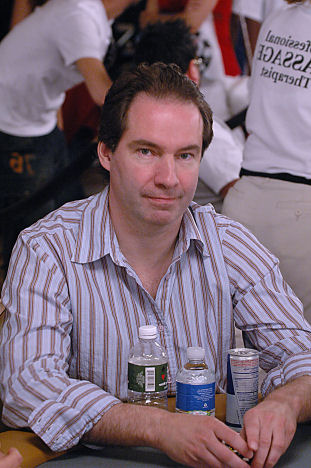
Ted Forrest
View on Wikipedia
Ted Forrest (born September 24, 1964) is an American professional poker player, currently residing in Las Vegas, Nevada.
Key Information
Tournament wins
[edit]In 1992, Forrest won two tournaments at the LA Poker Classic and one at the World Poker Finals in Mashantucket.[1][2][3] Forrest won three bracelets at the 1993 World Series of Poker (WSOP).[4][5][6] After the mid-1990s, Forrest turned his attention full-time to cash games. He made a triumphant return to the WSOP by winning two bracelets at the 2004 World Series of Poker.[7][8] Since then he has moved his focus from seven card stud to hold 'em with some success, including reaching five final tables on the World Poker Tour and winning a championship on the Professional Poker Tour.[9][10][11][12]
Forrest competed in the second season of Poker Superstars Invitational Tournament, where he advanced to the quarter-final stage.[13] He did not fare as well in season three, being mathematically eliminated early in the preliminaries. He played in the first two seasons of the GSN series High Stakes Poker.[14]
In March 2006, Forrest won the annual National Heads-Up Poker Championship, defeating (in order) Erik Seidel, Chad Brown, Ernie Dureck, Sam Farha, Shahram Sheikhan and Chris Ferguson to win the $500,000 first prize.[15]
Continuing with his history of tournament success, in March 2007 Ted won the Bay 101 Shooting Stars Tournament, outlasting J. J. Liu in the longest heads up duel in World Poker Tour history. For the victory, Forrest collected the first prize of $1,100,000.[16]
In June 2014 Ted defeated notable poker player Phil Hellmuth in the final table of the WSOP Razz event,[17] bringing his total number of WSOP bracelets to six.[18]
As of August 7, 2015, his total live tournament winnings exceed $6,200,000.[19] His 31 cashes as the WSOP account for $1,922,990 of those winnings.[20]
Strategy differentiation
[edit]Forrest's no-limit Texas hold 'em strategy vastly differs from that of many other established pros who believe that pre-flop one should always raise or fold, Forrest has repeatedly stated and demonstrated in his play, that limping, or simply calling a raise, is not a bad play and should be frequently employed.[21]
Andy Beal Showdown
[edit]Forrest is well known as a competitive high-stakes gambler. He has been a key part of a consortium of poker players who pooled their money together to play Texas billionaire Andy Beal in a series of very high limit, heads-up, Texas hold 'em games, with limits ranging anywhere from $20,000/$40,000 to $100,000/$200,000.[22]
World Series of Poker bracelets
[edit]| Year | Tournament | Prize |
|---|---|---|
| 1993 | $1,500 Seven Card Razz | $78,400 |
| 1993 | $1,500 Omaha 8 or better | $120,000 |
| 1993 | $5,000 Seven Card Stud | $114,000 |
| 2004 | $1,500 Seven Card Stud | $111,440 |
| 2004 | $1,500 No Limit Hold'em | $300,300 |
| 2014 | $1,500 Seven Card Razz | $121,196 |
Forrest's first three bracelets were stolen. He gave one of the remaining two to his daughter; and has the other locked away. Ted also owns one WSOP championship bracelet that formerly belonged to Hamid Dastmalchi, which he purchased from Dastmalchi after the 1992 World Series of Poker world champion complained that the bracelet wasn't worth what the Binion family claimed. Hamid told him, “They say it’s worth $5,000, but I’d take $1,500 for it” to which Forrest replied "Sold" and tossed him three $500 chips.[23]
Bad check charges
[edit]In September 2016, Forrest was charged in the Las Vegas Justice Court with two felonies: drawing and passing a check without sufficient funds with the intent to defraud, and theft.[24]
References
[edit]- ^ "LA Poker Classic, 1/2 Hold'em 1/2 Lowball". The Hendon Mob Poker Database. Retrieved April 21, 2024.
- ^ "LA Poker Classic, 1/2 Hold'em 1/2 Stud". The Hendon Mob Poker Database. Retrieved April 21, 2024.
- ^ "1992 World Poker Finals, Limit Seven Card Stud". The Hendon Mob Poker Database. Retrieved April 21, 2024.
- ^ "24th World Series of Poker - WSOP 1993, Seven-Card Stud". The Hendon Mob Poker Database. Retrieved April 21, 2024.
- ^ "24th World Series of Poker - WSOP 1993, Seven-Card Razz". The Hendon Mob Poker Database. Retrieved April 21, 2024.
- ^ "24th World Series of Poker - WSOP 1993, Omaha 8 or Better". The Hendon Mob Poker Database. Retrieved April 21, 2024.
- ^ "35th World Series of Poker - WSOP 2004, Seven Card Stud". The Hendon Mob Poker Database. Retrieved April 21, 2024.
- ^ "35th World Series of Poker - WSOP 2004, No-Limit Hold'em". The Hendon Mob Poker Database. Retrieved April 21, 2024.
- ^ "World Poker Tour - WPT Championship, WPT Championship - No Limit Hold'em". The Hendon Mob Poker Database. Retrieved April 21, 2024.
- ^ "2005 Mirage Poker Showdown, WPT No Limit Hold'em Championship". The Hendon Mob Poker Database. Retrieved April 21, 2024.
- ^ "Foxwoods Poker Classic 2008, No Limit Hold'em - WPT Event". The Hendon Mob Poker Database. Retrieved April 21, 2024.
- ^ "2005 Mirage Poker Showdown, PPT No Limit Hold'em Final". The Hendon Mob Poker Database. Retrieved April 21, 2024.
- ^ "Poker Superstars Invitational Tournament Season 2, Quarter Final 1". The Hendon Mob Poker Database. Retrieved April 21, 2024.
- ^ "High Stakes Poker Reviewed: Ted Forrest Runs It Back Up". PokerNews.com. November 20, 2018. Retrieved April 21, 2024.
- ^ "2006 National Heads-Up Poker Championship, Heads Up No Limit Hold'em". The Hendon Mob Poker Database. Retrieved April 21, 2024.
- ^ "World Poker Tour - WPT Bay 101 Shooting Star, WPT Championship Event - No Limit Hold'em". The Hendon Mob Poker Database. Retrieved April 21, 2024.[permanent dead link]
- ^ Welman, Jessica; Dalla, Nolan (June 2, 2014). "Ted Forrest Bests Phil Hellmuth To Win Sixth Bracelet". WSOP.com. Retrieved April 21, 2024.
- ^ "45th World Series of Poker - WSOP 2014, Seven Card Razz (Event #7)". The Hendon Mob Poker Database. Retrieved April 21, 2024.
- ^ "Ted Forrest's profile on The Hendon Mob". The Hendon Mob Poker Database. Retrieved December 8, 2023.
- ^ "Ted Forrest". WSOP.com. Retrieved March 24, 2024.
- ^ Craig, Michael (September 20, 2005). "Ted Forrest: The Education of a Suicide King". CardPlayer. Retrieved April 21, 2024.
- ^ "The Banker, The Boss, The Junkman and The Warrior Queen Part 3". ESPN.com. April 18, 2006. Retrieved April 21, 2024.
- ^ Monroe, Billy (July 24, 2008). "Where Are They Now – Hamid Dastmalchi". PokerWorks.com. Archived from the original on January 27, 2009.
- ^ Ferrara, David (September 2, 2016). "Arrest warrant issued for six-time WSOP bracelet winner in bad check case". Las Vegas Review-Journal. Retrieved December 30, 2016.
External links
[edit]Ted Forrest
View on GrokipediaEarly life and introduction to poker
Birth and upbringing
Ted Forrest was born on September 24, 1964, in Syracuse, New York.[8] He grew up in a middle-class family, with his father serving as an English professor at LeMoyne College, a Jesuit institution in Syracuse, where the family resided.[9] Public details about his mother and siblings remain scarce, reflecting the limited information available on his familial background beyond these basics.[9] As a teenager, Forrest displayed a strong independent streak and affinity for the outdoors, embarking on a solo camping trip to the Grand Canyon at age 16, where he spent weeks evading park rangers and overcoming personal challenges like a robbery.[10] He excelled athletically during high school, competing in wrestling, track and field, football, and basketball, which highlighted his competitive nature in a modest environment that emphasized self-reliance rather than privilege.[10] [11] By age 20, around 1984, he had relocated near the Grand Canyon area in Arizona, taking a low-wage job as a maid at the El Tovar Hotel for $4 per hour, while his parents supported his aspirations, including brief college attendance at LeMoyne aimed at studying psychology.[9] Forrest's initial exposure to gambling occurred casually during his college years through low-stakes local poker games, without any family tradition or formal introduction to the activity.[9] These experiences, combined with holiday visits to Las Vegas where he played small-limit stud games, sparked his interest, eventually leading him to commute from his hotel job for occasional low-stakes sessions in Nevada.[9] He attended LeMoyne College but dropped out around 1986-1987, shortly after his father's death in 1987, nine credits short of graduation, a decision he later viewed positively as it freed him to pursue gambling more seriously.[10][11][12]Entry into professional gambling
At the age of 20 in 1984, Ted Forrest was employed as a maid at a hotel near the Grand Canyon in Arizona, where he began making weekend commutes to Las Vegas to participate in modest-stakes poker games.[9] These early trips exposed him to casino poker environments, primarily seven-card stud, as he sought to test his budding interest in the game while maintaining his day job.[13][11] Forrest was largely self-taught in poker, honing his skills through participation in low-limit cash games and small tournaments across the mid-1980s in Las Vegas and surrounding areas.[9] Without formal training or mentorship, he developed an intuitive understanding of opponent tendencies by observing games informally before he was of legal age to play in casinos.[14] His approach emphasized practical experience over theory, focusing on games like 3 stud and 4 hold'em at local venues such as Palace Station.[9] In 1986, Forrest relocated permanently to the Las Vegas area, marking his transition from a gambling side hustle to a full-time professional pursuit.[9] He arrived with a modest $100 bankroll and took a job as a prop player at Palace Station, earning $30 per day plus meals while continuing to play and deal to sharpen his edge.[4][15] Early successes in underground games and casino cash sessions gradually built his bankroll, including a notable 43-month winning streak, though he had yet to achieve any significant tournament results.[9][3]Poker career overview
1993 World Series of Poker breakthrough
In 1993, Ted Forrest achieved a remarkable breakthrough at the World Series of Poker (WSOP), securing three gold bracelets in a single year and establishing himself as a formidable tournament player.[15] His victories came in diverse poker variants, showcasing his adaptability early in his professional career. Forrest's performance tied the record for the most WSOP bracelets won in one year, a feat shared with Phil Hellmuth that same summer and later matched by Phil Ivey in 2002.[1][16] Forrest's first bracelet of the series arrived on April 30 in Event #11, the $5,000 Limit Seven Card Stud, where he outlasted a field of 57 entrants to claim the top prize of $114,000.[17] Just two days later, on May 1, he captured his second in Event #12, the $1,500 Limit Razz, defeating 129 competitors for $77,400.[17] His third and final win came on May 2 in Event #13, the $1,500 Omaha Hi-Lo 8 or Better, earning him $120,000 after navigating another strong field.[18] These successes across stud, razz, and split-pot Omaha highlighted Forrest's versatility in mixed-game formats, a strength that defined his early tournament prowess.[15] The trio of victories netted Forrest $311,400 in earnings from the 1993 WSOP bracelet events, a substantial sum that propelled his transition from smaller-stakes games to high-level competition.[6] This record-tying accomplishment not only boosted his reputation but also underscored his strategic depth in an era when multi-bracelet seasons were exceedingly rare.[16]Shift to cash games in the mid-1990s
Following his remarkable success at the 1993 World Series of Poker, where he captured three bracelets, Ted Forrest maintained a presence in tournaments during the mid-1990s, achieving six final tables at the WSOP across those years.[15] Despite this continued tournament prowess, Forrest increasingly pivoted toward high-stakes cash games, prioritizing the format's higher volume of hands—which allowed him to leverage his skills more frequently—and the ability to select stakes and opponents suited to his bankroll and strategy.[9] Forrest concentrated his efforts on no-limit hold'em and mixed games, such as seven-card stud, razz, and Omaha hi-lo, primarily at prominent Las Vegas casinos like the Bellagio and Commerce Casino in nearby Los Angeles.[9] This period solidified his reputation as a formidable cash game player capable of dominating high-stakes tables, often in sessions featuring blinds as high as 600, where his aggressive, unorthodox style earned him respect among peers for outlasting and outmaneuvering opponents over extended play.[9][10] While Forrest's tournament earnings are well-documented at over $6 million, his cash game profits from the 1990s through the early 2000s remain largely undisclosed, though estimates suggest multimillion-dollar gains from these sessions, underscoring his status as one of poker's elite money players.[1] He navigated the inherent variance of these high-stakes environments through disciplined bankroll management, frequently recovering from significant downswings—such as six-figure losses—by grinding extended sessions and maintaining emotional resilience amid swings that could span days or weeks.[4] This approach was evident in instances like rebounding from a $60,000 deficit in just 12 hours at a Los Angeles table.[9] Forrest's deliberate avoidance of tournaments during this era stemmed from a preference for cash games' immediate payouts and flexibility, which provided direct financial rewards without the delays and fixed structures of buy-in events, allowing him to capitalize on skill edges in real-time rather than waiting for final placements.[9] By the late 1990s, this shift had become full-time, marking a decade-long emphasis on cash play before his partial return to tournaments in 2004.[10]Return to tournaments from 2004 onward
After focusing on high-stakes cash games throughout the mid-1990s and early 2000s, Ted Forrest re-engaged with tournament poker in 2004, winning two WSOP bracelets ($5,000 Seven-Card Stud and $2,000 No-Limit Hold'em) and securing several other cashes, including notable deep runs that demonstrated his enduring skill in live play.[6] His 2004 WSOP appearances marked a significant resurgence, with finishes that placed him among the money winners in various No-Limit Hold'em and mixed-game formats, signaling a shift back toward competitive tournament structures.[6] Forrest's momentum continued into 2006, where he captured the National Heads-Up Poker Championship title, defeating Chris Ferguson in the final match to claim the $500,000 first-place prize.[19] This victory highlighted his prowess in heads-up confrontations, as he navigated a bracket featuring prominent players like Eric Seidel, Chad Brown, and Sammy Farha to reach the championship round.[15] In 2007, Forrest achieved one of his most prominent tournament successes by winning the World Poker Tour (WPT) Bay 101 Shooting Star event, outlasting a field of 306 entrants in a grueling heads-up duel against Joanne "JJ" Liu—the longest in WPT history at the time—and earning $1,100,000, his largest career tournament cash to date.[20] This triumph underscored his adaptability in bounty-style formats, where he capitalized on aggressive play to eliminate multiple "shooting stars" and secure the championship.[21] Forrest has maintained consistent participation in major tournaments into the 2020s, with recent cashes reflecting his ongoing commitment to the circuit. For instance, he finished 33rd in a 2025 WSOP Pot Limit Omaha Hi-Lo 8 or Better event for $6,773, and placed 17th in a March 2025 WSOP Circuit $600 Limit Omaha 8 or Better/Stud 8 or Better ring event in Las Vegas, earning $1,272.[6] These results illustrate his sustained presence in mixed-game specialties, even as the poker landscape evolved with larger fields and diverse buy-ins.[2]Major tournament achievements
World Series of Poker bracelets
Ted Forrest has won six World Series of Poker (WSOP) bracelets, with victories spanning four different poker variants that highlight his versatility across mixed games and hold'em.[22] His bracelet wins occurred in 1993 (three), 2004 (two), and 2014 (one), demonstrating adaptability in both limit and no-limit formats.[23] In 1993, during a breakthrough year at the WSOP, Forrest captured three bracelets in quick succession, tying a record for the most wins in a single series at that time.[22] He first triumphed in the $1,500 Seven Card Razz event, earning $77,400 after defeating a field of 129 entrants.[23] Shortly after, he won the $1,500 Omaha Hi-Lo 8 or Better for $120,000 from 200 players, showcasing his skill in split-pot games.[23] His third victory came in the $5,000 Seven Card Stud, where he collected $114,000 from a 57-entry field, solidifying his reputation as a mixed-game specialist early in his tournament career.[24] Forrest returned to the WSOP winner's circle in 2004 after focusing on cash games, securing two more bracelets that year. He took the $1,500 Seven Card Stud title for $111,440, outlasting 258 competitors in a field heavy with stud experts.[25] Later that series, he claimed the $1,500 No-Limit Hold'em event, defeating 834 entrants to win $300,300—his largest bracelet payout at the time and a testament to his transition into no-limit formats.[25] His sixth and most recent bracelet arrived in 2014 at age 49, in the $1,500 Seven Card Razz event (Event #7), where he bested 352 players to earn $121,196.[26] Forrest defeated 13-time bracelet winner Phil Hellmuth heads-up in a dramatic finale, denying Hellmuth a record-extending 14th WSOP gold and marking a career highlight that reaffirmed his enduring competitiveness.[26][27]| Year | Event | Buy-in | Entrants | Prize Money |
|---|---|---|---|---|
| 1993 | Seven Card Razz | $1,500 | 129 | $77,400 |
| 1993 | Omaha Hi-Lo 8 or Better | $1,500 | 200 | $120,000 |
| 1993 | Seven Card Stud | $5,000 | 57 | $114,000 |
| 2004 | Seven Card Stud | $1,500 | 258 | $111,440 |
| 2004 | No-Limit Hold'em | $1,500 | 834 | $300,300 |
| 2014 | Seven Card Razz | $1,500 | 352 | $121,196 |
