
Recent from talks
Bracelet
Knowledge base stats:
Talk channels stats:
Members stats:
Bracelet
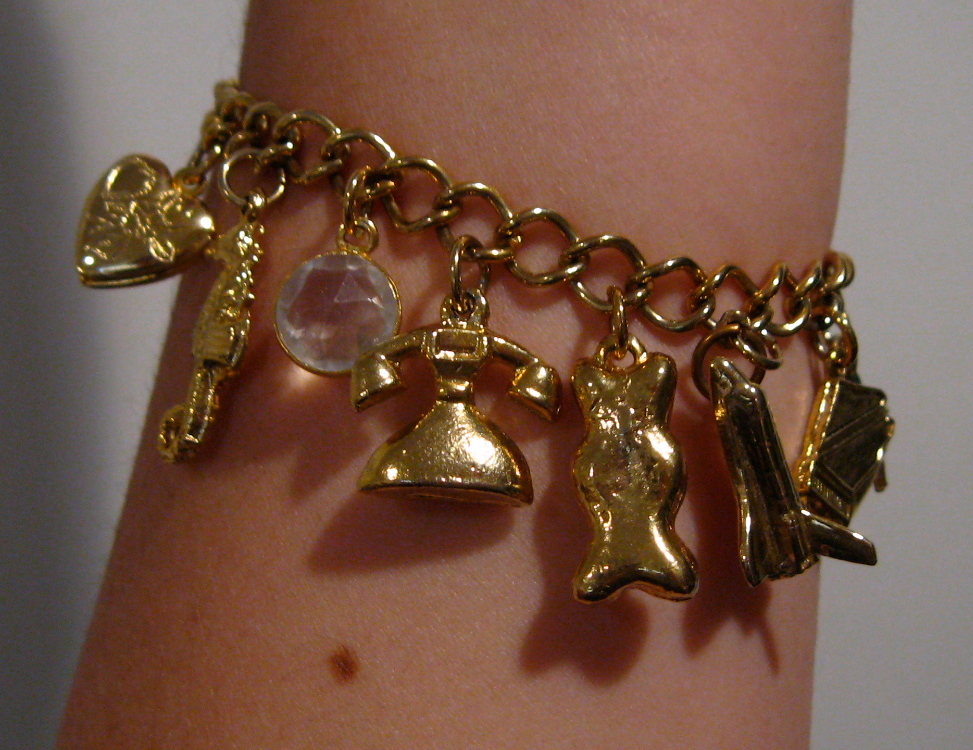
A bracelet is an article of jewellery that is worn around the wrist. Bracelets may serve different uses, such as being worn as an ornament. When worn as ornaments, bracelets may have a supportive function to hold other items of decoration, such as charms. Medical and identity information can be marked on some bracelets, such as allergy bracelets, hospital patient-identification tags, and bracelet tags for newborn babies. Bracelets may be worn to signify a certain phenomenon, such as breast cancer awareness, for religious/cultural purposes or as a sign of LGBTQ pride.
If a bracelet is a single, inflexible loop, it is often called a bangle. When it is worn around the ankle it is called an ankle bracelet or anklet. A boot bracelet is used to decorate boots. Bracelets can be manufactured from metal, leather, cloth, plastic, bead or other materials, and jewellery bracelets sometimes contain jewels, rocks, wood, shells, crystals, metal, or plastic hoops, pearls and many more materials.
Although the term armlet may be technically similar, it is taken to mean an item that sits on the upper shoulder: an arm ring. The origin of the term 'bracelet' is from the Greek brachile meaning 'of the arm', via the Old French bracel. A bracelet is also a small brace or bracer (an arm-guard used by archers).
The history of Egyptian bracelets is as old as 5000 BCE. Starting with materials like bones, stones and woods to serve religious and spiritual interests. From the National Geographic Society, the Scarab Bracelet is one of the most recognized symbols of ancient Egypt. The scarab represented rebirth and regeneration. Carved scarabs were worn as jewelry and wrapped into the linen bandages of mummies. Myth told of the scarab god, Khepri, pushing the sun across the sky.
In 2008, Russian archaeologists from the Institute of Archaeology and Ethnology of Novosibirsk, working at the site of Denisova Cave in the Altai Mountains of Siberia, uncovered a small bone fragment from the fifth finger of a juvenile hominin, dubbed the "X woman" (referring to the maternal descent of mitochondrial DNA), or the Denisova hominin. Artifacts, including a bracelet, excavated in the cave at the same level were carbon dated to around 40,000 BP.
In Bulgaria, there is a tradition called martenitsa, which sometimes involves tying a red and white string around the wrist to please Baba Marta in order for spring to come sooner.
In Greece, a similar tradition, weaving a bracelet from a red and white string on the first day of March and wearing it till the end of summer, is called "Martis" and is considered to help protect the wearer's skin from the strong Greek sun.
In some parts of India, the number and type of bangles worn by a woman denotes her marital status
Hub AI
Bracelet AI simulator
(@Bracelet_simulator)
Bracelet
A bracelet is an article of jewellery that is worn around the wrist. Bracelets may serve different uses, such as being worn as an ornament. When worn as ornaments, bracelets may have a supportive function to hold other items of decoration, such as charms. Medical and identity information can be marked on some bracelets, such as allergy bracelets, hospital patient-identification tags, and bracelet tags for newborn babies. Bracelets may be worn to signify a certain phenomenon, such as breast cancer awareness, for religious/cultural purposes or as a sign of LGBTQ pride.
If a bracelet is a single, inflexible loop, it is often called a bangle. When it is worn around the ankle it is called an ankle bracelet or anklet. A boot bracelet is used to decorate boots. Bracelets can be manufactured from metal, leather, cloth, plastic, bead or other materials, and jewellery bracelets sometimes contain jewels, rocks, wood, shells, crystals, metal, or plastic hoops, pearls and many more materials.
Although the term armlet may be technically similar, it is taken to mean an item that sits on the upper shoulder: an arm ring. The origin of the term 'bracelet' is from the Greek brachile meaning 'of the arm', via the Old French bracel. A bracelet is also a small brace or bracer (an arm-guard used by archers).
The history of Egyptian bracelets is as old as 5000 BCE. Starting with materials like bones, stones and woods to serve religious and spiritual interests. From the National Geographic Society, the Scarab Bracelet is one of the most recognized symbols of ancient Egypt. The scarab represented rebirth and regeneration. Carved scarabs were worn as jewelry and wrapped into the linen bandages of mummies. Myth told of the scarab god, Khepri, pushing the sun across the sky.
In 2008, Russian archaeologists from the Institute of Archaeology and Ethnology of Novosibirsk, working at the site of Denisova Cave in the Altai Mountains of Siberia, uncovered a small bone fragment from the fifth finger of a juvenile hominin, dubbed the "X woman" (referring to the maternal descent of mitochondrial DNA), or the Denisova hominin. Artifacts, including a bracelet, excavated in the cave at the same level were carbon dated to around 40,000 BP.
In Bulgaria, there is a tradition called martenitsa, which sometimes involves tying a red and white string around the wrist to please Baba Marta in order for spring to come sooner.
In Greece, a similar tradition, weaving a bracelet from a red and white string on the first day of March and wearing it till the end of summer, is called "Martis" and is considered to help protect the wearer's skin from the strong Greek sun.
In some parts of India, the number and type of bangles worn by a woman denotes her marital status
Recent media