Hubbry Logo
search
logo
2051803

Ted Lilly

logo
Community Hub0 Subscribers
Read side by side
from Wikipedia

Theodore Roosevelt Lilly III (born January 4, 1976) is an American former professional baseball pitcher. Lilly attended Yosemite High School in Oakhurst, California, and Fresno City College. He played in Major League Baseball (MLB) from 1999 to 2013 for the Montreal Expos, New York Yankees, Oakland Athletics, Toronto Blue Jays, Chicago Cubs and Los Angeles Dodgers. He was a two-time MLB All-Star.

Key Information

Professional career

[edit]

Minor leagues

[edit]

Lilly was drafted by the Los Angeles Dodgers in the 23rd round of the 1996 MLB draft. After two seasons in the Dodgers farm system, he was traded (along with Peter Bergeron, Wilton Guerrero and Jonathan Tucker) to the Montreal Expos for Hiram Bocachica, Mark Grudzielanek and Carlos Pérez.[1][2]

Montreal Expos

[edit]

Lilly made his MLB debut for the Expos on May 14, 1999, against the Pittsburgh Pirates, pitching one inning in relief. He made his first MLB start on September 19 against the Atlanta Braves. He pitched in nine games for the Expos, with three starts.

New York Yankees

[edit]

Lilly was traded to the New York Yankees on March 17, 2000, along with Christian Parker, as a player to be named later in the 1999 trade that also sent Jake Westbrook to the Yankees in exchange for Hideki Irabu.[3][4] On April 27, 2002, Lilly threw a one-hitter against the Seattle Mariners in a losing effort. Boston's Derek Lowe pitched a no-hitter on the same day.[5]

Oakland Athletics

[edit]

Lilly played for more than two years with the Yankees before being dealt to the Oakland Athletics in a three-team deal that included pitchers Jeff Weaver heading to New York and Jeremy Bonderman going to the Detroit Tigers.[6][7] Lilly was in the starting rotation for Oakland, and pitched in the American League Division Series in both 2002 and 2003.

Toronto Blue Jays

[edit]

Lilly was traded from the Athletics to the Toronto Blue Jays for Bobby Kielty.[8] In April, he threw a two-hitter against the Twins in Minnesota.[9] He made the American League All-Star team in 2004 as the Jays' lone representative that year.[10]

The highlight of his career as a Blue Jay was a start on August 23, 2004, against the Boston Red Sox. He pitched a complete-game shutout and struck out 13 batters in a three-hit 3–0 victory.[11]

Lilly was 15–13 with a 4.31 ERA and 160 strikeouts in 2006, exceeding his previous career-high for wins (12). He also equaled a career high for starts (32) and nearly matched his career highs in strikeouts and innings pitched. This season, he ranked first among the Jays' pitching staff in strikeouts and second only to Roy Halladay in wins (Halladay had a 16–5 record before a recurring elbow injury ended his season in late September).[12]

On August 21, 2006, in a game against the Oakland Athletics, Lilly was surrendering an early 8–0 lead in the 3rd inning when manager John Gibbons took him out of the game. With the score 8-5 and runners on 1st and 3rd, Lilly refused to give him the ball. Eventually, he reluctantly left the mound and later feuded with Gibbons in the tunnel leading to the locker rooms. It was reported that Gibbons left the scene with a bloody nose, though Lilly maintained no punches were thrown.[13]

Lilly filed for free agency at the end of the 2006 season, and alongside Barry Zito, Jason Schmidt and Jeff Suppan, was one of the most sought-after free agent pitchers, partially due to the thin market for starting pitching. On the morning of December 6, 2006, he informed the Blue Jays that he would not be returning to the club, thus rejecting a four-year, $40 million deal. He cited a "change in scenery" as his reasoning. Later on that day, Lilly agreed to an identical four-year, $40 million deal with the Chicago Cubs, officially ending his tenure with the Blue Jays.[14]

Chicago Cubs

[edit]
Lilly pitching for the Cubs in 2007.

In his first start for the Cubs, Lilly defeated the Cincinnati Reds in a strong outing, taking a no hitter into the fifth inning, and only yielding one earned run over seven innings.[15] Lilly then was the starting pitcher for the Cubs home opening game at Wrigley Field on April 9, 2007. Lilly gave up three runs in six innings, but did not factor into the decision.[16] Lilly pitched well in April, lasting at least six innings in each of his five starts while never giving up more than three runs in a game posting a 2.18 ERA.[17]

Lilly was prominent in a contentious series in Atlanta between the Cubs and the Atlanta Braves. In game one of the series, Alfonso Soriano hit three home runs in his first three at-bats as part of a Cubs 9–1 victory.[18] In the next game, Tim Hudson hit Soriano with a first-pitch fastball triggering home-plate umpire Tim Tschida to issue warnings to both teams.[19] On the final game of the series, Lilly hit Édgar Rentería in the first inning, and was promptly thrown out of the ballgame by Jim Wolf.[20] Lilly was not suspended for his actions in the game. In 2009, he was named to his second all-star game, as the Cubs lone representative.[21] He underwent shoulder surgery in the off-season to clean up debris and labrum fraying.[22]

On June 13, 2010, Lilly took a no-hitter into the 9th against the Chicago White Sox. In the ninth, he gave up a lead off single to Juan Pierre, then was lifted for relief pitcher Carlos Mármol, who got the save, getting out of a bases loaded jam, for a 1-0 Cub victory.[23] This was the longest outing that Lilly held a team hitless. The no-hitter would have been the first pitched at Wrigley Field since Milt Pappas in 1972. He also threw a two-hitter against the Rockies in August.[24]

2009 World Baseball Classic

[edit]

Lilly was the starting pitcher in two games for Team USA in the 2009 World Baseball Classic.

In the first game he faced Venezuela but was pulled after 36 pitches. Manager Davey Johnson wanted to get work for starter Jeremy Guthrie and as many relievers as possible. Lilly left with the United States trailing 1–0, thanks to the homer he served up to his former Cubs batterymate, Henry Blanco.[25] His second start was against Puerto Rico, a game that Team USA would win with a David Wright two-run single in the bottom of the ninth. For his part Lilly gave up two home runs, the only two hits he gave up in his 313 innings.

Los Angeles Dodgers

[edit]

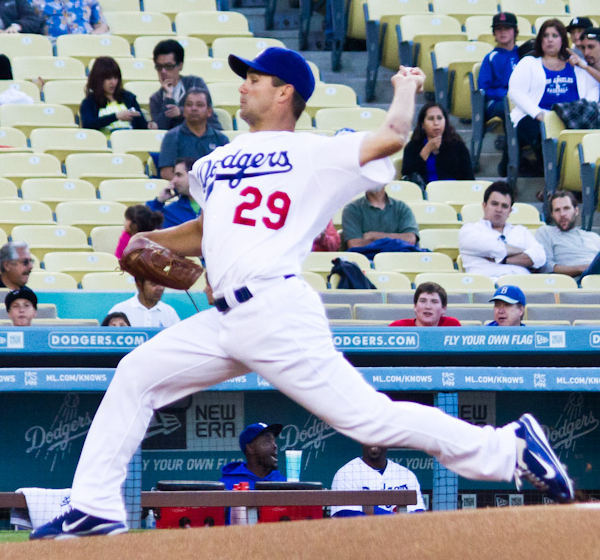
On July 31, 2010, Lilly and Ryan Theriot were traded to the Los Angeles Dodgers for Blake DeWitt, Brett Wallach, and Kyle Smit.[26] Lilly won his first five starts as a Dodger posting a 1.83 ERA. He finished his season with the Dodgers with a record of 7-4 and a 3.52 ERA in 12 starts, which included a complete game shutout on August 19 against the Colorado Rockies.[27] On October 19, 2010, Lilly agreed to a 3-year, $33 million, contract with the Dodgers.[28] After a disappointing first half of the season in 2011, where he had an ERA of 4.79, Lilly pitched much better in the second half, with a 2.94 mark, also allowing only 9 homers in the second half after allowing 19 the first half. His final record was 12–14 with a 3.97 ERA in 33 starts.

Lilly started the 2012 season with a 5–1 record and a 3.14 ERA in 8 starts. However, after struggling in his May 24 start, Lilly felt some pain in his shoulder and was placed on the disabled list.[29] He made some rehab appearances with Class-A Rancho Cucamonga in July but suffered a setback and was shut down.[30] He remained hopeful that he would return to the team and pitch out of the bullpen in September,[31] however it was eventually decided that he would have surgery on his shoulder on September 21 and would not return to the mound that season.[32]

Lilly returned for spring training in 2013 but lost time due to illness and rainouts so he was unable to build up arm strength.[33] He started the season on the disabled list, and made several rehab appearances in the minors.[34] After injuries to starters Zack Greinke and Chris Capuano, Lilly was activated off the disabled list and returned to the rotation on April 24.[35] He made 2 starts and then returned to the DL on May 3 with a strained rib cage muscle.[36] He returned again on May 20[37] and he made 3 more starts before injuring his neck when he was bumped into by Kyle Blanks of the San Diego Padres in a game on June 4,[38] which led to him returning to the disabled list.[39] After a few more rehab starts, Lilly claimed he was having trouble recovering after starts and that he wanted to work out of the bullpen after his return from the DL.[40] However, the Dodgers instead designated him for assignment on July 25[41] and released him on August 2.[42]

San Francisco Giants

[edit]

On August 6, 2013, Just a few days after being released by the Dodgers, reports claimed Lilly was signed to a minor league contract by the San Francisco Giants.[43] However, the Giants called off the deal after the two sides could not agree on a designated callup date.[44]

Retirement

[edit]

He had his nerve endings in his neck cauterized after the 2013 season in an attempt to stem the pain that had bothered him throughout the season and joined the Venezuela Winter League to try to show other MLB teams he could still play.[45] However, persistent health problems led him to announce his retirement on November 27, 2013.[46][47] The Cubs hired Lilly as a special assistant in March 2014.[48]

Lilly was eligible to be elected into the Hall of Fame in 2019, but received less than 5% of the vote and became ineligible for the 2020 ballot.[49]

Pitching style

[edit]

As a finesse pitcher, Lilly relied more on above-average control and movement rather than elite velocity. He also demonstrated the ability to throw a variety of pitches: a changeup, two fastballs—a four-seamer and a two-seamer in the 86-90 mph range, as well as two breaking balls, a slider and a curveball. His slider was more frequently used against left-handed batters and his other off-speed pitches more against right-handed batters. His pitching motion was a straight-over-the-top delivery.[50][51]

Personal life

[edit]

Lilly's wife, Natasha (Tasha), is a veterinarian. They are active advocates for animal humane societies.[52] Their son, Theodore Roosevelt Lilly IV, was born on March 14, 2010.[53][54]

In January 2015, Lilly was charged with three counts of vehicle insurance fraud.[55] He accepted a plea bargain to pay a $2,500 fine, be on informal probation for two years, and perform 250 hours of community service.[56]

References

[edit]
[edit]
Revisions and contributorsEdit on WikipediaRead on Wikipedia
from Grokipedia
Ted Lilly, born Theodore Roosevelt Lilly III on January 4, 1976, in Lomita, California, is a former American professional baseball pitcher who played in [Major League Baseball](/page/Major_League Baseball) (MLB) for 15 seasons from 1999 to 2013.[1] A left-handed starter known for his competitive mound presence and consistency, Lilly compiled a career record of 130 wins and 113 losses with a 4.14 earned run average (ERA) over 1,982.2 innings pitched, striking out 1,681 batters while maintaining a 1.25 WHIP.[2] Previously drafted by the Toronto Blue Jays in the 13th round of the 1995 MLB Draft but did not sign, he was selected by the [Los Angeles Dodgers](/page/Los Angeles_Dodgers) in the 23rd round of the 1996 MLB Draft out of Fresno City College, made his MLB debut with the Montreal Expos on May 14, 1999, and later played for five other teams, including the New York Yankees, Oakland Athletics, Toronto Blue Jays, Chicago Cubs, and Dodgers.[3] Lilly's career trajectory featured stints as a reliable mid-rotation starter, with his most productive years coming after a 2003 trade to the Blue Jays, where he emerged as an All-Star in 2004 by posting a 4.06 ERA and 143 strikeouts in 197.1 innings.[3] He earned his second All-Star selection in 2009 with the Cubs, finishing that season 12-9 with a 3.10 ERA.[4] Signed by the Cubs as a free agent in December 2006, Lilly became a key figure in their rotation during the late 2000s, contributing to back-to-back National League Central division titles in 2007 and 2008, with the team advancing to the playoffs both years but losing in the NLDS each time.[3] Traded to the Dodgers on July 31, 2010, his tenure from mid-2010 to 2013 was marred by injuries, including a neck issue that sidelined him for most of 2011 and a shoulder injury limiting him to 8 starts in 2012 (5-1, 3.14 ERA), followed by 5 appearances in 2013 before retiring at age 37.[4] Beyond his MLB accomplishments, Lilly represented Team USA in the 2009 World Baseball Classic, starting two games, and was noted for his cerebral approach to pitching, often studying hitters meticulously.[1] Over his career, he appeared in 356 games (331 starts), allowing 2,093 hits and 917 earned runs, while his durability—evidenced by 20+ starts in 11 of his 15 seasons—solidified his reputation as a workhorse in an era of specialized pitching.[2]

Early life and education

Childhood and family

Theodore Roosevelt Lilly III was born on January 4, 1976, in Lomita, California.[4] Lilly spent his early childhood in Southern California, primarily in the Torrance area, where outdoor activities and local sports culture played a role in his formative years. His father influenced his budding interest in baseball by regularly taking the family to Los Angeles Dodgers games, securing seats along the third base line that allowed young Ted to immerse himself in the sport.[5] In his youth, Lilly's family relocated from Southern California to the Oakhurst region in Central California, marking a shift from urban coastal life to a more rural setting amid the Sierra Nevada foothills. This move occurred before his high school years, shaping his early experiences in a new environment conducive to outdoor pursuits.[5]

High school baseball

Ted Lilly attended Yosemite High School in Oakhurst, California, where he graduated in 1994.[3][4] As a student-athlete at Yosemite, Lilly competed in baseball as a left-handed pitcher, honing his skills in a small-town program near Yosemite National Park.[4][6] Despite his efforts, he went undrafted out of high school, reflecting the limited scouting attention given to players from rural areas at the time.[7] Lilly's high school experience laid the groundwork for his transition to college ball at Fresno City College, where improved velocity and command drew professional interest. He was selected by the Toronto Blue Jays in the 13th round of the 1995 MLB Draft from Fresno City College but did not sign.[4] This path culminated in his selection by the Los Angeles Dodgers in the 23rd round (688th overall pick) of the 1996 MLB June Amateur Draft.[8][9] He signed with the organization shortly thereafter, marking his entry into professional baseball.[10]

Professional career

Minor leagues

Lilly signed with the Los Angeles Dodgers as a 23rd-round pick in the 1996 MLB draft out of Fresno City College.[4] He began his professional career that summer in the Dodgers' rookie-level affiliate, the Yakima Bears of the Northwest League, where he excelled as a starter with a 4–0 record, a 0.84 ERA, and 75 strikeouts over 53.2 innings pitched.[11] In 1997, Lilly advanced to High-A San Bernardino in the California League, posting a 7–8 record with a 2.81 ERA and 158 strikeouts in 134.2 innings, including two complete games and one shutout, demonstrating improved durability and command.[11] The following year, he progressed to Double-A San Antonio in the Texas League, where he went 8–4 with a 3.30 ERA and 96 strikeouts in 111.2 innings before a brief promotion to Triple-A Albuquerque in the Pacific Coast League, recording a 1–3 mark and 4.94 ERA in 31 innings.[11] On July 31, 1998, the Dodgers traded Lilly, along with outfielders Peter Bergeron and Wilton Guerrero and infielder Jonathan Tucker, to the Montreal Expos in exchange for shortstop Mark Grudzielanek, catcher Carlos Perez, and outfield prospect Zach Minor.[8] He immediately joined the Expos' Triple-A affiliate, the Ottawa Lynx of the International League, finishing the season 2–2 with a 4.85 ERA and 49 strikeouts in 39 innings.[11] The trade marked a significant organizational shift for the 22-year-old left-hander, who had been a mid-round draft pick viewed as a promising but unproven starter. Lilly opened the 1999 season back in Ottawa, going 8–5 with a 3.84 ERA and 78 strikeouts in 89 innings across 15 starts, though his progress was interrupted by a labrum tear in his throwing shoulder that sidelined him briefly.[11][6] These early professional hurdles, including the midseason trade and injury setback, tested his resilience as he adapted to higher levels of competition and multiple affiliations before earning a call-up to the majors.

Montreal Expos (1999–2000)

Lilly made his major league debut with the Montreal Expos on May 14, 1999, against the Pittsburgh Pirates at Three Rivers Stadium, entering in relief and pitching one inning in which he surrendered three hits and one earned run while striking out one batter.[12] His initial appearances that month were limited to short relief outings, including a 1.1-inning stint on May 16 where he allowed two runs, contributing to early struggles in adapting to professional hitters after his minor league seasoning.[12] Following a demotion to Triple-A Ottawa after five relief games in May, Lilly was recalled in September for his first major league starts, marking a transition to a starting role.[10] In his debut start on September 19 against the Atlanta Braves, he lasted 5 2/3 innings, yielding five hits and four earned runs with seven strikeouts but taking the loss in a 7-3 defeat.[13] Over the full 1999 season, he appeared in nine games for the Expos—three as starts—compiling a 0-1 record and 7.61 ERA across 23 2/3 innings, during which he allowed 30 hits and walked nine, highlighting challenges in command and facing big-league power as a 23-year-old rookie.[4] Lilly showed signs of adjustment in his final two starts of the season, pitching seven scoreless innings of relief-like efficiency on September 24 against Atlanta (six hits, two earned runs, no decision in a 3-2 loss) and five innings on September 29 versus the Florida Marlins (four hits, three earned runs, no decision in a 6-3 win).[12] These outings suggested growing comfort with major league competition, though his overall inefficiency—reflected in a 1.65 WHIP—underscored the steep learning curve from minor league ball.[3] Prior to the 2000 season, on March 17, Lilly was traded by the Expos to the New York Yankees along with pitcher Christian Parker to complete an earlier deal that had sent Hideki Irabu and Jake Westbrook to Montreal.[14] This move ended his brief tenure with the Expos without any appearances that year.

New York Yankees (2000–2002)

Ted Lilly was acquired by the New York Yankees on March 17, 2000, from the Montreal Expos as part of a trade that sent pitcher Hideki Irabu to Montreal in exchange for Jake Westbrook, with Lilly and Christian Parker completing the deal as players to be named later.[8] He spent most of the 2000 season in Triple-A with the Yankees' affiliate Columbus Clippers, where he recorded an 8-11 record with a 4.19 ERA over 22 starts and 137.1 innings pitched, striking out 127 batters. Lilly made his Yankees debut in September 2000, appearing in seven relief outings with a 5.63 ERA in 8 innings and 11 strikeouts, marking his initial exposure to major league competition.[4] In 2001, Lilly secured a spot in the Yankees' starting rotation after beginning the year in Triple-A Columbus and being recalled on April 22. He posted a 5-6 record with a 5.37 ERA across 21 starts and 26 total appearances, logging 120.2 innings and 112 strikeouts while allowing 20 home runs in a high-offense era.[4] One notable performance came early in the season on April 22 against the rival Boston Red Sox at Yankee Stadium, where Lilly contributed to a victory that highlighted his potential as a rotation mainstay.[15] As part of the Yankees' roster, Lilly gained his first postseason experience that year, with the team advancing to the American League Division Series against the Oakland Athletics, the American League Championship Series against the Seattle Mariners, and the World Series against the Arizona Diamondbacks, though he did not appear in any playoff games.[4] Lilly's 2002 season began promisingly as a key member of the Yankees' rotation, where he demonstrated improved command and effectiveness. On April 27, he nearly achieved a no-hitter against the Seattle Mariners, allowing just one hit in a 1-0 loss, his only blemish coming on a bloop single in the eighth inning.[16] Through 11 starts with New York, he compiled a 3-6 record with a strong 3.40 ERA over 76.2 innings, striking out 59 while holding opponents to a .200 batting average, though poor run support contributed to his sub-.500 record—averaging under three runs per start.[4] Despite his solid underlying performance, Lilly was traded on July 5, 2002, to the Oakland Athletics in a three-team deal that brought pitcher Jeff Weaver to the Yankees from the Detroit Tigers, along with minor leaguers Jason Arnold and John-Ford Griffin sent to Oakland.[17]

Oakland Athletics (2002–2003)

Ted Lilly joined the Oakland Athletics midseason in 2002 after being acquired from the New York Yankees on July 5 in a trade for pitcher Jeff Weaver and two minor league prospects.[4] In six appearances, including five starts, for Oakland that year, Lilly posted a 2-1 record with a 4.63 ERA over 23.1 innings pitched and 18 strikeouts.[18] He made his Athletics debut on July 15 against the Toronto Blue Jays, allowing no earned runs in six innings for the win, though his overall stint included a challenging outing on September 10 against the Anaheim Angels where he lasted just 2.1 innings and took the loss.[19] Lilly also pitched in the 2002 American League Division Series against the Minnesota Twins, starting Game 3 but surrendering six runs in four innings en route to a no-decision in a 3-2 series loss.[4] In 2003, Lilly secured a full-time spot in Oakland's starting rotation alongside established aces Barry Zito and Tim Hudson, contributing to the Athletics' strong 96-66 regular-season record and AL West title.[20] He made 32 appearances, all starts, finishing 12-10 with a 4.34 ERA, a career-high 178.1 innings pitched, and 147 strikeouts—also a personal best at the time.[3] Notable performances included a career-high 10 strikeouts in 5.2 scoreless innings against the Seattle Mariners on April 15 (no-decision) and nine strikeouts in a July 2 start against the same opponent, though he took the loss after allowing five earned runs in 4.2 innings.[21] Lilly appeared in two games of the 2003 ALDS against the Boston Red Sox, pitching nine scoreless innings across a relief outing and a start but receiving no decisions in the A's 3-2 series defeat.[4] Following the season, the Athletics traded Lilly to the Toronto Blue Jays on November 18, 2003, in exchange for outfielder Bobby Kielty.[8]

Toronto Blue Jays (2003–2007)

Lilly joined the Toronto Blue Jays after an off-season trade from the Oakland Athletics on November 18, 2003, in exchange for outfielder Bobby Kielty.[4] Lilly solidified his role as a mainstay in the Blue Jays' rotation from 2004 to 2006, appearing in 89 starts with a cumulative 37-34 record and an ERA under 4.50 across those years.[4] His 2004 campaign marked a breakout, as he went 12-10 with a 4.06 ERA in 32 starts, striking out 168 batters—his highest total during his Toronto tenure—and earning his first All-Star selection as the lone Blue Jays representative at the game in Houston.[4] A highlight came on August 23, 2004, when he pitched a complete-game shutout against the Boston Red Sox, fanning a then-career-high 13 batters in a three-hit victory that halted Boston's six-game winning streak.[22] Injuries sidelined him for much of 2005, limiting him to 25 starts with a 10-11 mark and 5.56 ERA, but he rebounded in 2006 to lead the team with 15 wins against 13 losses, a 4.31 ERA, and 160 strikeouts over 181.2 innings.[4] Following the 2006 season, Lilly became a free agent and signed a four-year, $40 million contract with the Chicago Cubs on December 15, 2006, ending his four-year stint in Toronto where he established himself as a reliable left-handed starter.[8]

Chicago Cubs (2007–2010)

Ted Lilly signed a four-year, $40 million contract with the Chicago Cubs as a free agent on December 15, 2006, marking the beginning of his tenure with the team.[8] In his first season with the Cubs in 2007, Lilly established himself as a reliable starter in the rotation, posting a 15-8 record with a 3.83 ERA over 34 starts and 207 innings pitched, while recording 174 strikeouts.[4] His performance helped anchor the pitching staff during a season in which the Cubs finished 85-77 and clinched a Wild Card berth, though they were swept in the NLDS by the Arizona Diamondbacks.[23] Lilly's productivity peaked in 2008 and 2009, where he combined for a 29-18 record and a 3.60 ERA across 68 starts and 381⅔ innings, striking out 335 batters.[4] In 2008, he went 17-9 with a 4.09 ERA in 204⅔ innings, contributing to the Cubs' 97-64 record and second consecutive NL Central title.[24] A highlight came on September 15, when Lilly carried a no-hitter into the seventh inning against the Houston Astros before Mark Loretta's single broke it up; he allowed just one hit total in a 6-1 victory, helping the Cubs clinch the division the following day.[25] The Cubs advanced to the NLDS against the Los Angeles Dodgers but were swept in three games, with Lilly starting Game 3. In 2009, Lilly rebounded with a 12-9 mark and 3.10 ERA in 27 starts and 177 innings, earning his second All-Star selection despite the Cubs finishing 83-78 and missing the playoffs.[26] The 2010 season proved challenging for Lilly with the Cubs, as injuries limited him to 18 starts before the July 31 trade deadline, where he recorded a 3-8 record with a 3.69 ERA over 117 innings and 89 strikeouts.[3] Overall that year across both the Cubs and Dodgers, Lilly finished 12-9 with a 3.73 ERA in 30 starts.[4] On July 31, 2010, the Cubs traded Lilly along with infielder Ryan Theriot and cash considerations to the Los Angeles Dodgers in exchange for infielder Blake DeWitt and prospects Brett Wallach and Kyle Smit.[27]

2009 World Baseball Classic

Ted Lilly was selected to the Team USA roster for the 2009 World Baseball Classic as one of the starting pitchers, drawing from his established role with the Chicago Cubs.[28] In the Pool C opener against Canada on March 7 at Rogers Centre in Toronto, Lilly started and pitched 4 innings, surrendering 4 earned runs on 4 hits and 3 walks while striking out 3 batters; he earned no decision in the United States' 6-5 victory.[29] Three days later, on March 11 against Venezuela, he delivered a stronger outing with 3 innings pitched, allowing 1 earned run on 3 hits, no walks, and 2 strikeouts, though he was saddled with the loss in a 5-3 defeat that still advanced the U.S. to the second round.[30] Lilly's tournament workload peaked in the quarterfinals on March 17 versus Puerto Rico at Dolphin Stadium in Miami, where he started and went 4.1 innings, giving up 3 earned runs on 10 hits—including solo home runs by Alex Rios and a two-run shot by Carlos Delgado—with no walks and 2 strikeouts; Team USA rallied late for a 6-5 win to reach the semifinals.[31] Over his three starts, totaling 11.1 innings, Lilly compiled a 1-1 record with a 5.56 ERA, 17 hits allowed, 3 walks, and 7 strikeouts.[32] The United States earned the bronze medal with a semifinal loss to Japan followed by a 10-6 third-place victory over Venezuela, marking Lilly's only international tournament appearance.[28] Returning to the Cubs shortly after the March 23 conclusion, Lilly experienced no notable fatigue and seamlessly resumed his MLB duties.[33]

Los Angeles Dodgers (2011–2012)

Lilly returned to the Los Angeles Dodgers, the organization that originally drafted him in the 1996 MLB Draft, via a midseason trade from the Chicago Cubs on July 31, 2010, in exchange for infielder Blake DeWitt.[4] In the partial 2010 season with the Dodgers, he excelled initially, winning his first five starts with a 1.83 ERA before finishing the year 7-4 with a 3.52 ERA over 12 starts and 76 2/3 innings pitched.[3] This performance earned him a three-year contract extension worth $33 million through the 2013 season.[34] In 2011, Lilly anchored the Dodgers' rotation with a full workload, making 33 starts and recording a 12-14 mark with a 3.97 ERA, 158 strikeouts, and 51 walks across 192 2/3 innings.[4] He demonstrated consistency early, posting a 3.44 ERA in his first 15 starts, but endured a stiff neck issue in August that forced him to exit a start against the Colorado Rockies after just 3 1/3 innings on August 20.[35] Despite the discomfort, Lilly managed to avoid an extended absence and completed the season without further major disruptions, contributing to a Dodgers staff that finished 13th in the National League with a 3.97 team ERA. Lilly's 2012 campaign was severely curtailed by multiple injuries, beginning with placement on the 15-day disabled list in late March due to recurring neck stiffness that delayed his season debut until mid-April.[36] Upon returning, he made eight starts, going 5-1 with a 3.14 ERA, allowing just 17 earned runs in 48 2/3 innings while striking out 31 batters.[4] However, left shoulder inflammation emerged in late May, landing him back on the disabled list on May 28 after his final appearance on May 26 against the New York Mets, where he surrendered eight runs in 3 2/3 innings.[37] The injury, which required ongoing management and rehab assignments through the summer, limited his effectiveness and marked the beginning of a prolonged struggle that defined the latter part of his Dodgers tenure.[38] Lilly underwent season-ending arthroscopic surgery on his left shoulder on September 21, 2012.[39]

Retirement

Lilly re-signed with the Dodgers on a minor-league contract with an invitation to spring training ahead of the 2013 season.[4] He made the Opening Day roster and recorded five starts, going 0-2 with a 5.09 ERA over 23 innings, but multiple stints on the disabled list for neck and shoulder issues hampered his performance. The Dodgers designated him for assignment and released him on July 25, 2013.[40] In an effort to revive his career after the surgery and release, Lilly signed with the Navegantes del Magallanes of the Venezuelan Winter League in November 2013, but his comeback was short-lived; he made one start on November 8, allowing three earned runs in 3.1 innings without factoring in the decision.[11] The Giants explored a minor league deal with Lilly in August 2013 after his release from the Dodgers, but the agreement fell through due to disagreements over medical evaluations and call-up terms.[41] After attempting a comeback in the 2013 Venezuelan Winter League with Navegantes del Magallanes following his release from the Dodgers in July 2013, Ted Lilly announced his retirement on November 26, 2013, citing persistent physical limitations that prevented him from regaining his previous form.[42] In an interview with the Venezuelan newspaper El Universal, Lilly explained that despite undergoing a procedure to cauterize nerves in his neck earlier that year, the cumulative toll of injuries had become insurmountable.[42] Lilly's 15-season Major League Baseball career concluded with a 130-113 win-loss record, a 4.14 earned run average, and 1,681 strikeouts over 1,982.2 innings pitched across six teams.[4] His tenure was marked by nagging shoulder and neck issues, particularly after a rib strain in 2012 that sidelined him for much of the season, leading to his release by the Los Angeles Dodgers in July 2013.[40] Reflecting on these setbacks, Lilly noted the frustration of not being able to pitch as he once did, but expressed overall satisfaction with his achievements, stating, "In some ways it’s been a much better career than I imagined."[42] As a capstone to his career, Lilly's personal highlights included a career-high 17 wins and 184 strikeouts in 2007 with the Chicago Cubs, along with several near-misses for no-hitters, such as carrying a no-hitter into the ninth inning against the Chicago White Sox on June 13, 2010, before it was broken by a leadoff single from Juan Pierre.[3] Another notable bid came on April 27, 2002, with the Oakland Athletics, where he one-hit the Seattle Mariners through seven innings before a single ended the effort in the eighth.[16] These moments underscored his consistency as a left-handed starter, even amid the physical challenges that ultimately led to his retirement.[43]

Pitching style

Repertoire

Ted Lilly's pitching arsenal was built around a four-seam fastball typically ranging from 88 to 92 mph, though often measured at 88 mph, which generated below-average whiff rates compared to other left-handed pitchers' fastballs and induced more fly balls than average.[44] His primary breaking pitch was a looping curveball at 71 mph, characterized by exceptional downward bite and vertical movement that produced more ground balls and a career .211 batting average against, with a 31.6% strikeout rate.[44][45] Complementing these was an changeup thrown at 80 mph, which achieved high whiff rates relative to similar off-speed pitches from left-handers.[44] Lilly also employed a cutter at 81 mph, featuring heavy sink and sweeping horizontal cut action that resulted in fewer whiffs but more fly balls, often used to jam hitters inside.[44] He threw a slider as another breaking option, particularly effective against left-handed batters due to its lateral movement away from them, while reserving his curveball and changeup more for right-handed hitters.[46] In the mid-career period around 2003, Lilly expanded his repertoire by incorporating a two-seam sinker at 88 mph, which added armside run and helped vary movement on his fastballs, though it was used sparingly in later seasons with only 1,708 total pitches thrown career-wide.[47][45] Overall, he relied heavily on off-speed pitches rather than velocity, with his fastball serving primarily as a setup for deception.[44] Usage data from his peak years with the Chicago Cubs (2007–2010) highlights the curveball as a staple, accounting for 9–16% of total pitches—peaking at 16% in 2007—while the four-seam fastball hovered around 14–20% and the changeup 15–20%.[45] The curveball's effectiveness stood out against both left- and right-handed hitters, contributing to low walk rates (1.0% career) and high strikeouts regardless of matchup.[45] Lilly's mechanics featured a deceptive crossfire delivery from the left side, with his body angling sharply toward first base, which quickened the arm action and made his motion mimic a pickoff attempt to disrupt runners.[48] This compact, efficient motion enhanced command and supported his above-average pickoff success, holding baserunners close throughout his career.[48]

Approach and effectiveness

Ted Lilly's pitching approach emphasized precision, deception, and pitch sequencing to keep hitters off-balance, often starting with elevated fastballs to set up his curveball for maximum effect. This strategy disrupted hitters' timing by varying speeds and locations, allowing him to limit hard contact despite lacking overpowering velocity.[49] His career ground ball rate of 34.1% reflected a fly ball-oriented style, but he effectively induced weaker contact through movement and command, contributing to a career opponent batting average of .242.[50][51] Lilly demonstrated notable durability throughout his prime, regularly pitching 180 or more innings in multiple seasons, including 207.0 in 2007 and 204.2 in 2008, which underscored his ability to handle heavy workloads with consistency.[51] His control was a key strength, evidenced by a career walk rate of 3.0 BB/9, enabling him to avoid deep counts and maintain efficiency.[51] This low walk rate, combined with his deceptive sequencing, proved particularly effective against power hitters, as he limited their ability to time his off-speed pitches, holding opponents to a .242 batting average overall.[51] Often categorized as a "crafty lefty," Lilly drew comparisons to Jamie Moyer for his reliance on guile, location, and pitch mix rather than velocity, succeeding as a soft-tossing southpaw who frustrated lineups with subtle movement and smart sequencing.[52][53] This approach yielded a solid career ERA of 4.14 over 1,982.2 innings, establishing him as a reliable mid-rotation starter who maximized his arsenal through strategic execution.[50]

Post-playing career

Front office role

Following his retirement from professional baseball in November 2013, Ted Lilly transitioned to a front office position with the Chicago Cubs, where he was hired on March 4, 2014, as a special assistant to president of baseball operations Theo Epstein and general manager Jed Hoyer.[54][55] In this capacity, Lilly drew upon his 15-year MLB career, including four seasons with the Cubs from 2007 to 2010 that contributed to back-to-back National League Central Division titles, to provide valuable perspectives on team-building efforts.[54] Lilly's responsibilities encompassed scouting minor league pitchers, evaluating talent during spring training, visiting Cubs affiliates throughout the season, and offering input on player development strategies.[54][55] He also assisted in assessing amateur players and scouting opponents across MLB, serving as a bridge between on-field experiences and front office decision-making.[56] These duties allowed him to apply insights from his time in professional clubhouses, particularly his role in the Cubs' 97-win 2008 season, to enhance evaluations of emerging talent.[54] Lilly served in this advisory role with the Cubs, beginning in 2014, contributing to the organization's farm system analysis and long-term player development initiatives. In interviews, he highlighted how his playing background informed his advisory work, enabling a nuanced understanding of player potential and team dynamics that supported the front office's goals.[57]

Community involvement

Following his retirement from Major League Baseball in 2013, Ted Lilly has remained actively involved in community initiatives centered on youth development through sports in California. He co-founded the annual Ted Lilly Golf Tournament in 2011, initially held at Sierra Meadows Golf Course in Ahwahnee, with the inaugural event raising approximately $50,000 through auctions and raffles to support local youth baseball programs.[5] The tournament, now organized by the Badger Baseball Boosters, continues annually to fund improvements for Yosemite High School baseball, Sierra Mountain Little League, Yosemite Little League, and the Yosemite Colts Travel Baseball Team, including field enhancements and stadium lighting; the 2025 edition is scheduled for October 14 at Eagle Springs Golf Course in Friant.[58][59] Lilly has described his motivation as a personal commitment to improving the lives of children through these efforts.[5] Lilly has participated in speaking engagements and public panels to inspire young athletes, including Q&A sessions at the Chicago Cubs Convention alongside team executives to discuss perseverance and career paths in baseball, aimed at high school recruits.[60] These appearances complement his advisory roles in amateur baseball, such as joining the management group of the San Luis Obispo Blues, a collegiate summer league team, in 2020 to support player development and program operations.[61] In media and broadcasting, Lilly has taken on occasional guest analyst roles for Chicago Cubs games, including a well-received pairing with radio play-by-play announcer Pat Hughes in 2024, where his insights on pitching were praised for enhancing the broadcast.[62] He has also appeared in interviews on platforms like Marquee Sports Network and podcasts, sharing experiences on topics such as modern pitching techniques and career resilience up through 2024.[63][64]

Personal life

Family

Ted Lilly married Natasha (Tasha) Lilly in 2003 following a blind date in 1996; she works as a veterinarian.[65] The couple has two children, born in 2010 during Lilly's time with the Chicago Cubs and in 2012 while he played for the Los Angeles Dodgers, with names withheld for privacy.[66] Throughout Lilly's MLB career, which involved multiple trades and team relocations—from the Toronto Blue Jays to the Cubs and later to the Dodgers and San Francisco Giants—the family adapted to frequent moves across North America, maintaining stability amid the demands of professional baseball.[43] His wife and young children provided essential support during periods of injury and extensive road travel, helping him navigate the rigors of the sport until his retirement in 2013.[43] After retiring, the Lilly family returned to California, where Lilly grew up, allowing more time together away from the baseball schedule.[43] They share interests in outdoor activities, such as hiking near their Oakhurst home, and maintain pets, including a Labrador retriever, aligning with Natasha's veterinary background and the couple's mutual passion for animals.[67] This family focus has also shaped their involvement in animal welfare causes.[65]

Philanthropy

Ted Lilly has been a prominent advocate for animal welfare, particularly through his partnership with PAWS Chicago, a no-kill animal shelter organization. In 2010, he and his wife, Dr. Tasha Lilly, a veterinarian, were honored as PAWS Chicago's Heroes of the Year for their efforts in fundraising and raising awareness to support homeless pets.[68] This recognition highlighted their collaborative work, including organizing events to generate donations and attention for the shelter's mission.[69] Additionally, in 2009, Lilly was nominated by the Chicago Cubs as their Roberto Clemente Award recipient, and he directed the associated $25,000 MLB grant to PAWS Chicago to further its no-kill initiatives.[3] Lilly's animal advocacy extends to personal and family rescue efforts, including donations to various shelters, motivated in part by his wife's veterinary career focused on companion animal care.[65] The couple has remained supporters of PAWS Chicago post-retirement, appearing as contributors in the organization's 2016 publications and continuing to promote animal humane societies.[70] Beyond animal welfare, Lilly has contributed to educational and youth development causes, particularly in his hometown area. He has supported Yosemite High School's baseball program through alumni booster funds, including donations that aid school athletics.[5] Since 2011, he has hosted annual golf tournaments in California, with proceeds benefiting youth baseball programs such as Sierra Mountain Little League and Yosemite Little League, providing equipment and field improvements for young athletes.[58] Following his 2013 retirement, Lilly expanded his philanthropic activities, organizing ongoing events like the golf tournaments that have raised funds for youth baseball and educational initiatives through 2025, including a jersey retirement dinner at the October 2025 event.[71][59] These efforts underscore his commitment to community support in California, blending his baseball background with broader charitable impact.

References

User Avatar
No comments yet.