


Community hub
Recent from talks
Contribute something
Nothing was collected or created yet.
Strikeout
View on Wikipedia

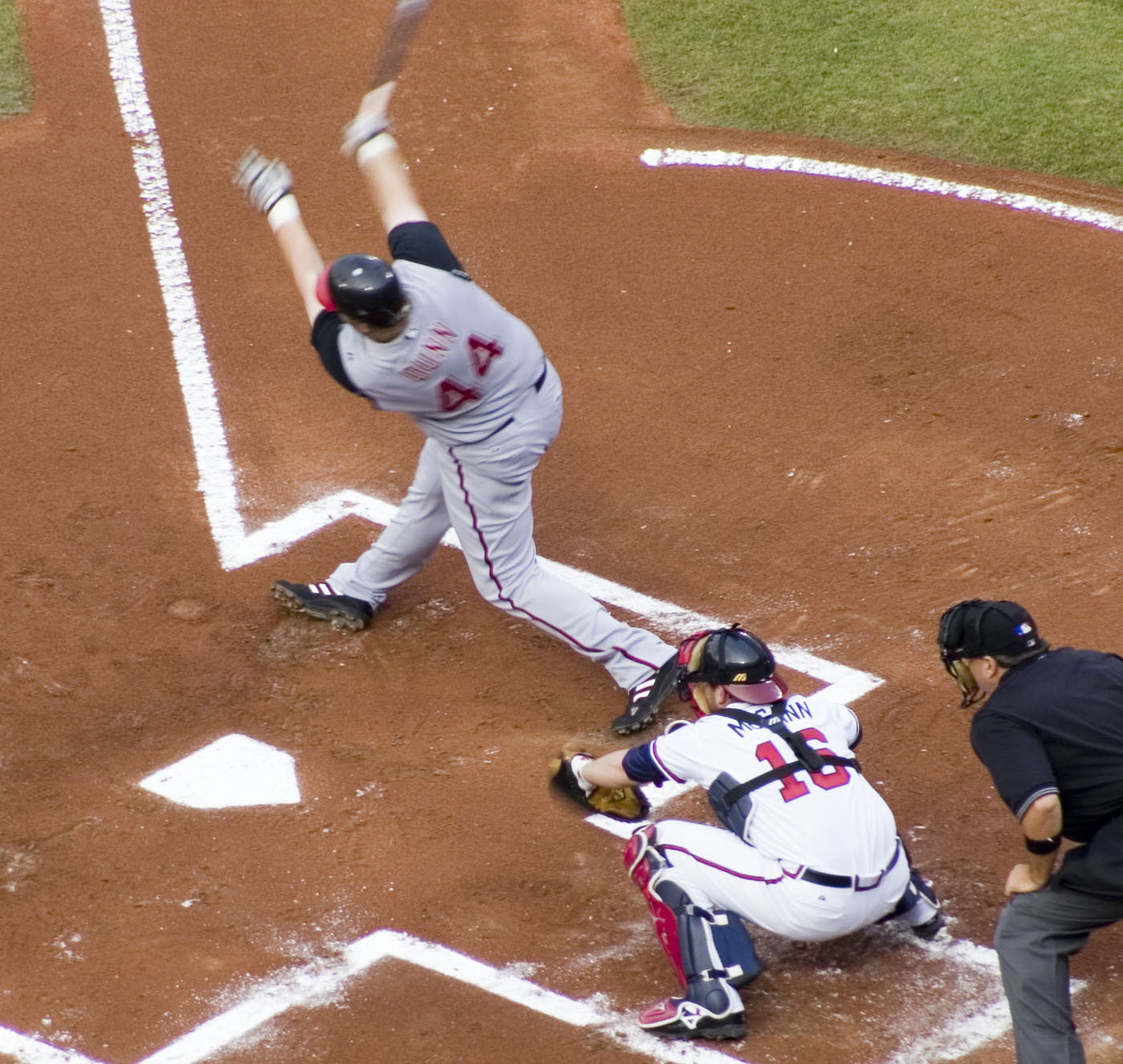
In baseball or softball, a strikeout (or strike-out) occurs when a batter accumulates three strikes during a time at bat. It means the batter is out, unless the third strike is not caught by the catcher and the batter reaches first base safely as a result. A strikeout is a statistic recorded for both pitchers and batters, and is usually denoted by the letter K, or sometimes by the initialism SO. A "strikeout looking"—in which the batter does not swing and the third strike is called by the umpire—may be denoted by an inverted K (i.e. ꓘ).[1]
Although a strikeout suggests that the pitcher dominated the batter, the free-swinging style that generates home runs also leaves batters susceptible to striking out. Some of the most prolific home run hitters of all time (such as Adam Dunn, Mickey Mantle, Reggie Jackson, Alex Rodriguez, and Jim Thome) were notorious for striking out often. Notably, Jackson and Thome respectively hold the major league records for most and second most times struck out in a career. Conversely, Tony Gwynn who is notorious for his strikeout statistics amassing only 434 strikeouts in 10,232 plate appearances over his 20-year playing career, was also noted for his lack of home runs.
Rules and jargon
[edit]A pitched ball is ruled a ball by the umpire if the batter did not swing at it and, in that umpire's judgement, it does not pass through the strike zone. Any pitch at which the batter swings unsuccessfully or, that in that umpire's judgement passes through the strike zone, is ruled a strike. Each ball and strike affects the count, which is incremented for each pitched ball with the exception of a foul ball on any count with two strikes. That is, a third strike may only occur by the batter swinging and missing at a pitched ball, or the pitched ball being ruled a strike by the umpire with no swing by the batter. A pitched ball that is struck by the batter with the bat on any count, and is not a foul ball or foul tip, is in play. A batter may also strike out by bunting, even if the ball is hit into foul territory.
A pitcher receives credit for (and a batter is charged with) a strikeout on any third strike, but a batter is out only if one of the following is true:
- The third strike is pitched and caught in flight by the catcher (including foul tips);
- On any third strike, if a baserunner is on first and there are at most 1 out;
- The third strike is bunted foul and is not caught by a fielder.
Thus, it is possible for a batter to strike out, but still become a runner and reach base safely if the catcher is unable to catch the third strike cleanly, and he then does not either tag out the batter or force him out at first base. In Japan, this is called furinige (振り逃げ), or "swing and escape". In Major League Baseball, it is known as an uncaught third strike. When this happens, a strikeout is recorded for both the pitcher and the batter, but no out is recorded. Because of this, a pitcher may occasionally be able to record more than three strikeouts in one inning.
It is also possible for a strikeout to result in a fielder's choice. With the bases loaded and two strikes with two outs, the catcher drops the ball or catches it on the bounce. The batter-runner is obliged to run for first base and other base-runners are obliged to attempt to advance one base. Should the catcher field the ball and step on home plate before the runner from third base can score, then the runner from third base is forced out.
In baseball scorekeeping, a swinging strikeout is recorded as a K or a K-S. A strikeout looking (where the batter does not swing at a pitch that the umpire then calls strike three) is often scored with a backwards K (ꓘ), and sometimes as a K-L, CK, or Kc (the 'c' for 'called' strike). In terms of gameplay, swinging and looking strikeouts are exactly equivalent; the difference in notation is simply to record this aspect of the time at bat. Despite the scorekeeping custom of using "K" for strikeout, "SO" is the official abbreviation used by Major League Baseball.[2]
"K" is still commonly used by fans and enthusiasts for purposes other than official record-keeping. One baseball ritual involves fans attaching a succession of small "K" signs to the nearest railing, one added for every strikeout notched by the home team's pitcher, following a tradition started by New York Mets fans in honor of "Dr. K", Dwight Gooden. The "K" may be reversed (ꓘ) in cases where the batter strikes out looking, just as it would appear on a scorecard. Virtually every televised display of a high-strikeout major league game will include a shot of a fan's strikeout display, and if the pitcher continues to strike out batters, the display may be shown following every strikeout.[citation needed]
The use of "K" for a strikeout was invented by Henry Chadwick, a newspaper journalist who is widely credited as the originator of the box score and the baseball scorecard. As is true in much of baseball, both the box score and scorecard remain largely unchanged to this day. Chadwick decided to use "K", the last letter in "struck", since the letter "S" was used for "sacrifice". Chadwick was responsible for several other scorekeeping conventions, including the use of numbers to designate player positions.[3]
Those unaware of Chadwick's contributions have speculated that "K" was derived from the last name of 19th-century pitcher Matt Kilroy. If not for the evidence supporting Chadwick's earlier use of "K", this explanation would be reasonable. Kilroy raised the prominence of the strikeout, setting an all-time single-season record of 513 strikeouts in 1886, only two years after overhand pitching was permitted. His record, however, is limited to its era since the pitcher's mound was only 50 feet (15 m) from the batter during that season. It was moved to its current distance of 60'6" in 1893. The modern record (1901–present) is 383 strikeouts, held by Nolan Ryan, one better than Sandy Koufax's 382.
For 55 years, Walter Johnson held the career strikeout record, at 3,508. That record fell in 1982 to Nolan Ryan, who was then passed by Steve Carlton, before Ryan took the career strikeout record for good at 5,714.
History
[edit]Early rules stated that "three balls being struck at and missed and the last one caught, is a hand-out; if not caught is considered fair, and the striker bound to run." The modern rule has changed very little. The addition of the called strike came in 1858.
In 1880, the rules were changed to specify that a third strike had to be caught on the fly. A later adjustment to the dropped third strike rule specified that a batter is automatically out when there are fewer than two out and a runner on first base. In 1887, the number of strikes for an out was changed to four, but it was promptly changed back to three the next season.
The rule that a third strike (only) must be caught originates in the concept that a third strike is not an automatic out, but rather puts the ball in play. The rule was described at least as early as Johann Christoph Friedrich GutsMuths' 1793 book Gymnastik für die Jugend (Gymnastics for Youth) and has remained in effect since. After the third strike, the ball being in play, the batter (now a runner) must be put out. This is almost always done immediately after the strike is made, by the catcher (putouts on strikeouts are still credited to the catcher),[4] but if the ball is not caught on the fly by the catcher, the batter/runner must be put out by the same means as any other runner who puts a ball in play which is not caught on the fly—by soaking (hitting the runner with a ball thrown by a fielder, now long obsolete), or by being tagged out, or by leaving the baseline, or by force out at first base.[5]
Slang
[edit]
A swinging strikeout is often called a whiff, while a batter who is struck out by a fastball is often said to have been blown away. A batter who strikes out on a swung third strike is said to have fanned (as in a fanning motion), whereas if he takes a called third strike it is called a punch out (describing the plate umpire's dramatic punching motion on a called third strike). However, sometimes these words are used as general synonyms for a strikeout, irrespective of whether it was swinging or looking. The announcer Ernie Harwell called a batter who took a called third strike, usually on the other team, "out for excessive window-shopping" or having "stood like the house by the side of the road".
On a called third strike, it is said that the batter was caught looking, or that he looked at a strike. Typically, a called third strike can be somewhat more embarrassing for a batter, as it shows that he was either fooled by the pitcher or, even worse, had a moment of hesitation.
For example, Carlos Beltrán was caught looking at strike 3 to end the 2006 NLCS, and the season, for the New York Mets. Sports commentators have also been known to refer to it as browsing if the batter did not move his bat at all.
A pitcher is said to striking out the side when he retires all three batters in a half-inning by striking them out. This term is also used when all three outs were caused by strikeouts, regardless of how other batters in the inning fared. If a pitcher strikes out three batters on nine pitches, he is said to have pitched an immaculate inning. A batter that takes the third strike looking, especially on a breaking pitch like a slider or a curveball that appears to be out of the strike zone but drops in before he can get the bat off his shoulders, can be said to have been frozen.
In slang, when a batter strikes out three times in a game, he is said to have completed a hat trick. If he strikes out four times, it is called a golden sombrero. He receives a platinum sombrero if he strikes out five times, and this dishonor is also known as the Olympic rings.
Striking out six times is a rare occurrence, which in the history of major league play has only occurred in games that went to extra innings, with Sam Horn of the Baltimore Orioles being one of the few to do this. The slugger's then-teammate, pitcher Mike Flanagan, told reporters after that 1991 event that six strikeouts would thereafter be known as a Horn. He added that if anyone ever strikes out seven times in one game, it will be a Horn of Plenty.

Some pitchers who specialize in strikeouts have acquired nicknames including the letter "K". Dwight Gooden was known as "Doctor K" (alluding to basketball star Julius Erving a.k.a. "Dr. J"). Francisco Rodríguez is known as "K-Rod".[6] Roger Clemens has taken the "K" name to an extreme by naming his four sons Koby, Kory, Kacy, and Kody. Tim Lincecum is nicknamed "The Say 'K' Kid", alluding to former Giants player Willie Mays who was called "The Say Hey Kid". Daisuke Matsuzaka is known as "Dice-K", a term that was used as a pronunciation guide for his name when he first arrived in MLB.
Hall of Fame strikeout artist Sandy Koufax of the Los Angeles Dodgers coincidentally has a last name starting with "K", and in his call of the pitcher's perfect game in 1965, Dodgers announcer Vin Scully commented that Koufax's name "will always remind you of strikeouts".[7]
More than three strikeouts in an inning
[edit].jpg)
If a third strike is not caught cleanly by the catcher, it is still recorded as a strikeout for both the pitcher and the batter, but the batter becomes a runner and the play is still alive. (This is not true when first base is occupied and there are fewer than two outs; see Uncaught third strike.)[8] The runner may take first base unless the defense tags or throws him out. Therefore, a pitcher can achieve more than three strikeouts in one standard half-inning.
Prior to 1960, the event occurred only seven times.[9] The first Major League player to be credited with the feat was Ed "Cannonball" Crane of the New York Giants on October 4, 1888.[10] It has occurred in Major League Baseball 76 times.[11][12] Chuck Finley accomplished the feat on May 12 and August 15, 1999, with the Anaheim Angels and again on April 16, 2000, with the Cleveland Indians. Pete Richert of the Los Angeles Dodgers is the only pitcher to do it in his MLB debut (April 12, 1962, against the Cincinnati Reds).[13] Steve Delabar struck out four men in the 10th inning, and recorded the win in a 3–2 victory over the Chicago White Sox on August 13, 2012, making him the first pitcher in major league history to record four strikeouts in an extra inning.[14]
For a list of pitchers who have achieved more than three strikeouts in an inning, including the most recent pitcher to do so, see List of Major League Baseball single-inning strikeout leaders.
Five strikeouts in one inning have never occurred in a regulation Major League Baseball game. They have occurred at least six times at the minor league level. John Perkovitsh of Wisconsin Rapids did so against Oshkosh in a Wisconsin State League game on May 17, 1946, while Ron Necciai of Bristol in the Appalachian League accomplished the feat against Johnson City on May 17, 1952. Kelly Wunsch of the Beloit Brewers fanned five in the third inning on April 15, 1994.[15] Mike Schultz of the Lancaster JetHawks struck out five batters in one inning on July 16, 2004, and Garrett Bauer of the Rockford RiverHawks struck out five batters in one inning on July 1, 2008.[16] Most recently, Malcolm Van Buren of the Burlington Royals struck out five in the seventh inning of a game on July 31, 2019.[17] That this has never happened in Major League play reflects the rarity of a pitcher getting a strikeout with an uncaught third strike, but also that,
- A second uncaught third strike happens with two outs, whether or not a runner is on first base and that the batter safely reaches first base, or
- that with fewer than two outs, the first baserunner, who reached base on an uncaught third strike, must have scored or be on a base other than first before another strikeout with a dropped 3rd strike can occur. Alternately, one or two normal strikeouts must be recorded before the second runner can possibly reach first base on a dropped 3rd strike; only when the second batter-runner reaches base can the 5th strikeout be completed.
Houston Astros pitcher Joe Niekro struck out five Minnesota Twins batters in the first inning of an exhibition spring training game[18] on April 7, 1976, in New Orleans. Niekro's catcher, Cliff Johnson, was charged with five passed balls in the inning.[19] Exhibition games are not recorded in official statistics.
Records
[edit]Pitchers
[edit]
Career total
[edit]The top 20 Major League Baseball career strikeout leaders (active players in bold) (since 1901):[20]
- Nolan Ryan – 5,714
- Randy Johnson – 4,875
- Roger Clemens – 4,672
- Steve Carlton – 4,136
- Bert Blyleven – 3,701
- Tom Seaver – 3,640
- Don Sutton – 3,574
- Justin Verlander – 3,553
- Gaylord Perry – 3,534
- Walter Johnson – 3,509
- Max Scherzer – 3,489
- Greg Maddux – 3,371
- Phil Niekro – 3,342
- Ferguson Jenkins – 3,192
- Pedro Martínez – 3,154
- Bob Gibson – 3,117
- Curt Schilling – 3,116
- CC Sabathia – 3,093
- John Smoltz – 3,084
- Clayton Kershaw – 3,052
Active pitchers with over 2,000 strikeouts (as of the end of the 2025 season):[21]
- Justin Verlander – 3,553
- Max Scherzer – 3,489
- Clayton Kershaw – 3,052
- Chris Sale – 2,579
- Gerrit Cole – 2,251
- Charlie Morton – 2,196
- Yu Darvish – 2,075
Strikeouts per 9 innings
[edit]The top 10 Major League Baseball career strikeout-per-nine innings leaders (since 1900, minimum 1,000 IP):[22]
- Blake Snell - 11.21
- Chris Sale – 11.12
- Dylan Cease – 10.89
- Robbie Ray – 10.83
- Jacob deGrom – 10.81
- Randy Johnson – 10.60
- Max Scherzer – 10.59
- Stephen Strasburg – 10.54
- Yu Darvish – 10.51
- Gerrit Cole – 10.36
The top 5 Major League Baseball single-season strikeout-per-nine innings leaders (since 1900, minimum 1.0 IP per team game):[23]
- Shane Bieber, 2020 – 14.19
- Gerrit Cole, 2019 – 13.81
- Jacob deGrom, 2020 – 13.76
- Spencer Strider, 2023 - 13.54
- Randy Johnson, 2001 – 13.40
Season
[edit]The top 10 Major League Baseball single-season strikeout totals (since 1900):[24]
| Pitcher | Strikeouts | Season | Team | League | Overall Rank |
|---|---|---|---|---|---|
| Nolan Ryan | 383 | 1973 | California Angels | AL | 8 |
| Sandy Koufax | 382 | 1965 | Los Angeles Dodgers | NL | 9 |
| Randy Johnson | 372 | 2001 | Arizona Diamondbacks | NL | 11 |
| Nolan Ryan | 367 | 1974 | California Angels | AL | 14 |
| Randy Johnson | 364 | 1999 | Arizona Diamondbacks | NL | 15 |
| Rube Waddell | 349 | 1904 | Philadelphia Athletics | AL | 18 |
| Bob Feller | 348 | 1946 | Cleveland Indians | AL | 19 |
| Randy Johnson | 347 | 2000 | Arizona Diamondbacks | NL | 20 |
| Nolan Ryan | 341 | 1977 | California Angels | AL | 25 |
| Randy Johnson | 334 | 2002 | Arizona Diamondbacks | NL | 30 |
The top 10 Major League Baseball single-season strikeout totals (all time):[25]
| Pitcher | Strikeouts | Season | Team | League | Overall Rank |
|---|---|---|---|---|---|
| Matt Kilroy | 513 | 1886 | Baltimore Orioles | AA | 1 |
| Toad Ramsey | 499 | 1886 | Louisville Colonels | AA | 2 |
| Hugh Daily | 483 | 1884 | Chicago Browns/Pittsburgh Stogies/Washington Nationals | UA | 3 |
| Dupee Shaw | 451 | 1884 | Detroit Wolverines/Boston Reds | NL/UA | 4 |
| Old Hoss Radbourn | 441 | 1884 | Providence Grays | NL | 5 |
| Charlie Buffington | 417 | 1884 | Boston Beaneaters | Da | 6 |
| Guy Hecker | 385 | 1884 | Louisville Eclipse | AA | 7 |
| Nolan Ryan | 383 | 1973 | California Angels | AL | 8 |
| Sandy Koufax | 382 | 1965 | Los Angeles Dodgers | NL | 9 |
| Bill Sweeney | 374 | 1884 | Baltimore Monumentals | UA | 10 |
Game
[edit]Progression of major league strikeout record for one nine-inning game, regular season (partial listing):
- 18 – Dupee Shaw, Boston Reds (UA), July 19, 1884.[26] Matched by:
- Henry Porter, Milwaukee Brewers (UA), October 3, 1884.[26][27]
Modern era:
- 16 – Rube Waddell, July 29, 1908
- 18 – Bob Feller, October 2, 1938. Matched by:
- Sandy Koufax, August 31, 1959
- Koufax again, April 24, 1962
- Don Wilson, July 14, 1968
- Ron Guidry, June 17, 1978.
- 19 – Steve Carlton, September 15, 1969. Matched by:
- Tom Seaver, April 22, 1970
- Nolan Ryan, August 12, 1974.
- David Cone, October 16, 1991
- 20 – Roger Clemens, April 29, 1986. Matched by:
- Clemens again, September 18, 1996
- Kerry Wood, May 6, 1998
- Randy Johnson, May 8, 2001 (the first nine innings of an extra-inning game)
- Max Scherzer, May 11, 2016
Note: Tom Cheney struck out 21 batters overall, in a 16-inning game, September 12, 1962.[28] He had 13 strikeouts through the first nine innings.
Progression of strikeout record, World Series game:
- 10 – 1903 (first modern Series), Game 1, Deacon Phillippe
- 11 – 1903, Game 2, Bill Dinneen
- 12 – 1906, Game 3, Ed Walsh
- 13 – 1929, Game 1, Howard Ehmke
- 14 – 1953, Game 3, Carl Erskine
- 15 – 1963, Game 1, Sandy Koufax
- 17 – 1968, Game 1, Bob Gibson[29]
Progression of major league strikeout record for a relief pitcher, regular season (partial listing):[30]
- 15 – Walter Johnson, July 25, 1915
- 16 – Randy Johnson, July 18, 2001[31]
Batters
[edit]Career
[edit]The top 15 Major League Baseball career strikeout leaders (as of the end of the 2025 season):[32]
- Reggie Jackson – 2,597
- Jim Thome – 2,548
- Adam Dunn – 2,379
- Sammy Sosa – 2,306
- Alex Rodriguez – 2,287
- Miguel Cabrera – 2,105
- Giancarlo Stanton – 2,059
- Andrés Galarraga – 2,003
- Paul Goldschmidt – 1,979
- Justin Upton - 1,971
- José Canseco – 1,942
- Willie Stargell – 1,937
- Mark Reynolds – 1,927
- Nelson Cruz – 1,916
- Curtis Granderson – 1,916
Active batters with over 1,300 K's (as of the end of the 2025 season):
- Giancarlo Stanton – 2,059
- Paul Goldschmidt – 1,979
- Andrew McCutchen – 1,893
- Eugenio Suárez – 1,814
- Freddie Freeman – 1,763
- J.D. Martinez – 1,714
- Mike Trout – 1,663
- Bryce Harper – 1,654
- Nick Castellanos – 1,617
- Christian Yelich – 1,548
- Carlos Santana – 1,540
- Kyle Schwarber – 1,527
- Marcell Ozuna – 1,490
- Manny Machado – 1,433
- Javier Báez – 1,403
- Aaron Judge – 1,369
- George Springer – 1,315
- Marcus Semien – 1,305
- Salvador Perez – 1,303
Season
[edit]Single-season strikeout records (batters):
| Rank | Player | Team | Strikeouts | Year |
|---|---|---|---|---|
1 |
Mark Reynolds | Arizona Diamondbacks | 223 | 2009 |
2 |
Adam Dunn | Chicago White Sox | 222 | 2012 |
3
|
James Wood | Washington Nationals | 221 | 2025 |
4 |
Chris Davis | Baltimore Orioles | 219 | 2016 |
5
|
Elly De La Cruz | Cincinnati Reds | 218 | 2024 |
6 |
Yoán Moncada | Chicago White Sox | 217 | 2018 |
7 |
Kyle Schwarber | Philadelphia Phillies | 215 | 2023 |
8
|
Eugenio Suárez | Arizona Diamondbacks | 214 | 2023 |
9
|
Joey Gallo | Texas Rangers | 213 | 2021 |
10
|
Chris Carter | Houston Astros | 212 | 2013 |
Game (teams combined)
[edit]Progression of record for total strikeouts by both teams in one game (partial listing):
- 33 – San Francisco Giants at Philadelphia Phillies (14 innings), June 22, 1958.[33][34] Matched by:
- 36 – San Francisco Giants at New York Mets (23 innings), May 31, 1964[36][37][34]
- 43 – California Angels at Oakland Athletics (20 innings), July 9, 1971[38][39][37]
- 48 – New York Yankees at Chicago Cubs (18 innings), May 7, 2017[40][39]
See also
[edit]
References
[edit]- ^ Major League Baseball (2001–2009). "Baseball Basics: Abbreviations". Retrieved September 2, 2009.
- ^ "The Official Site of Major League Baseball: Official info: Baseball Basics: Abbreviations". Mlb.mlb.com. May 24, 2013. Retrieved June 6, 2013.
- ^ "In baseball scoring, why is a strikeout marked with a K?". Thestraightdope.com. Retrieved December 20, 2005.
- ^ "Putout (PO): Definition". Major League Baseball. Retrieved March 30, 2021.
- ^ Hershberger, Richard (Spring 2015). "The Dropped Third Strike: The Life and Times of a Rule". Baseball Research Journal. SABR (Society for American Baseball Research). Retrieved March 30, 2021.
- ^ "Truth&Rumors | K-Rod expects to leave Angels". FanNation. March 22, 2008. Retrieved June 6, 2013.
- ^ Shaikin, Bill (September 25, 2016). "Three calls that are arguably Vin Scully's all-time best". Los Angeles Times. Retrieved December 26, 2017.
- ^ Official Rules of Major League Baseball 6.09b
- ^ "Four Strikeouts in One Inning". Baseball-almanac.com. 2011. Retrieved May 12, 2011.
- ^ "Fluke or Feat: Ranking the Toughest Single Game Accomplishments in MLB". Bleacherreport.com. 2011. Retrieved May 13, 2011.
- ^ "Rare Feats: Four K's in One Inning". mlb.mlb.com. Retrieved August 17, 2012.
- ^ Kercheval, Nancy (June 25, 2011). "Burnett Becomes First New York Yankee to Strike Out 4 in a Single Inning". Bloomberg.com. Bloomberg. Retrieved September 28, 2011.
- ^ "Los Angeles Dodgers 11, Cincinnati Reds 7". Retrosheet.org. April 12, 1962. Retrieved October 17, 2010.
- ^ "Cooper drives in winning run as Jays beat White Sox in 11th". TSN.ca. August 13, 2012. Retrieved August 14, 2012.
- ^ "Brewer Farmhand Fans 5 - In One Inning". April 21, 1994. Retrieved July 31, 2019.
- ^ "Bauer K's 5 in first; James hits winner in 12th". Rockfordriverhawks.com. July 1, 2008. Retrieved October 17, 2010.
- ^ Burlington Baseball- 2021 Appy League [@BurlingtonBases] (July 31, 2019). "Mid 7: MALCOLM VAN BUREN STRIKES OUT FIVE BATTERS IN ONE INNING! Twins kept off the board as they still lead 6-5" (Tweet). Retrieved December 31, 2020 – via Twitter.
{{cite web}}: CS1 maint: numeric names: authors list (link) - ^ Schlossberg, Dan (2007). Baseball Gold: Mining Nuggets from Our National Pastime. Chicago: Triumph Books. pp. 302–303. ISBN 978-1-57243-958-0.
- ^ The Chicago Tribune, April 8, 1976, p. C2
- ^ "Career Leaders & Records for Strikeouts". Baseball-Reference.com. Retrieved October 14, 2018.
- ^ "Active Leaders & Records for Strikeouts". Baseball-Reference.com. Retrieved October 14, 2018.
- ^ "Career Leaders & Records for Strikeouts per 9 IP". Baseball-Reference.com. Retrieved October 14, 2018.
- ^ "Single-Season Leaders & Records for Strikeouts per 9 IP". Baseball-Reference.com. Retrieved October 14, 2018.
- ^ "Strikeouts Single Season Leaders by Baseball Almanac". Baseball-almanac.com. Retrieved June 6, 2013.
- ^ "Single-Season Leaders & Records for Strikeouts". Retrieved May 10, 2011.
- ^ a b "Baseball Recordbook 2007" (PDF). Sporting News. p. 63.
- ^ Bevis, Charlie. "George Bignell". SABR. Retrieved June 6, 2013.
- ^ "Washington Senators 2, Baltimore Orioles 1". Retrosheet. September 12, 1962. Retrieved May 8, 2017.
- ^ "St. Louis Cardinals 4, Detroit Tigers 0". Retrosheet. October 2, 1968. Retrieved May 8, 2017.
- ^ "Strikeout Records". Baseball Almanac.
- ^ "Arizona Diamondbacks 3, San Diego Padres 0". Retrosheet. July 18, 2001. Retrieved May 8, 2017.
- ^ "Career Leaders & Records for Strikeouts".
- ^ "San Francisco Giants 5, Philadelphia Phillies 4 (1)". Retrosheet. June 22, 1958. Retrieved May 8, 2017.
- ^ a b c "Major League Records Set in Marathon". Chicago Tribune. June 1, 1964. Retrieved May 8, 2017 – via newspapers.com.
- ^ "Cleveland Indians 3, Washington Senators 2 (2)". Retrosheet. June 14, 1963. Retrieved May 8, 2017.
- ^ "San Francisco Giants 8, New York Mets 6 (2)". Retrosheet. May 31, 1964. Retrieved May 8, 2017.
- ^ a b "Mangual Ends Angels' Night Life". St. Louis Post-Dispatch. July 10, 1971. Retrieved May 8, 2017 – via newspapers.com.
- ^ "Oakland Athletics 1, California Angels 0". Retrosheet. July 9, 1971. Retrieved May 8, 2017.
- ^ a b "Yankees-Cubs sets MLB record with 48 combined strikeouts". ESPN.com. May 8, 2017. Retrieved May 8, 2017.
- ^ "New York Yankees vs. Chicago Cubs – Box Score". ESPN.com. May 7, 2017. Retrieved May 8, 2017.
Further reading
[edit]- Carig, Marc (June 25, 2024). "Missing Bats: A special series in The Athletic". The Athletic. Retrieved August 11, 2024.
External links
[edit]- Career Leaders and Records for Strikeouts (batters)
- Career Leaders and Records for Strikeouts (pitchers)
- Four Strikeouts in 1 Inning


Strikeout
View on GrokipediaDefinition and Rules
Basic Mechanics
A strikeout occurs when a batter accumulates three strikes during an at-bat, resulting in an out recorded against the batter and credited to the pitcher.[7] Strikes are called by the umpire and can result from a pitch entering the strike zone without the batter swinging, a swing that misses the ball, or certain foul balls.[7] Strikes are categorized into several types based on the batter's action and the pitch's location. A swinging strike happens when the batter swings at and misses the ball, regardless of whether the pitch is in the strike zone.[7] A called strike is declared when the pitch passes through the strike zone and the batter does not swing.[7] Foul balls count as strikes if they occur with fewer than two strikes already recorded, but after two strikes, a foul ball (other than a foul tip or bunt) does not add another strike.[7] A foul tip, defined as a batted ball that travels sharply and directly from the bat to the catcher's glove and is legally caught, counts as a strike even after two strikes.[7] Checked swings involve the batter starting a swing but attempting to stop; the plate umpire judges whether it constitutes a full swing, potentially calling a swinging strike if so, with assistance from base umpires if requested.[7] The pitcher plays a central role by delivering the ball from the pitcher's plate, 60 feet, 6 inches from home plate, aiming to induce swings or target the strike zone to accumulate strikes.[7] The catcher supports this effort by positioning behind home plate to receive pitches and framing them—positioning the mitt to make borderline pitches appear within the strike zone, potentially influencing the umpire's call.[7] The umpire, specifically the home plate umpire, has sole authority to call balls and strikes, verbally announcing "strike" for each valid pitch and signaling with an arm gesture.[7] The strike zone is the three-dimensional area over home plate that determines called strikes, extending vertically from the midpoint between the top of the batter's shoulders and the top of the uniform pants down to the hollow beneath the kneecap, and horizontally from one side of the plate to the other, when the batter assumes a natural stance.[7] The umpire evaluates whether the pitch passes through this zone in flight, based on the batter's stance at the moment of pitch release.[7] Upon the third strike, the batter is out and must return to the dugout, unless the pitch is not caught by the catcher—in which case, it is an uncaught third strike (also known as a dropped third strike), allowing the batter to become a runner and attempt to reach first base if it is unoccupied or there are two outs.[7] Runners on base may advance at their own risk on an uncaught third strike.[7]Jargon and Terminology
In baseball scorekeeping and statistics, a strikeout is abbreviated as "K," a convention originating from the last letter in the word "struck" to avoid confusion with "S" for sacrifice.[8] A backward "K" specifically denotes a called third strike where the batter does not swing, distinguishing it from a swinging strikeout.[1] Strikeouts are categorized into two primary types: swinging and looking. A swinging strikeout occurs when the batter attempts to hit the pitch but accumulates three strikes, including at least one missed swing on the final pitch.[1] In contrast, a looking strikeout, also known as a called strikeout, happens when the batter does not swing at a pitch deemed a strike by the umpire, resulting in the third strike.[1] These distinctions highlight the batter's decision-making and the pitcher's ability to induce either aggressive swings or precise location within the strike zone. The strike zone itself is a fundamental term referring to the imaginary rectangular area over home plate where a pitch must pass to be called a strike, defined officially as extending from the midpoint between the batter's shoulders and the top of their uniform pants down to the hollow beneath the kneecap.[9] A full count describes the 3-2 ball-strike situation, the maximum before the at-bat resolves in a walk or strikeout, often leading to high-tension pitches.[10] Related jargon includes "batting the breeze," an older expression for a batter whiffing or swinging through a pitch without contact, evoking the empty motion of stirring air.[11] Umpires communicate calls through standardized signals, particularly for strikes and strikeouts. For a strike, the umpire typically extends the right arm outward with a clenched fist, known as "pounding the zone," while a full strikeout on the third strike involves a similar emphatic fist pump to indicate the out.[12] Catchers contribute to these calls via "framing the pitch," a technique where they subtly adjust their glove position to present borderline pitches as strikes, influencing the umpire's perception without overt movement.[13] Statistical terminology for strikeouts includes K/9 for pitchers, which measures strikeouts per nine innings pitched by dividing total strikeouts by innings pitched and multiplying by nine, providing a normalized rate of dominance.[14] For batters, K% represents the strikeout percentage, calculated as strikeouts divided by total plate appearances, indicating how often a hitter fails to put the ball in play.[15]Historical Development
Origins in Early Baseball
The origins of the strikeout in baseball trace back to the mid-19th century, when the sport was transitioning from informal variants like town ball and the Massachusetts game to more structured rules. In these pre-professional eras, games such as town ball—played widely in the northeastern United States—typically featured a three-strike rule where a batter was out only if they swung and missed three times and the ball was caught each time by a fielder, without any concept of called strikes or balls.[16] Similarly, the Massachusetts rules, formalized around 1858 but rooted in earlier 1800s play, required three missed swings with each catch to declare an out, emphasizing contact over non-swinging inaction.[17] These variants, often played by amateur clubs in urban and rural settings, rarely resulted in strikeouts due to underhand pitching styles that encouraged hitting rather than overpowering batters.[18] A pivotal advancement came with the 1845 Knickerbocker Rules, drafted by members of the Knickerbocker Base Ball Club in New York City, which formalized baseball's foundational structure and introduced the core mechanic of three strikes for an out.[19] Under Rule 11, "Three balls being struck at and missed and the last one caught, is a hand-out; if not caught is considered fair, and the striker bound to run," meaning batters had to swing at every pitch since no balls were called, making non-contact outs dependent on fielders catching all three misses.[20] Alexander Cartwright, a key club member and influential figure in the club's organization, played a significant role in shaping these rules, including the diamond-shaped field and out mechanisms that standardized play and reduced chaos from earlier folk games.[21] This framework marked the first widespread adoption of strikes as a primary way to retire batters, though strikeouts remained uncommon in the 1850s amateur contests that followed, as pitchers delivered slow, underhand tosses and batters took unlimited pitches without penalty until swinging.[22] The introduction of called strikes in 1858, proposed by Daniel "Doc" Adams at the National Association of Base Ball Players convention, allowed umpires to declare a strike on any fairly delivered pitch not swung at, shifting responsibility and enabling true strikeouts without catches.[23] Called balls followed in 1864 to prevent pitchers from wasting time with unreachable deliveries, initially requiring nine for a walk, which balanced the game but kept strikeouts infrequent in the underhand pitching era.[24] By the late 19th century, as overhand pitching emerged, strikeouts began to increase slightly, though they were still rare compared to groundouts and flyouts due to the dead-ball style's emphasis on contact hitting.[25] A key balancing change occurred in 1889, when the National League reduced the walk threshold to four balls—down from five in 1887—while maintaining three strikes, making strikeouts a more viable offensive threat without overly favoring pitchers.[26]Evolution and Rule Changes
The formalization of the strike zone in Major League Baseball (MLB) began to take shape in the early 20th century, with significant changes aimed at clarifying what constitutes a strike and balancing offensive and defensive play. In 1901, the National League (followed by the American League in 1903) adopted the foul strike rule, stipulating that a foul ball not caught on the fly counts as a strike unless the batter already has two strikes; this change increased the potential for strikeouts by making foul balls punitive rather than neutral, addressing strategies where batters fouled off pitches indefinitely.[27] By 1950, the strike zone was explicitly defined as the area over home plate between the batter's armpits and the top of the knees when in a natural stance, narrowing the upper boundary from the previous top-of-the-shoulders limit and thereby reducing the zone's size to favor hitters slightly, which contributed to fewer called strikeouts in borderline pitches.[28] Further adjustments in the late 20th century sought greater consistency in umpiring and gameplay dynamics. The 1969 rule change redefined the strike zone as the space from the batter's armpits to the top of the knees based on their usual swinging stance, shrinking it from the prior 1963-1968 definition (top of shoulders to bottom of knees) to counteract pitcher dominance observed in the "Year of the Pitcher" (1968); this, combined with lowering the pitcher's mound from 15 inches to 10 inches, led to a modest decline in strikeout rates from 17.8% in 1968 to 16.8% in 1969, as hitters gained better visibility and reaction time on pitches.[28][29] In 1988, the zone was adjusted to run from the midpoint between the top of the shoulders and the top of the uniform pants down to the top of the knees, determined by the batter's stance when prepared to swing; this refinement aimed to standardize calls across umpires and slightly expanded the lower boundary for consistency, though it had minimal immediate effect on overall strikeout totals.[28] In 1887, amid pitcher dominance, MLB briefly experimented with a four-strike rule to encourage offense and attendance, but reverted to three strikes in 1888 after it resulted in higher batting averages.[2] The rise in intentional walks during the 1960s—tracked officially since 1955 and reaching an average of approximately 0.75 per game in 1970—allowed pitchers to bypass high-average hitters without risking hits or walks, often shifting focus to strikeout-prone batters in subsequent at-bats and altering lineup management.[30] The American League's adoption of the designated hitter (DH) rule in 1973, which permitted a non-pitching batter to hit in place of the pitcher, indirectly reduced strikeouts by removing pitchers—who historically struck out at rates exceeding 40%—from the lineup.[31] In the years immediately following, AL strikeout rates decreased relative to the National League, with a difference of about 0.7 percentage points in 1973.[32] Recent innovations continue to evolve strikeout dynamics through pacing and technology. The 2023 introduction of the pitch clock—15 seconds between pitches with bases empty or 20 seconds with runners on, with automatic balls or strikes for violations—has accelerated gameplay, potentially increasing strikeouts by limiting batter adjustments and step-outs, as evidenced by a 2-3% uptick in minor league strikeout rates during testing phases.[33] Concurrently, MLB's automated ball-strike (ABS) system experiments, implemented in the Florida State League since 2021 and Triple-A since 2023, with a challenge variant tested in 2025 Spring Training (yielding a 50% overturn rate on ~4 challenges per game), aim to enhance call accuracy and consistency, which could refine strike zone enforcement and affect strikeout frequencies by reducing umpire variability.[34]Slang and Cultural Impact
Common Expressions
In baseball discourse, informal expressions for strikeouts often capture the dramatic flair of a batter missing the pitch, emphasizing the swing's futility or the pitcher's dominance. The term "whiff" describes a batter swinging through a pitch without making contact, evoking the sound or sensation of air being displaced by the bat, and has been used since at least 1881 to denote a strikeout.[35] Similarly, "fan" refers to striking out a batter, particularly on a swinging third strike, implying the batter fanning the air ineffectually; this usage emerged in late 19th-century play-by-play descriptions.[36] "Strike out swinging" is a casual synonym for this action, highlighting the batter's aggressive but unsuccessful attempt, distinct from a called strike.[37] Batter-focused idioms underscore quick or frustrating endings to at-bats. "Three up, three down" conveys an inning where three batters come to the plate and are retired swiftly, often via strikeouts, emphasizing efficiency in the pitcher's performance.[38] "Painting the black" praises a pitcher for locating pitches precisely on the edge of the strike zone— the "black" referring to the plate's rubber border—often resulting in close calls that lead to a strikeout.[38] Pitchers' boasts in slang celebrate overpowering the opposition. To "put away" a batter means to record the out via strikeout, as if securing the batter beyond reach, a phrase synonymous with finalizing the at-bat decisively.[39] "Nasty stuff" lauds a pitcher's arsenal of deceptive or high-velocity pitches that prove unhittable, causing batters to miss badly; the term gained traction in the late 20th century alongside descriptions of movement and spin.[40] Regional and notational variations add color to scorekeeping and commentary. "K'd" is shorthand for being struck out, derived from the formal "K" abbreviation for strikeout, which originated in the 1860s as the last letter of "struck" to distinguish it from other notations.[41] A "golden sombrero" denotes a batter striking out four times in a game, an escalation from the "hat trick" concept, coined in baseball lore to mock the ignominy.[42] Baseball slang has been enriched by radio broadcasts since the 1920s, where announcers covering Major League games used vivid phrases to paint pictures for listeners, such as likening a wild swing to a "fishing trip" for a bad pitch, helping embed these terms in fan vernacular.[43][44]Depictions in Media and Culture
Strikeouts have been a staple in baseball's portrayal on television since the medium's early adoption in the 1950s, when broadcasts began capturing the high-stakes tension of these moments for a growing audience of home viewers. As television sets proliferated across American households, networks like NBC and CBS aired regular season games and World Series matchups, emphasizing the dramatic pauses and crowd reactions during strikeouts to heighten viewer engagement.[45] In film, strikeouts often serve as pivotal narrative devices symbolizing personal triumph or downfall, as seen in the 1984 movie The Natural, directed by Barry Levinson. A memorable early scene depicts young pitcher Roy Hobbs (played by Robert Redford) striking out the arrogant slugger "The Whammer" in a tense, informal matchup, showcasing the pitcher's dominance and foreshadowing Hobbs' own journey through failure and redemption. Later in the film, strikeouts underscore themes of moral testing and resilience, contrasting Hobbs' supernatural talents with his human vulnerabilities, drawing from Bernard Malamud's 1952 novel of the same name where baseball becomes a metaphor for heroism and ethical struggle.[46][47] Literature similarly employs strikeouts to explore failure and redemption, evident in W.P. Kinsella's 1982 novel Shoeless Joe, which weaves baseball's inherent risks into a fantastical tale of second chances. The protagonist Ray Kinsella's reflections on the sport's failures parallel the redemption arcs of historical figures like Shoeless Joe Jackson, whose career was marred by scandal yet redeemed through mythic narrative. This motif highlights baseball's role in processing personal and cultural setbacks.[48] Video games have further embedded strikeouts in popular culture through realistic simulations, particularly in the MLB The Show series, where players engage with detailed pitching and hitting mechanics to execute or avoid these outcomes. Developed by San Diego Studio, the game's strike zone interface and timing-based controls replicate real-world strategy, allowing users to pitch breaking balls for strikeouts or adjust stances to foul off strikes, thereby shaping fans' understanding of the play's tactical depth.[49] On social media during the 2010s, strikeouts fueled viral content and memes, often turning embarrassing or dramatic moments into shareable humor that amplified baseball's entertainment value. For instance, Manny Machado's contorted 2018 postseason strikeout, where he dropped to one knee while flailing at a pitch, quickly became a meme resembling the letter "K"—baseball's shorthand for strikeout—spreading across platforms and highlighting players' vulnerabilities in high-pressure situations. Such compilations and reactions contributed to broader fan engagement, blending athletic failure with comedic relief.[50][51] Beyond sports, strikeouts frequently appear as metaphors for defeat and perseverance in non-athletic media, particularly business literature. In entrepreneurial contexts, Babe Ruth's record 1,330 career strikeouts alongside his 714 home runs illustrate the necessity of enduring failures to achieve breakthroughs, a lesson applied to innovators who view setbacks as essential to long-term success. This symbolism extends to investment strategies, where a "strikeout" denotes a total loss on a venture, yet portfolios succeed through selective high-reward hits amid frequent misses.[52][53]Unusual Strikeout Scenarios
Multiple Strikeouts in an Inning
In baseball, the structure of an inning limits it to three outs regardless of the number of strikeouts recorded, allowing pitchers to achieve more than three strikeouts if the uncaught third strike rule comes into play. This rule, in effect since the late 19th century, permits a batter to attempt to reach first base on a dropped third strike when first base is unoccupied or with two outs already recorded; the strikeout counts toward the pitcher's statistics, but no immediate out is made if the batter safely reaches base.[54] Theoretically, this enables an unlimited number of strikeouts in a single inning, as each uncaught third strike can extend the frame without producing an out, though practical limitations like base advancement and eventual outs cap occurrences. For instance, six strikeouts could occur without hits or fielding errors if multiple dropped third strikes allow batters to reach base and subsequent wild pitches advance runners sufficiently to keep first base open, delaying the three-out threshold until later in the sequence.[55] The uncaught third strike often involves a passed ball or wild pitch, which not only allows the batter to run but can also enable baserunners to advance, further prolonging the inning and creating opportunities for additional strikeouts. In a typical scenario leading to four strikeouts—the maximum recorded in Major League Baseball history—a pitcher records the first two outs via clean strikeouts, then induces a third strike that is dropped with first base open, allowing the batter to reach safely; the fourth batter then strikes out, but if dropped with the previous runner now at second (via a wild pitch), the batter reaches first without an out, before the inning ends on subsequent plays.[56][57] This mechanic has enabled over 100 such four-strikeout innings in MLB since 1887, though five or more remain unrecorded at the major league level, occurring only in minor leagues (e.g., Malcolm Van Buren in 2019).[58][59] The first recorded four-strikeout inning in major league history occurred on September 30, 1885, when Bobby Mathews of the Philadelphia Athletics fanned four Pittsburgh Alleghenys batters in the seventh inning, with two reaching base on dropped third strikes amid wild pitches that advanced runners.[56][60] Such events underscore pitcher dominance, including the rarer "immaculate inning," where a hurler strikes out three batters on exactly nine pitches (three strikes each), a subset of the standard three-strikeout frame that has happened 117 times in MLB history as of 2025.[61] Statistically, multiple strikeouts in an inning are notable rarities given the league average of under one strikeout per defensive half-inning—approximately 0.95 in recent seasons based on 8.6 strikeouts per nine innings league-wide—highlighting how exceptional circumstances like uncaught strikes elevate these occurrences beyond the norm.[62]Other Rare Events
One notable rarity involves ambidextrous pitchers facing switch-hitters, exemplified by Pat Venditte, who pitched professionally with both hands from 2008 to 2020. On June 19, 2008, while with the Staten Island Yankees, Venditte struck out switch-hitter Ralph Henriquez in the ninth inning after a prolonged standoff where both adjusted their stances multiple times, prompting Major League Baseball to establish the "Venditte Rule" (Official Baseball Rule 5.07(f)) to clarify procedures for such matchups.[63][64] The eephus pitch, a slow, high-arcing lob typically traveling at 50-60 mph, has occasionally induced unexpected whiffs despite its lack of velocity. Invented by Pittsburgh Pirates pitcher Rip Sewell in 1943 following a leg injury that altered his delivery, the pitch debuted on April 21, 1943, against the Chicago Cubs when outfielder Dom Dallessandro struck out swinging in frustration at the unusual trajectory. Sewell employed it up to 15 times per game in favorable counts during the 1940s, contributing to his 21-12 record and 2.54 ERA in 1943, though it famously yielded a home run to Ted Williams in the 1946 All-Star Game.[65] Strikeouts with the bases loaded remain uncommon in modern baseball, as managers often issue intentional walks to avoid risking runs against power hitters, but they occurred more frequently in the dead-ball era (roughly 1900-1919) when home runs were scarce and pitchers routinely challenged batters in high-leverage spots without walking them. This era's emphasis on contact hitting and low-scoring games (averaging around 4 runs per team per game) meant pitchers like Walter Johnson faced loaded bases without immediate capitulation, leading to strikeouts as a defensive outcome in tight contests.[25] Umpire errors occasionally result in reversed strikeout calls, altering game outcomes through crew consultations under Official Baseball Rule 8.02(c), which permits corrections for misjudged plays like half-swings or foul tips. Such reversals can significantly impact at-bats and innings. In perfect games, strikeout variations add to their uniqueness; the record of 14 strikeouts is shared by Sandy Koufax (1965) and Matt Cain (2012), far exceeding the typical 7-10 in most no-hit bids, highlighting exceptional dominance without defensive support.[66] In the 2020s, trials of the Automated Ball-Strike (ABS) system in minor leagues have introduced new rarities by enforcing a consistent strike zone, potentially increasing called strikeouts through precise tracking via Hawk-Eye cameras. Tested in Triple-A since 2022 and refined in 2023-2024 with adjustments to zone height (top at 53.5% of batter height), ABS has overturned about 52% of challenged calls in 2025 spring training previews. In September 2025, MLB approved the ABS challenge system for use starting in the 2026 season, with each team allowed two challenges per game, leading to more strikes on borderline pitches and subtly elevating overall strikeout rates in experimental games without significantly altering swing decisions.[67][68]Records and Achievements
Pitcher Milestones
In the history of Major League Baseball, career strikeout totals have progressively increased from the early 20th century, when pitchers like Cy Young amassed 2,803 strikeouts over 22 seasons and Walter Johnson reached 3,509 in 21 seasons, to the modern era dominated by power pitching.[69][70] Nolan Ryan holds the all-time record with 5,714 strikeouts across five teams from 1966 to 1993, a mark he achieved through exceptional velocity and durability.[5] Randy Johnson ranks second with 4,875 strikeouts in 22 seasons, primarily with the Seattle Mariners and Arizona Diamondbacks, surpassing Ryan's total in 2004 before retiring in 2009.[5] These totals reflect advancements in training, scouting, and the emphasis on strikeout-oriented pitching strategies that emerged post-1960s. Single-season strikeout records highlight both 19th-century extremes and modern benchmarks. In 1886, Matt Kilroy set the all-time single-season mark with 513 strikeouts for the Baltimore Orioles of the American Association, pitching 582.2 innings in an era of high-volume workloads.[71] In the modern era (post-1900), Nolan Ryan established the record with 383 strikeouts in 1973 for the California Angels, a total later approached by Sandy Koufax's 382 in 1965 for the Los Angeles Dodgers.[72] Randy Johnson's 372 strikeouts in 2001 for the Arizona Diamondbacks stand as a prominent recent achievement, underscoring the blend of endurance and dominance in the pitcher's duel.[72] The single-game strikeout record for a nine-inning outing is 20, first achieved by Roger Clemens on April 29, 1986, for the Boston Red Sox against the Seattle Mariners, and matched by Clemens again on September 18, 1996, for the Red Sox against the Detroit Tigers.[6] Kerry Wood tied this mark with 20 strikeouts on May 6, 1998, for the Chicago Cubs against the Houston Astros, while Randy Johnson and Max Scherzer also reached 20 in 2001 and 2016, respectively.[6] These performances represent the pinnacle of individual dominance, often against lineups ill-equipped for high-velocity or breaking pitches. Strikeout rate statistics, measured as strikeouts per nine innings (K/9), have evolved dramatically, with league averages rising from approximately 3-4 K/9 in the dead-ball era (1900-1919) to over 8 K/9 in recent seasons, driven by specialized bullpens, advanced analytics, and swing-and-miss pitch arsenals.[73] Among career leaders (minimum 1,000 innings), Blake Snell tops the list at 11.21 K/9 as of 2025 with the Tampa Bay Rays, San Francisco Giants, San Diego Padres, and [Los Angeles Dodgers](/page/Los Angeles_Dodgers), exemplifying the modern emphasis on efficiency over volume.[74] Key milestones in strikeout history include reaching 3,000 and 4,000 career strikeouts, feats first accomplished by Nolan Ryan. On July 4, 1980, Ryan recorded his 3,000th strikeout against César Gerónimo of the Cincinnati Reds while pitching for the Houston Astros, joining Bob Gibson, Steve Carlton, and Gaylord Perry in the elite club.[75] Five years later, on July 11, 1985, Ryan became the first to reach 4,000 by fanning Danny Heep of the New York Mets, further cementing his legacy as the strikeout king.[76]| Category | Leader | Total | Year/Span | Source |
|---|---|---|---|---|
| Career Strikeouts | Nolan Ryan | 5,714 | 1966-1993 | Baseball-Reference |
| Single-Season Strikeouts (All-Time) | Matt Kilroy | 513 | 1886 | SABR |
| Single-Season Strikeouts (Modern) | Nolan Ryan | 383 | 1973 | Baseball-Almanac |
| Single-Game Strikeouts (9 IP) | Roger Clemens (tied by others) | 20 | 1986 | MLB.com |
| Career K/9 (Min. 1,000 IP) | Blake Snell | 11.21 | 2016-2025 | Baseball-Reference |
Batter Vulnerabilities
Batter vulnerabilities in baseball are often highlighted by records of excessive strikeouts, particularly among power hitters who prioritize long balls over consistent contact. Reggie Jackson holds the all-time MLB record for career strikeouts by a batter with 2,597, a mark he set over 21 seasons primarily with the Oakland Athletics, New York Yankees, and California Angels.[77] Closely following is Jim Thome with 2,548 strikeouts across 22 seasons, mainly with the Cleveland Indians and Philadelphia Phillies, underscoring how sluggers like these embrace high strikeout totals in pursuit of home run power.[77] Other notable power hitters, such as Adam Dunn (2,379) and Alex Rodriguez (2,287), round out the top ranks, reflecting a tradeoff where elevated strikeouts correlate with prodigious home run output.[77] Single-season strikeout records further illustrate batter susceptibility in high-volume at-bat years. Mark Reynolds set the modern benchmark with 223 strikeouts in 2009 while playing for the Arizona Diamondbacks, surpassing the previous mark in an era of increasing pitching dominance.[78] This feat exemplifies the rise of "three-true-outcome" players—those whose plate appearances typically end in a strikeout, walk, or home run—who frequently post 200-plus strikeouts; for instance, Adam Dunn reached 222 in 2012 with the Chicago White Sox, and James Wood recorded 221 in 2025 for the Washington Nationals.[78] Such players, including Reynolds, Dunn, and Wood, thrive on raw power but expose vulnerabilities to pitchers who induce swings and misses. Negative milestones emphasize extreme individual games or situational weaknesses. The MLB record for most strikeouts by a batter in a nine-inning game is five, a mark achieved nearly 200 times since 1901, including by Adam Dunn on July 27, 2011, against the Detroit Tigers.[79] Platoon matchups exacerbate these rates, as batters generally strike out more against opposite-handed pitchers; right-handed hitters, for example, post a career K% of about 23% versus left-handed pitchers compared to 21% against right-handers league-wide.[80] Historical context reveals how era-specific conditions amplify batter vulnerabilities. The 1910s dead-ball era was contact-heavy, with league-wide strikeout rates hovering around 3.5% of plate appearances, favoring hitters who put balls in play.[81] In contrast, the 1960s marked a shift toward higher strikeouts, with rates climbing to approximately 15.5% amid livelier balls and specialized pitching, making batters more prone to whiffs than in earlier decades.[81] On the opposite end, remarkable contact streaks highlight batter resilience against strikeouts. Hall of Famer Joe Sewell owns the record for the longest streak without a strikeout, enduring 114 consecutive at-bats from June 28 to August 25, 1929, while with the Cleveland Indians—a testament to his disciplined approach in an evolving game.[82]Combined Game Totals
In Major League Baseball, the record for the most strikeouts recorded against a single team in a nine-inning game stands at 20, a mark first achieved by the Seattle Mariners against the Boston Red Sox on April 29, 1986, and later matched by teams including the Detroit Tigers in 1996 and the Mariners again in 2012.[83] In extra-inning contests, this figure rises to 26, initially set by the Oakland Athletics versus the Kansas City Royals on July 9, 1971, in a 20-inning affair, and tied multiple times since, including by the Atlanta Braves against the Miami Marlins on August 23, 2019.[84] These team totals reflect the cumulative strikeouts of a lineup against opposing pitchers, often highlighting dominant pitching staffs or weak offensive performances. Combined strikeouts across both teams in a single game reached an MLB record of 48 during the New York Yankees' 5-4 victory over the Chicago Cubs on May 7, 2017, in an 18-inning marathon at Wrigley Field, where Yankees pitchers fanned 24 Cubs and Cubs pitchers struck out 24 Yankees.[85] A notable postseason total of 42 combined strikeouts occurred in Game 3 of the 2022 American League Division Series between the Houston Astros and Seattle Mariners, with 22 and 20 strikeouts respectively in a 1-0 Astros win.[86] Earlier benchmarks include the 33 combined strikeouts in a 16-inning game between the Pittsburgh Pirates and Cincinnati Reds on September 30, 1964, setting a major-league record at the time through the efforts of pitchers Bob Veale (16 strikeouts) and Jim Maloney (17).[87] Within no-hitters, the highest strikeout total by a pitcher is 17, shared by Nolan Ryan in his 1973 no-hitter against the Detroit Tigers and Max Scherzer in his second no-hitter of 2015 against the New York Mets, underscoring the rarity of blending complete-game no-hits with overwhelming dominance.[88] In perfect games, where all 27 opposing batters are retired without reaching base, the maximum strikeouts against the team is 14, achieved in Matt Cain's 2012 perfect game for the San Francisco Giants against the Houston Astros and tied by Sandy Koufax in his 1965 perfect game for the Los Angeles Dodgers against the Chicago Cubs.[89] The 2020s have seen elevated strikeout volumes in games, driven by rising average fastball velocities exceeding 94 mph league-wide, which has correlated with increased whiff rates on pitches.[90] Notable examples include the 42 combined strikeouts in the Astros-Mariners 2022 playoff matchup and regular-season games like the Miami Marlins' 14-strikeout outing by Max Meyer against the Cincinnati Reds in 2025, contributing to broader trends.[91] On a seasonal scale, MLB recorded a combined 40,653 strikeouts in 2025—20,577 in the American League and 20,076 in the National League—with 2023 holding the recent high of 41,843 and reflecting the ongoing evolution toward pitcher-friendly conditions.[92]| Category | Record | Details | Source |
|---|---|---|---|
| Single Team (9 Innings) | 20 | Seattle Mariners vs. Boston Red Sox, April 29, 1986 | Baseball Almanac |
| Single Team (Extra Innings) | 26 | Oakland Athletics vs. Kansas City Royals, July 9, 1971 (20 innings) | Guinness World Records |
| Combined (Game) | 48 | New York Yankees vs. Chicago Cubs, May 7, 2017 (18 innings) | ESPN |
| No-Hitter (Pitcher) | 17 | Nolan Ryan (1973) and Max Scherzer (2015) | MLB.com |
| Perfect Game (Team) | 14 | Houston Astros vs. Matt Cain, June 13, 2012 | MLB.com |
| League-Wide (2025 Season) | 40,653 | AL: 20,577; NL: 20,076 | Baseball Almanac |