Hubbry Logo
Tim HudsonTim HudsonMain
Open search
Tim Hudson
Community hub
Tim Hudson
logo
8 pages, 0 posts
0 subscribers
Be the first to start a discussion here.
Tim Hudson
Tim Hudson
from Wikipedia

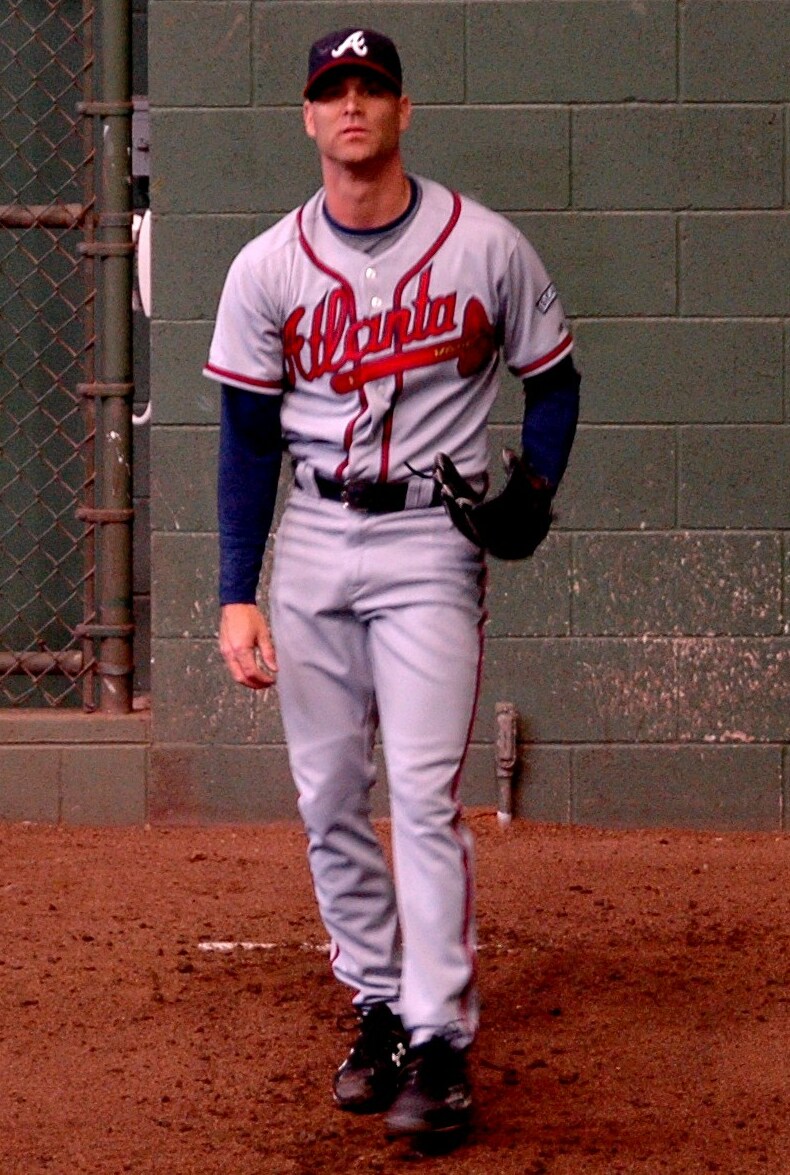
Timothy Adam Hudson (born July 14, 1975), nicknamed "Huddy",[1] is an American former professional baseball pitcher of Major League Baseball (MLB). After playing in college for Chattahoochee Valley Community College and Auburn University, Hudson played in the major leagues for the Oakland Athletics (1999–2004), Atlanta Braves (2005–13), and San Francisco Giants (2014–15). With the Giants, he won the 2014 World Series over the Kansas City Royals.

Key Information

During his 17-season career, Hudson established himself as one of baseball's most consistent pitchers and until 2014 had never had a season where he suffered more losses than wins. Hudson was also named an All-Star four times: twice with Oakland, once with Atlanta, and once with San Francisco.

Before retiring in 2015, Hudson led active major league pitchers in most wins and one of four active pitchers with at least 200 career wins. With a win against the Oakland A's on July 26, 2015, he has won a game against every team in the majors, the 15th pitcher to do so.[2] Hudson is one of 21 pitchers in major league history to win at least 200 games, strike out at least 2,000 batters and have a winning percentage above .600. Of those 21, 14 are in the National Baseball Hall of Fame.

Early life

[edit]

Timothy Adam Hudson was born on July 14, 1975, in Columbus, Georgia. Hudson attended Glenwood School in Phenix City, Alabama where in his senior season he led the team to the 1993 AISA state championship.[3] He finished his high school career with a 12–1 record and a 1.78 ERA. Despite his record, Hudson was considered undersized by scouts at 6'0" tall and 160 pounds and was not offered a scholarship to a major college.[4] Hudson decided to attend a local two-year college, Chattahoochee Valley Community College (CVCC).

College career

[edit]

In 1994, his freshman year at CVCC, he earned First-team All American honors while leading his team to the AJCCC Division II championship. He also led CVCC team in batting average (.385), home runs (9), RBI (42), wins (10–2), strikeouts (76), and was second on the team with a 2.76 ERA. As a sophomore, he was named Second-team All American and set a school and conference record with 117 strikeouts which also led the nation. As a hitter, Hudson batted .345 with five home runs, and 29 RBI. His sophomore season ERA of 1.95 was the team and conference best.[3]

Prior to his junior year, Hudson transferred to Auburn University where he would play two seasons. He is still at or near the top of many school records. In 1997, he played all 65 games for the Tigers while both pitching and playing outfield. That season, he hit .396 with 18 home runs and 95 RBI. As a pitcher, he finished 15–2 with a 2.97 ERA to earn SEC Player of the Year and consensus All-American honors. Hudson was the first player to be named First Team All-SEC at two positions (P, OF) in the same year. He was drafted by the Oakland Athletics in the sixth round of the 1997 amateur draft.

Professional career

[edit]
Hudson with the Oakland Athletics in 2004 spring training

Drafts and minor leagues

[edit]

Hudson was drafted by the Oakland Athletics twice, in the 35th round of the 1994 MLB draft and again in the 6th round of the 1997 MLB draft, signing in 1997.

Oakland Athletics (1999–2004)

[edit]

Hudson made his Major League debut with a five inning start on June 8, 1999, against the San Diego Padres, where he allowed three earned runs in a game the Athletics eventually lost 5–3. He recorded his first career win in his next start, on June 13 against the Los Angeles Dodgers. He allowed only one run in seven innings of the 9–3 victory.

Hudson with Oakland

In his rookie season, Hudson had an 11–2 mark and finished 5th in the AL Rookie of the Year vote. He became a member of Oakland's so-called "Big Three", along with left-handed pitchers Mark Mulder and Barry Zito. In 2000, he posted a career-high 20 victories along with a 4.14 ERA for Oakland. He finished second in AL Cy Young Award voting behind Pedro Martínez. Over the course of the next three seasons, Hudson's records were 18-9 in 2001, 15–9 in 2002 and 16–7 in 2003 with a career low 2.70 ERA. In 2004, Hudson failed to pitch 30 games due to injury. He went 12–6 in 27 starts. Hudson's record while with the A's was 92–39, and an ERA of 3.30.

Atlanta Braves (2005–2013)

[edit]

Before the 2005 season, Hudson was traded to the Atlanta Braves in exchange for Charles Thomas, Dan Meyer, and Juan Cruz. On August 6, 2005, Hudson won his 100th career game, defeating the St. Louis Cardinals 8–1.

In January 2006, Hudson was named to the Team USA roster for the 2006 World Baseball Classic.

His second season with the Braves was disappointing. He posted career-highs in losses (12) and ERA (4.86) in 2006. He returned to his earlier form in 2007 however, finishing with a 16–10 record and a 3.33 ERA. He was in the midst of a nine-game winning streak, the second of his career, at one point in the season. Hudson struck out a career-high 13[5] batters on April 25 against the Florida Marlins.

On April 29, 2007, both Hudson's grandmother and St. Louis Cardinals relief pitcher Josh Hancock, his college teammate at Auburn, died. He drew his grandmother's initials on the pitcher's mound before his next start, and wore them on his spikes. He also sewed Hancock's initials (JH) on his jersey. He pitched eight innings, giving up two earned runs against the Philadelphia Phillies. He did not get a decision, but the Braves ultimately won, 5–2.

Hudson is one of only seven ballplayers who pitched in the NL in 2007 who won at least 12 games in each year from 2004 to 2007, the others being Carlos Zambrano, Greg Maddux, Roy Oswalt, Jason Marquis, Derek Lowe, and Jeff Suppan.

On August 2, 2008, Hudson revealed that he would undergo Tommy John ligament transplant surgery on his pitching elbow, and missed the remainder of the 2008 season. He started the 2009 season on the 60-day DL, and did not play prior to the All Star break.[6] On July 2, 2009, he threw a 90-pitch bullpen session and Atlanta Braves manager Bobby Cox said: "He's ready to go. ... He's really come along. He's got major-league stuff right now, his normal stuff." But Cox added that the Braves would not rush the timetable on Hudson's return, which was scheduled for mid- to late-August. Hudson's first minor-league rehab start was tentatively scheduled for July 19 at Class A Myrtle Beach.[7] After completing several minor league rehab sessions, Hudson returned to the Atlanta Braves starting pitching rotation on September 1, 2009. He gave up only two runs and earned his first win of the 2009 season.

Hudson in 2009

On November 12, 2009, Hudson signed a $28 million, three-year extension with the Braves with a $9 million option for a fourth year.[8] On August 28, 2010, against the Florida Marlins, Hudson set a career high in strikeouts with 13.

On October 5, 2010, Hudson was awarded the 2010 NL Comeback Player of the Year Award.[9]

On June 20, 2011, in Atlanta, Hudson hit his second career home run, a two-run shot which accounted for the only scoring in a 2–0 victory over the Toronto Blue Jays. On the same day, he got his 1,600th strikeout in the top of the fifth inning against J. P. Arencibia.[10] On July 15, 2011, Hudson was the winning pitcher in the Braves' 10,000th win in franchise history.[11]

Hudson went 16–7 with a 3.62 ERA in 2012. On October 30, 2012, Hudson had his $9 million option exercised by the Braves.[12]

On April 30, 2013, Hudson became the 113th major league pitcher to reach 200 wins, with an 8–1 victory over the Washington Nationals at Turner Field. Hudson went seven innings, giving up only three hits and one run while recording six strikeouts and two walks. Hudson also went 2-for-3 at the plate with a double and a home run.[13] On July 24, 2013, Hudson was pitching a four-hit shutout against the New York Mets when Eric Young, Jr., who was trying to beat a throw to first base, accidentally stepped on Hudson's leg above the ankle. This resulted in an ankle fracture that ended Hudson's 2013 season.[14] After the season, Hudson became a free agent. His record with the Braves was 113–72 with an ERA of 3.56.

San Francisco Giants (2014–2015)

[edit]
Hudson with the San Francisco Giants

On November 18, 2013, Hudson agreed to a two-year, $23 million contract with the San Francisco Giants.[15][16] Hudson set a franchise record by pitching 30+23 innings in the season before issuing a walk. The streak was snapped on April 25 when he walked Carlos Santana.[17] Hudson posted at the time a Major League-best and leading 1.81 ERA in his first 13 starts with the Giants, the lowest in 104 years in the 133-year history of the franchise.[18][19] In his first year with the Giants, he was selected to participate in the All-Star Game. Accomplishing this feat, he has made the All-Star team at least once with every team he has pitched for.[20][21][22] On August 27, in a 4–2 team win over the Colorado Rockies at AT&T Park, Hudson recorded his 2,000th career strikeout.[23] He started Game 2 of the NLDS, a game that went 18 innings; Hudson also started the only other postseason game to go longer than 16 innings while on the Braves in 2005.[24] On October 29, Hudson became the oldest pitcher to start Game 7 of the World Series.[25] The Giants went on to win the game, 3–2, and the series, 4–3, over the Kansas City Royals, giving Hudson the first and only World Series ring of his 16-year career.

Prior to the 2015 season, Hudson stated it would likely be his last.[26] Following a 4–3 win against the Oakland Athletics on July 26, 2015, Hudson became the 15th pitcher in MLB history to register at least one win against all 30 current teams.[2] On September 26, 2015, Hudson started against Zito and the Athletics in a matchup that was arranged as a tribute to the A's "Big Three" of the early 2000s. Both pitchers received lengthy standing ovations from the sold-out Oakland Coliseum crowd (which included the third Big Three member, Mulder) upon leaving the game.[27]

On October 1 at AT&T Park, Hudson started his final major league game. Giants manager Bruce Bochy made a pitching change, allowing Hudson to receive a standing ovation from his family, friends, and Giants announcers, executives, and fans as he walked off the mound. As he reached the dugout steps, he was greeted and embraced by all of his teammates and coaches outside and inside of it.[28][29] On October 3 at AT&T Park, during Fan Appreciation Weekend, the Giants honored Hudson with a pregame ceremony surrounded by his family, friends, Giants teammates, coaches, and executives. The event was broadcast live on local television on Comcast SportsNet Bay Area, where Giants sportscaster Jon Miller served as MC. The ceremony included a taped video message from his Hall of Fame Braves manager Bobby Cox, speeches from president and chief executive officer Larry Baer, Bochy, and starting rotation mates Jake Peavy and Madison Bumgarner, before Hudson emotionally addressed the crowd.[30]

Scouting report

[edit]

Hudson was a sinkerballer, using that pitch about half the time and at a speed of 87–91 mph. His next-most used pitch was a cutter at 84–87. He expanded his repertoire to left-handers with a curveball (75–77) and splitter (78–81). He also had a four-seam fastball (88–91 mph). His favored pitch with two strikes to right-handed hitters was his cutter, while he stayed with the sinker to lefties.[31]

Achievements

[edit]
  • Professional
  • College
    • Won Rotary Smith Award (1997)
    • Consensus All-American (1997)
    • NCAA East Regional Tournament MVP (1997)
    • SEC Player of the Year (1997)
    • All-SEC, both pitcher and outfielder (1997)
    • ABCA All-South Region, both pitcher and outfielder (1997)
    • Led NCAA in winning games (15, 1997)

Coaching career

[edit]

In 2016, Hudson served as a guest instructor in spring training for both the Braves and Giants.[32][33] In 2017, Hudson returned as a spring training instructor for the Giants.[34] He served in the same role for the Braves in 2018.[35] In January 2020, Hudson was named the pitching coach for the Auburn Tigers.[36][37]

On July 27, 2022, it was announced Hudson would be stepping away from Auburn.[38] Shortly thereafter, Hudson accepted the position as head coach of the Lee-Scott Academy baseball team. He stepped down from that position after one season, still coaching as a volunteer.[39]

Broadcasting career

[edit]

In 2016, Hudson joined Fox Sports South and Fox Sports Southeast as a part-time broadcaster for select Braves games.[40]

Personal life

[edit]

Hudson and his wife he met while he was a student at Auburn.[3] They have two daughters and one son.[41] They currently live in Auburn, Alabama. Hudson and his wife are active with their philanthropy for children, the Hudson Family Foundation.[42]

Hudson is a Christian.[43]

See also

[edit]

References

[edit]
[edit]
Revisions and contributorsEdit on WikipediaRead on Wikipedia
from Grokipedia
Timothy Adam Hudson (born July 14, 1975) is an American former pitcher who played 17 seasons in (MLB) from 1999 to 2015, primarily as a for the , , and Giants. Over his career, Hudson compiled a 222–133 win–loss record with a 3.49 (ERA) and 2,080 strikeouts in 3,126+ , establishing himself as one of the most durable and consistent right-handed starters of his era. A standout two-way player at Auburn University, where he earned Southeastern Conference Player of the Year honors in 1997 as both a pitcher and outfielder, Hudson was selected by the Athletics in the sixth round of the 1997 MLB Draft and made his big-league debut in 1999, finishing fifth in American League Rookie of the Year voting. He rose to prominence as part of Oakland's famed "Big Three" rotation alongside Barry Zito and Mark Mulder, posting a league-leading 20 wins in 2000 and winning at least 15 games in each of the next three seasons (2000–2003) and earning his first of four All-Star selections in 2000. Traded to the Braves ahead of the 2005 season, Hudson anchored their rotation for nine years, amassing 113 victories and two more All-Star selections (2010, 2014) while maintaining a sub-4.00 ERA in eight of those campaigns. In 2014, Hudson signed with the Giants, where he contributed to their championship over the , marking his lone postseason title and culminating a career that saw him reach 200 wins in 2014—joining an elite group of just 21 pitchers with at least 200 victories, 2,000 strikeouts, and a .600 . He retired following the 2015 season at age 40, later serving as Auburn's pitching coach from 2020 to 2022 before taking on high school coaching roles. Hudson was inducted into the Hall of Fame in 2018 for his contributions to the franchise. In 2025, he was inducted into the Georgia Sports Hall of Fame and the Hall of Fame as part of the "Big Three."

Early life and education

Early life

Timothy Adam Hudson was born on July 14, 1975, in , to Ronnie and Sue Hudson. He was the youngest of three sons in a blue-collar family, with his father working as a plant supervisor at a cereal box factory and his mother serving as a homemaker. His parents emphasized a strong and a passion for sports, shaping Hudson's early development through encouragement and family involvement in his activities. Hudson spent his childhood in Salem, Alabama, a rural community just across the state line from Columbus, where the family lived on five acres of land. He enjoyed typical outdoor pursuits, such as playing in the woods, riding bicycles, and organizing informal games with siblings and neighbors in a nearby cow pasture. His initial exposure to organized came at age eight through local little leagues in nearby , where he first took up pitching the following year, displaying early enthusiasm despite initial challenges with control. Family support played a key role, with his parents attending games and fostering his interest in athletics as a positive outlet. In high school at Glenwood School in , from which he graduated in 1993, Hudson expanded his athletic involvement beyond to include football as a starting . On the diamond, he played and center field before transitioning to pitching during his junior year, helping lead the team to state championships in both his junior and senior seasons. His football teams also secured two state titles, highlighting his versatility and competitive drive, qualities praised by coach Russ Martin for Hudson's "heart and guts" despite his unassuming physical stature. By the end of high school, Hudson had committed fully to , setting the stage for his recruitment to .

College career

After attending Chattahoochee Valley Community College for two years, Tim Hudson transferred to in 1996, where he played baseball for the under coach Hal Baird. As a that year, Hudson emerged as a standout , compiling an 8-3 record with a 1.96 and leading the nation with 117 strikeouts in 82 innings pitched, earning First Team All-Southeastern Conference (SEC) honors as a . In his junior season of 1997, Hudson delivered one of the most dominant two-way performances in Auburn history, going 15-2 with a 2.97 and 165 strikeouts over 118.1 while also batting .396 with 18 home runs and 95 RBIs in . For these achievements, he was named SEC Pitcher of the Year, consensus First Team All-American, and the first player in conference history to earn First Team All-SEC honors at two positions (pitcher and outfielder); he also received the Rotary Smith Award as the nation's top collegiate player. Hudson's contributions were pivotal in leading Auburn to the 1997 , where he made key starts, including a over in the Tigers' final game of the tournament. He completed his undergraduate degree in interdisciplinary studies, with emphases in and , in December 2021, more than two decades after leaving for his career.

Professional career

Draft and minor leagues

Hudson was selected by the in the sixth round, 185th overall, of the 1997 June Amateur Draft out of . He signed with the team on June 13, 1997, receiving a $22,500 as part of his initial professional contract. Following the draft, Hudson began his minor league career in 1997 with the Short-Season A Southern Oregon Timberjacks of the , where he recorded a 3-1 record with a 2.51 over 28 2/3 . In 1998, he advanced to High-A Modesto of the , starting the season with a strong 4-0 mark and 1.67 in 39 before earning a promotion to Double-A of the Southern League. At Huntsville, he went 10-9 with a 4.54 in 135 , finishing the year with a combined 14-9 record and 3.92 across both levels. Hudson returned to Double-A in 1999 with the of the , dominating with a 3-0 record and 0.50 in 18 innings to open the season. He was quickly promoted to Triple-A of the , where he posted a 4-0 record with a 2.20 and 61 strikeouts in 49 innings, contributing to an overall mark of 7-0 and 1.75 that year. His rapid ascent through Oakland's system highlighted his development into a ground-ball , featuring a sinking in the low-90s, an effective , and a slider, which helped him induce weak contact and limit home runs. Hudson's impressive 1999 performance, including a 1.060 across the upper minors, earned him a call-up to the major leagues in June.

Oakland Athletics (1999–2004)

Tim Hudson made his debut with the on June 8, 1999, starting against the Padres at Jack Murphy Stadium, where he pitched five , allowing three runs on six hits and recording his first career against Quilvio Veras. In his rookie season, Hudson quickly established himself as a reliable starter, finishing with an 11-2 record and a 3.23 over 136 1/3 in 21 starts, helping the Athletics improve from 74 wins in 1998 to 87 in 1999. His immediate impact as a ground-ball with strong command fit seamlessly into Oakland's strategy under manager , setting the stage for the team's emergence as contenders in the . Hudson became a cornerstone of the ' renowned "Big Three" rotation alongside left-handers and , a trio that anchored the team's pitching staff from 2000 to 2004 and powered four consecutive playoff appearances (2000–2003). The group combined for exceptional durability and effectiveness, with Hudson often leading the way in and wins; their efforts were central to Oakland's low-budget success during the "Moneyball" era, as chronicled in Michael Lewis's book, where the Athletics won 91 games in 2000, 102 in 2001, 103 in 2002, and 96 in 2003 despite limited payroll resources. In postseason play, Hudson posted a 1-2 record with a 3.44 across seven appearances, including a victory in the 2000 ALDS against the and a strong outing in the 2002 ALCS against the . Over his six seasons with Oakland (1999–2004), Hudson compiled a 92-39 record with a 3.35 in 1,241 2/3 across 183 starts, striking out 899 batters while maintaining a .702 that reflected the team's and his consistency. He earned his first selection in 2000, where he went 20-6 to lead the in wins, though his 4.14 that year was bolstered by Oakland's potent offense. In 2002, Hudson delivered one of his most durable performances, going 15-9 with a 2.98 in 238 1/3 over 33 starts, including 20 outings of at least seven that underscored his stamina and efficiency in keeping games close during the Athletics' 20-game . On December 16, 2004, following Oakland's third-place finish in the AL West, the traded Hudson to the in exchange for outfielder Charles Thomas, left-handed pitcher Dan Meyer, and right-handed pitcher Juan Cruz, marking the end of his tenure with the team that had developed him from a sixth-round draft pick into a perennial 15-game winner.

Atlanta Braves (2005–2013)

Tim Hudson was traded from the to the on December 16, 2004, in exchange for pitchers Juan Cruz and Dan Meyer and outfielder Charles Thomas, marking a pivotal move that shifted him from the to the National League. In his first season with Atlanta in 2005, Hudson adapted quickly to the NL, posting a 14-9 record with a 3.52 over 29 starts and 192 , contributing to the Braves' 14th consecutive division title. His performance established him as a reliable anchor in the rotation, blending ground-ball tendencies with precise command to limit hard contact. Hudson demonstrated consistency throughout his Braves tenure, leading the rotation during several playoff-contending campaigns, including the 2010 Wild Card push. He earned his lone selection with in 2010, when he went 17-9 with a 2.83 in 34 starts and 229 innings, finishing fourth in NL Cy Young voting and earning Comeback Player of the Year honors after rebounding from prior injuries. Other strong seasons included 16-10 with a 3.33 in 2007 and 16-7 with a 3.62 in 2012, showcasing his durability and effectiveness into his mid-30s. Hudson started key postseason games, such as Game 3 of the 2010 NLDS against the Giants, though the Braves fell in the series. Injuries posed significant challenges, testing Hudson's resilience. In July 2008, he suffered a torn in his right elbow, requiring surgery that sidelined him for most of 2009, where he made only seven starts with a 2-1 record and 3.61 . He also dealt with chronic back issues, undergoing surgery for a herniated disc after the 2011 season despite logging 33 starts that year (16-10, 3.22 ). In 2013, at age 37, Hudson started strongly with an 8-7 record and 3.97 through 21 starts before a gruesome fractured right ankle injury on July 24 against the ended his season prematurely. Over nine seasons with the Braves, Hudson compiled a 113-72 record with a 3.56 ERA in 243 starts and 1,573 innings, ranking among the NL's top workhorses in innings pitched multiple times. His contract expired after the 2013 season, making him a free agent; he departed Atlanta on November 18, 2013, to sign with the Giants.

San Francisco Giants (2014–2015)

On November 19, 2013, Hudson signed a two-year, $23 million contract with the Giants, marking his return to the Bay Area where he had begun his professional career in the minors nearly two decades earlier. In the 2014 regular season, he made 31 starts for the Giants, posting a 9–13 record with a 3.57 ERA over 189.1 , contributing to the team's 88–74 record and runner-up finish. His performance provided stability to the rotation amid the Giants' push for the playoffs. Hudson's postseason role was pivotal in the Giants' successful 2014 campaign. He started Game 3 of the against the St. Louis Cardinals, allowing three runs in 6.1 to help secure a 6–3 victory in a series the Giants won in five games. In the against the , Hudson started Game 1, yielding one run over five in a 7–1 Giants win, and opened Game 7 on October 29 at age 39—the oldest starter in a Game 7 in history—pitching 1.2 before the Giants rallied to a 3–2 victory and their third championship in five years. Across two starts, he recorded a 1–0 mark (with one no-decision) with a 3.68 in 7.1 . The 2015 season proved challenging for Hudson, limited by a shoulder injury and offseason ankle surgery to remove bone spurs, resulting in 21 starts and an 8–9 record with a 4.44 over 123.2 . On September 9, 2015, he announced his retirement at season's end, concluding a 17-year major league career with 222 wins, 133 losses, a 3.49 , and 2,080 strikeouts in 3,126.2 across 482 games. His final appearance came in relief on against the , earning a warm ovation from the home crowd.

Scouting report

Tim Hudson was renowned as a crafty who emphasized command, movement, and deception over raw velocity, earning him a reputation as one of the premier ground-ball specialists of his era with a career 58.0% ground-ball rate. His primary arsenal consisted of a two-seam sinker/ typically ranging from 88-92 mph that generated heavy sinking action to induce weak contact, complemented by a split-finger for deception against right-handed batters, a cutter/slider for late movement, and a for depth. Analysts praised his ability to locate pitches precisely within the , often grading his command as above-average (60 on the 20-80 scale), while his overall pitch mix received solid marks (55/80) for its effectiveness in contact management rather than swing-and-miss potential. Additionally, Hudson excelled in ancillary skills, boasting one of the best pickoff moves among pitchers—evidenced by multiple successful pickoffs in high-leverage situations—and Gold Glove-caliber fielding, with a career .963 fielding percentage that highlighted his athleticism and quick reflexes around the mound. Hudson's style evolved across his career, beginning with a power-oriented sinker in his days that overpowered lineups through sheer movement. Upon transitioning to the , he refined his control and sequencing, incorporating more off-speed pitches to maintain effectiveness in a deeper lineup environment, which helped sustain his durability into his mid-30s. In his later years with the San Francisco Giants, Hudson adapted to the pitcher-friendly National League and the physical toll of age by further emphasizing location and mixing his cutter more frequently, though this period saw increased vulnerability to home runs as his velocity dipped below 90 mph consistently. Scouts and analysts consistently highlighted his intangibles, including a fierce competitiveness and mound presence that allowed him to outthink hitters, often likening him to a "" who thrived on inducing grounders rather than strikeouts. Despite these strengths, Hudson's profile included notable weaknesses, such as a modest career rate of 6.0 per nine , reflecting his contact-oriented approach that prioritized efficiency over dominance. Later in his career, particularly after age 35, he became more susceptible to the , with his rate climbing above league averages due to diminished sink on his and exposure in the expansive National League parks.

Post-playing career

Coaching career

Following his retirement from Major League Baseball after the 2015 season, Tim Hudson transitioned into roles, beginning with instructional positions during . In 2017, he served as a spring training instructor for the Giants, his final MLB team, where he worked with pitchers on fundamentals and game preparation. He continued in a similar capacity the following year with the , focusing on mentoring young arms and sharing insights from his four-time . In January 2020, Hudson joined his , , as a volunteer assistant coach and pitching coach for the Tigers program. Over three seasons, he contributed to the development of the pitching staff, emphasizing command, efficiency, and mental resilience—hallmarks of his own 222-win MLB tenure with a 3.49 . Under head coach Butch Thompson, Auburn advanced to the 2022 College World Series, where the team posted a 1-2 record before elimination, marking the program's first appearance there since 1967. Hudson departed Auburn in August 2022 after helping guide the Tigers to a 43-23 overall record that year. Hudson then took on his first head coaching role at Lee-Scott Academy, a private high school in , starting in the 2023 season. Leading the Warriors in the Alabama Independent School Association (AISA), he guided the team to a strong performance, culminating in a semifinal appearance in the AISA Class AA state playoffs with a 20-12 record. His tenure focused on instilling discipline and competitive mindset in young players, drawing directly from his experiences as a two-way standout at Auburn and a 17-year MLB veteran. Hudson stepped down from the position in July 2023. In 2025, Hudson was inducted into the Hall of Fame alongside former teammates and . That year, he returned to a prominent MLB-affiliated role as the National League pitching coach for the , held at in . Working under manager , he advised top prospects on pitch sequencing, stamina, and handling pressure, leveraging his expertise from postseason appearances, including the championship with the Giants. This guest stint highlighted his ongoing influence in player development at the professional level.

Broadcasting career

Following his retirement from Major League Baseball in 2015, Tim Hudson transitioned into broadcasting as a part-time color analyst for South and Southeast, debuting on April 9, 2016, during a game against the St. Louis Cardinals. He was initially scheduled to provide commentary for five games that season, focusing on select telecasts to leverage his extensive pitching experience. Hudson made occasional guest appearances on national platforms, including MLB Network's MLB Central in June 2020, where he discussed his new role as a pitching coach at . In June 2024, he joined the ' broadcast team for their telecast against the Blue Jays on June 9, offering analysis during the game. That same month, on June 26, 2024, Hudson appeared as a guest on the official podcast Behind the Braves, sharing insights into his playing career and post-retirement life, including coaching. As of 2025, Hudson has maintained a limited presence in , with no full-time contract and contributions remaining sporadic. His analyses often draw from his background to explain pitching and strategy in an accessible manner.

Awards and honors

Professional awards

Tim Hudson was selected to four All-Star Games during his career, representing the in and 2004, the in 2010, and the Giants in 2014. His first selection came in after a breakout season in which he recorded 20 wins, leading the in victories and helping solidify his role as a cornerstone of Oakland's rotation. These appearances highlighted his consistency as a across three different teams and leagues over 15 years. In his 1999 rookie season with the , Hudson finished fifth in Rookie of the Year voting after posting an 11-2 record with a 3.23 in 21 starts. This strong debut earned him recognition as one of the top young pitchers in the league, setting the stage for his long-term success. Hudson was named the National League Comeback Player of the Year in 2010 after posting a 17-9 record with a 2.83 . Hudson contributed to the San Francisco Giants' 2014 World Series championship, appearing in three games during the postseason (all starts) with a 0-1 record and a 3.79 , including starts in Game 2 of the NLDS, Game 3 of the NLCS, and Game 3 of the . This title marked his only and capped a resilient career phase after overcoming injuries.

Post-career honors

Following his retirement from Major League Baseball in 2015 after a distinguished 17-year career that included 222 wins, Tim Hudson has received several prestigious honors recognizing his contributions to the sport. In 2018, he was inducted into the Atlanta Braves Hall of Fame for his nine seasons with the team, where he posted a 113-72 record and helped anchor the pitching staff during a competitive era. That same year, Hudson was enshrined in the Alabama Sports Hall of Fame, acknowledging his roots in the state and his standout collegiate performance at Auburn University, where he was part of the 1997 College World Series team. In 2025, Hudson's legacy continued to be celebrated with multiple inductions. He was selected for the Georgia Sports Hall of Fame Class of 2025, honoring his overall impact on as a Georgia native who amassed four appearances and a title; the induction banquet occurred on March 6 in . Later that year, Hudson joined former teammates and —the trio known as the "Big Three"—in the Athletics Hall of Fame, with the induction announced in early June and the ceremony held on September 13 at , celebrating their role in the team's early-200s playoff runs. Hudson's post-career recognition also includes his selection as pitching coach for the National League team in the 2025 MLB Futures Game, held on July 12 in as part of All-Star Week festivities, a role that highlighted his expertise in developing young talent alongside Braves legends like manager . Additionally, Hudson has been ranked among MLB's all-time great right-handed pitchers in various retrospectives, such as placing fifth on the Braves' franchise list for starting pitchers and being one of only 21 hurlers in history to achieve at least 200 wins, 2,000 strikeouts, and a over .600, underscoring his enduring influence on the game. These honors reflect ongoing tributes to his tenure with the Braves and Giants, including mentions during franchise milestone events commemorating their 2010s successes.

Personal life

Family

Tim Hudson married his college sweetheart, Kim Bruner, on October 23, 1999, shortly after meeting her while attending , where she transferred from Purdue. The couple has three children: daughters Kennedie Rose, born in July 2001, and Tess, born in 2004, along with son Kade, born in 2005. Throughout Hudson's professional career, his family relocated multiple times to support his teams, living in the area during his tenure from 1999 to 2004, moving to the , Georgia region for his nine seasons with the from 2005 to 2013, and briefly to the during his two years with the Giants from 2014 to 2015. Hudson's family provided steadfast support during his MLB career, with Kim and the children attending significant events including All-Star Games and the , where the Giants the . Following his retirement in 2015, the family returned to Hudson's home state and settled in , near Lee-Scott Academy, where Hudson later served as head baseball coach and Kade played as a senior in 2023. Hudson's family life has been shaped by their shared Christian faith, which has influenced his personal values and post-career endeavors.

Philanthropy and interests

Tim Hudson has been actively involved in philanthropy throughout his baseball career and beyond, focusing primarily on supporting children and families in need. During his tenure with the , he was nominated seven times for the , recognizing his contributions to community service, including youth initiatives through the Braves Foundation. With the San Francisco Giants, Hudson participated in team community efforts, such as events aligned with the Giants Community Fund to promote youth development programs. In 2009, he co-founded the Hudson Family Foundation with his wife Kim, a dedicated to providing financial grants, emotional support, and resources for children and families facing physical, emotional, or financial challenges in Georgia and ; the foundation has funded programs like youth clinics and scholarships, distributing aid to hundreds of recipients annually. Post-retirement, Hudson has continued leading the foundation, which marked its 15th year in 2024 by expanding support for school-age children through self-esteem-building initiatives, and he participates in MLB alumni charity events to raise funds for pediatric causes. In 2017, he and his wife were honored at the Cancer and Blood Disorders Center for their work aiding families affected by childhood illnesses. Additionally, in 2010, he received the Hutch Award from the Fred Hutchinson Cancer Research Center for his perseverance and charitable efforts, and he donated $200,000 to his alma mater's program. Hudson's philanthropic endeavors are deeply intertwined with his Christian faith, leading him to engage in faith-based activities such as on integrating spiritual values into sports. He has shared his testimony through platforms affiliated with the , emphasizing discipleship and trust in God's plan during challenges like injuries and career transitions. In interviews, Hudson has discussed how his beliefs guided his approach to and , including a 2013 Sports Spectrum feature highlighting his journey from doubt to conviction. Beyond charity, Hudson pursues personal interests centered on and family time. A avid golfer, he has participated in pro-am events like the 2016 Barbasol Championship, where he showcased his swing while enjoying retirement. He is also an enthusiastic hunter and fisherman, often sharing experiences from trips at properties like Southwind in Georgia, and he values family outdoor activities such as coaching his children's sports teams. In 2021, Hudson completed his long-delayed bachelor's degree in interdisciplinary studies at , 26 years after leaving to pursue , applying his education to personal projects and community involvement.

References

Add your contribution
Related Hubs
User Avatar
No comments yet.