Hubbry Logo
Ted WeemsTed WeemsMain
Open search
Ted Weems
Community hub
Ted Weems
logo
8 pages, 0 posts
0 subscribers
Be the first to start a discussion here.
Ted Weems
Ted Weems
from Wikipedia

Key Information

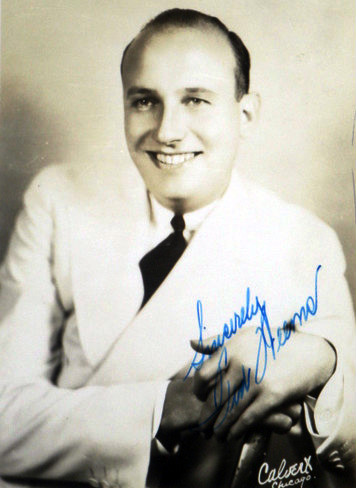
Wilfred Theodore Wemyes (September 26, 1901 – May 6, 1963), known professionally as Ted Weems, was an American bandleader and musician. Weems's work in music was recognized with a star on the Hollywood Walk of Fame.[1]

Biography

[edit]

Born in Pitcairn, Pennsylvania, Weems learned to play the violin and trombone. Young Ted's start in music came when he entered a contest, hoping to win a pony. He won a violin instead and his parents arranged for music lessons.[2] He was a graduate of Lincoln School in Pittsburgh. While still in school at Lincoln, Weems organized a band there, initially providing some instruments himself. His teacher offered young Ted and his band a penny each if they would play when the alarm sounded for fire drills. Weems kept the monies of the band and in turn charged each band member a penny for membership. He used the money to purchase better instruments than those the band started out with. When the family moved to Philadelphia, young Weems entered West Philadelphia High School. He joined the school's band and became its director.[3]

He attended the University of Pennsylvania, where he and his brother Art organized a small dance band that became the "All American Band". The brothers sought the most talented college musicians for the group. The All American Band soon started receiving offers to perform in well-known hotels throughout the United States. Weems, who had originally intended to become a civil engineer, found himself being attracted to a musical career. His band had a contract to play four weeks at a Philadelphia restaurant; the owner was able to keep Weems and his band there for four months by making Ted a partner in his business.[4] They were one of the bands that played at the inaugural ball of President Warren G Harding in March, 1921.[3] Going professional in 1923, Weems toured for the MCA Corporation and began recording for the Victor Talking Machine Company.[5] "Somebody Stole My Gal" became the band's first #1 hit in early 1924. It sold over one million copies, and was awarded a gold disc by the RIAA.[6]

Weems recorded for Victor/RCA Victor from 1923 through 1933,[7] although the final three sessions were released on RCA Victor's newly created Bluebird Records label. He then signed with Columbia for two sessions in 1934 and subsequently signed with Decca from 1936. Weems also co-wrote several popular songs: "The Martins and the McCoys", "Jig Time", "The One-Man Band", "Three Shif'less Skonks", and "Oh, Monah!", which he co-wrote with band member "Country" Washburn.[8][9]

Ted Weems and his Orchestra on the Fibber McGee and Molly NBC Radio show, 1937.

Weems moved to Chicago with his band around 1928.[5] The Ted Weems Orchestra had more chart success in 1929 with the novelty song "Piccolo Pete", which rewarded him with his second gold record,[10] and the number one hit "The Man from the South". The band gained popularity in the 1930s, making regular radio broadcasts. These included Jack Benny's Canada Dry program on CBS and NBC during the early 1930s, and the Fibber McGee & Molly program in the late 1930s.[8][11]

In 1936, the Ted Weems Orchestra gave young singer Perry Como his first national exposure; Como recorded with the band for Decca Records, beginning his long and successful career. Among Weems's other discoveries were whistler-singer Elmo Tanner, sax player and singer Red Ingle, Marilyn Maxwell, who left the band for an acting career; and arranger Joe Haymes, who created the band's unique jazz-novelty style. Weems also signed 14-year-old ventriloquist Paul Winchell to a contract, after seeing him with one of the Major Bowes touring companies.[12] The first season of the Beat the Band radio show (1940–1941) included Weems and his orchestra as part of the cast.[13][14][15]

In 1940, Weems and his orchestra were featured on Beat the Band on the NBC-Red radio network.[16]

In November 1942, Ted Weems and his entire band enlisted in the United States Merchant Marine, directing the Merchant Marine Band.[17][18] Reorganizing his big band in 1945,[19] he made records for Mercury, including the hits "Peg O' My Heart" and "Mickey". However, the biggest hit of Weems's career was a reissue on his former Decca label: the Weems Orchestra's 1938 recording of "Heartaches" topped the national charts for 13 weeks.[5][20]

Ted Weems (right) with William P. Gottlieb, WINX Studio, Washington, D.C., ca. 1940.

For his August 4, 1933 session, Weems recorded six tunes, including "Heartaches". Since RCA Victor wanted the recording made quickly, Weems and his band had time for only one rehearsal session prior to this. Weems did not like the song at first, and decided to have Elmo Tanner whistle rather than use a vocalist. While rehearsing, someone came up with the idea of trying the song at a faster tempo than it was written for. The fast-tempo recording attracted very little attention after its release.

In 1938 Weems recorded a new "rhumba fox trot" version of "Heartaches" for Decca Records. This version again featured Elmo Tanner's whistling, and the tune was played briskly but not at the breakneck tempo of the 1933 version. In 1947, an overnight disc jockey named Kurt Webster, at station WBT in Charlotte, North Carolina, found the 1938 version in a box of old records he had recently received. He played it on the air and the radio station's phones never stopped ringing; the callers wanted to hear the song again. The calls continued, now joined by record stores wanting to know how to order copies of the record. Other radio markets began playing the song, prompting Decca to press new copies.[21] Since the Weems orchestra had also recorded "Heartaches" for Victor, that company decided to re-release its own version of the song. Both labels shared credit on the charts. "Heartaches" topped the Hit Parade on April 19, 1947; nine years after it was recorded. In a 1960 interview, band member Elmo Tanner related that he and Weems received nothing for the reissue as both men had let their contracts expire while they were in the Merchant Marine.[22][23]

The new-found popularity of the 1938 "Heartaches" came at a time when Weems was struggling to re-form his band; many former members had other music-related jobs, others were no longer interested in performing. Two of his band members were killed in World War II. Weems was then able to recruit new band members and was again being asked to play at the same venues as before the war.[24] Ted Weems made front-page news in 1947 when he publicly repaid his debt to disc jockey Kurt Webster, who had revived "Heartaches" and thus Weems's career. Weems staged a benefit performance by his band on June 6, with all proceeds going to war veteran Webster.[25] Decca cashed in on Weems's new popularity by reissuing another oldie, "I Wonder Who's Kissing Her Now" with vocals by Perry Como, which became another major chart hit.

Despite this sudden surge of popularity for Weems, the hits dried up after 1947. Weems continued touring until 1953. At that time, he accepted a disc jockey position in Memphis, Tennessee,[5] later moving on to a management position with the Holiday Inn hotel chain. Perry Como played host to his old boss, Elmo Tanner, and three other Weems band members on his Perry Como's Kraft Music Hall show of October 18, 1961.[22][26]

Ted Weems died of emphysema in Tulsa, Oklahoma, in 1963.[27] He had been operating a talent agency in Dallas with his son which also served as his band's headquarters.[28] Weems was in Tulsa with his band for an engagement the day he was taken ill.[5][29] His son Ted Jr. led a revival band sporadically during the 1960s and 1970s.

[edit]

[30]

References

[edit]
[edit]
Revisions and contributorsEdit on WikipediaRead on Wikipedia
from Grokipedia
Ted Weems (September 26, 1901 – May 6, 1963) was an American bandleader, violinist, and renowned for directing the Ted Weems Orchestra, which gained widespread popularity in the Midwest during the era of the and through lively and memorable recordings. Born Wilfred Theodore Wemyes in , Weems developed an early interest in music after winning a in a local contest as a child, later mastering the trombone as well. He attended High School, where he led the school band, and briefly studied engineering at the before pursuing music professionally. In 1922, he formed the All American Band with his brother Art, securing a contract with the MCA Corporation and beginning recordings for Victor Records in 1923. The orchestra, known for its hot-dance style, relocated to Chicago around 1928 and featured vocalists such as Parker Gibbs and, notably, a young Perry Como in the late 1930s, who gained early fame through Weems' radio broadcasts on programs like Fibber McGee and Molly. Weems' ensemble produced several chart-topping hits, including "Somebody Stole My Gal" in 1924, "Piccolo Pete" and "The Man from the South" in 1929, and "Heartaches" in 1933, the latter of which became a massive postwar sensation in 1947 despite Weems receiving no royalties due to earlier rights sales. He also co-wrote novelty tunes like "The Martins and the Coys" and "Oh, Monah." During World War II, Weems enlisted in the U.S. Merchant Marine in 1942, serving as a lieutenant junior grade and leading the Merchant Marine Band in San Mateo, California. After the war, he briefly revived the orchestra before transitioning to a disc jockey role at a Memphis radio station in 1953, where he remained until his death from emphysema in Tulsa, Oklahoma. Weems was posthumously honored with a star on the Hollywood Walk of Fame in the recording category on February 8, 1960. His son, Ted Weems Jr., later revived the orchestra in the 1960s and 1970s.

Early Life and Education

Birth and Family

Wilfred Theodore Wemyes, professionally known as Ted Weems, was born on September 26, 1901, in , a small industrial town near . His reflected the family's original , which was later simplified to Weems for professional purposes. Weems grew up in a working-class environment, with his family relocating from the area to during his childhood, exposing him to new cultural influences in the urban setting. He was one of three sons and had a younger brother, Art Weems, who shared his interest in music and later collaborated with him on early band projects. Weems' initial spark for music came early through local contests in ; at around age 10, he entered a competition hoping to win a pony but instead received a as the prize, prompting his family to arrange formal lessons and nurturing his budding talent. This early win marked the beginning of his lifelong engagement with music, shaping his path before formal training.

Musical Beginnings

Weems attended Lincoln School in , , during his early years, before his family relocated to . There, he enrolled at West Philadelphia High School, where he joined the school's band and eventually became its director, honing his leadership skills in music. He graduated from West Philadelphia High School in 1916. Following high school, Weems enrolled at the , initially pursuing studies in engineering but shifting focus to music. He studied and during his time there and graduated from the . Influenced by his family's musical inclinations, Weems immersed himself in instrumental training and performance. At the , Weems and his brother Art, a player, organized early amateur performances through a small student dance band that evolved into the "All American Band" in 1922. The group featured talented college musicians and performed at university events, providing Weems with his initial platform for arranging and leading ensembles. These amateur outings marked his transition from student to emerging . A pivotal moment came in March 1921, when Weems secured his first paid engagement as part of a student group that performed at President Warren G. Harding's inaugural ball in This high-profile appearance exposed him to professional settings and affirmed his potential in the music industry.

Professional Career

Band Formation and Early Tours

After completing his studies at the , Ted Weems formed his professional orchestra, initially as a five-piece ensemble that evolved from the campus-based All American Band he had organized in 1922 with his brother Art on . This group marked Weems' transition from student performances to a full-time musical career, drawing on talented college musicians for its lineup. The orchestra quickly established early residencies in , including a notable four-month engagement at a local restaurant where Weems became a , and performances at the Adelphia Hotel. These local gigs provided a foundation for the band's sound, blending with emerging influences suited to hotel and ballroom audiences. In late 1923, Weems signed with Victor Records (later RCA Victor) and recorded the orchestra's debut session on November 20 in , producing sides such as "Covered Wagon Days" and "Somebody Stole My Gal," which were issued as Victor 19212. The contract enabled steady output, with the band touring under the management of the MCA Corporation to promote their growing catalog. By 1925, the orchestra had expanded into a full configuration and begun broader tours across the Midwest and East Coast, performing at hotels and ballrooms to build a regional following. This period saw the incorporation of novelty acts, such as whistler Elmo Tanner, and vocalists to enhance their live shows and appeal to diverse audiences.

Rise in the 1920s and 1930s

Ted Weems' orchestra achieved its first major commercial breakthrough in 1924 with the recording of "Somebody Stole My Gal," which topped the charts for five weeks and sold over one million copies, earning a gold disc. This Victor Records release marked the band's transition from regional performances to national prominence, showcasing Weems' talent for blending hot jazz elements with accessible dance rhythms. By the late 1920s, the orchestra had established a strong presence in Chicago, securing a notable residency at the Hotel Sherman's College Inn during the early 1930s, where they performed lively swing arrangements that drew crowds for their energetic, danceable style. Complementing these engagements, Weems led extensive national tours through theaters and ballrooms across the United States, solidifying the band's reputation as a versatile Midwestern dance outfit during the formative years of the big band era. The 1929 novelty hit "Piccolo Pete," another Victor recording, further boosted their popularity, reaching number one and earning Weems his second gold disc for its whimsical piccolo solos and upbeat tempo. In 1934, the band briefly shifted to for a few sessions before signing with Decca in 1936, where they continued producing dance-oriented tracks that highlighted the orchestra's swing proficiency. To enhance their live appeal, Weems incorporated comedic elements into performances, notably featuring vocalist Elmo Tanner, who joined in 1929 and developed a distinctive persona discovered during a tour, adding novelty and humor to stage shows. Tanner's routines, often integrated into songs like "Heartaches," contributed to the band's entertaining, multifaceted presentation that captivated audiences throughout the decade.

Radio and Media Engagements

Ted Weems and his orchestra gained significant exposure through radio broadcasts beginning in the early 1930s, including on , which led to regular appearances on the popular comedy series . These spots showcased the band's versatile sound, blending dance music with humorous sketches and novelty numbers, helping to solidify Weems' reputation as a reliable radio entertainer during the era's of broadcasting. In 1940, Weems hosted Beat the Band on , a musical program that aired through 1941 and featured competitive band performances, challenges, and comedic interludes with cast members including . The show emphasized lively orchestrations and interactive elements, such as identifying tunes or outplaying rival ensembles, which highlighted Weems' skill in adapting his format to the medium's demands. Weems integrated vocalists like into his radio performances starting in the mid-1930s, providing Como with national visibility through spots on , , and Beat the Band, which propelled Como's transition to solo stardom. This approach not only enhanced the band's appeal but also launched careers by leveraging radio's reach to promote singers alongside instrumental features. Weems extended his media presence into early television with guest spots on programs like Cavalcade of Bands in 1950, where his orchestra performed alongside acts such as Romo Vincent and on the DuMont Network. These appearances marked Weems' adaptation to the visual medium during its formative years, though his primary focus remained radio until later revivals.

Era

Military Service

In November 1942, Ted Weems enlisted in the United States Merchant Marine alongside many members of his orchestra, serving as a lieutenant junior grade and directing the United States Merchant Marine Band. His role focused on providing musical entertainment to boost morale among service personnel. Stationed in , Weems led the Cadet Basic School Band, which was featured in the 1944 short film The United States Merchant Marine Cadet Corps Band produced by the U.S. Maritime Service, providing musical entertainment to boost morale among trainees and service personnel. The enlistment effectively placed his civilian band on hiatus, as the core group shifted to military duties; notably, vocalist departed the orchestra in late 1942 to begin a solo career, signing with shortly thereafter. Weems continued his service until the war's end, receiving an honorable discharge in 1945, after which the band remained inactive for a brief period before eventual reformation.

Band Hiatus and Transitions

During World War II, the Ted Weems Orchestra underwent a major operational shift as it effectively disbanded in late 1942, coinciding with Weems and many band members enlisting in the United States Merchant Marine. Weems, commissioned as a lieutenant junior grade, directed the Merchant Marine Cadet Basic School Band in San Mateo, California, where the ensemble performed to boost morale among service personnel, maintaining elements of the orchestra's signature sound through military service engagements. A key transition involved the departure of vocalist , who left the band in late 1942 following the disbandment, returning to his hometown of , with plans to resume barbering; the wartime disruptions accelerated his pivot to a solo career, as radio opportunities emerged amid the band's absence. Whistler Elmo Tanner, a longtime collaborator, also transitioned by enlisting alongside Weems, contributing to the Merchant Marine Band's efforts rather than pursuing independent work during this period.

Post-War Revival

Reformation and New Hits

Following , Ted Weems reformed his orchestra in 1945 to rebuild the ensemble after wartime disruptions. This reorganization marked a fresh start for the band, which had disbanded in 1942 when Weems joined the Merchant Marines. The reformed group quickly regained momentum, resuming national tours in 1946 with a focus on Midwest circuits and extended hotel residencies that capitalized on the region's strong following. In 1947, a of the band's 1933 Decca recording "Heartaches," featuring Tanner's signature , surged to #1 on Billboard's Most-Played Juke Box Records chart for 13 weeks that year, becoming one of the decade's biggest sellers and earning a gold record. This unexpected revival highlighted the enduring appeal of Weems' lighthearted, danceable style. That same year, the orchestra switched to , where it recorded several nostalgic numbers that resonated with post-war audiences seeking familiar melodies. The Mercury period also produced other chart successes, including "" and "," both released in 1947 and peaking in the top 10 on , further fueling the band's brief resurgence through their evocation of pre-war innocence. These tracks, backed by the full orchestra's polished brass and rhythm sections, exemplified the era's blend of sentimentality and swing, drawing crowds to live performances across the .

Final Touring and Retirement

By the early 1950s, the popularity of big bands had waned significantly following the end of , as economic pressures, rising costs, and the rise of smaller ensembles and new musical styles like and rock 'n' roll diminished demand for large orchestras on national tours. Ted Weems' orchestra, which had experienced a brief resurgence with the 1947 revival of "Heartaches," shifted to more limited regional engagements in the Midwest during this period. Weems retired from full-time performing and leading his band in 1953, marking the end of his active touring career. In the years following, he transitioned to a role in , where he hosted radio programs featuring music from his era. Later in the decade, he took on a management position with the Holiday Inn hotel chain, eventually relocating to . Weems' health declined due to , a chronic lung condition that progressively worsened in his final years. He was hospitalized for seven weeks before his death on May 6, , at the age of 61 in Tulsa.

Musical Style and Contributions

Orchestra Sound and Innovations

Ted Weems' orchestra was renowned for its distinctive blend of sweet swing and novelty , which combined melodic, danceable rhythms with humorous elements to appeal to a broad audience. This style featured prominent whistling solos by Elmo Tanner, who joined the band in 1929 and became a signature sound, as heard in recordings like "Heartaches" (1933), and tight vocal harmonies that added a lighthearted, accessible charm to their arrangements. The band's instrumentation centered on Weems' dual leadership on and , forming the core of their sound, while expanding to a typical of 12 to 15 pieces that included reeds such as clarinets and saxophones, along with trumpets, , , , , and vocalists. This setup allowed for versatile arrangements that balanced instrumental solos with playing, emphasizing Weems' lines and riffs to drive the melody. Weems innovated by incorporating radio-friendly skits and themed medleys into performances, which enhanced their appeal on broadcasts like The Jack Benny Program (1932) and The Fibber McGee and Molly Show, influencing other light entertainment bands in the era. These elements turned their shows into engaging variety acts, blending music with comedic interludes to suit the medium's format. The orchestra's sound evolved from the hot jazz-infused dance band style of the 1920s, characterized by strong jazz flavors, concise solos, and energetic rhythms in hits like "Somebody Stole My Gal" (1923), to a smoother, more polished ballroom approach by the 1940s, featuring peppy, mature-audience dance music akin to early sweet band precursors. This shift reflected broader changes in popular music, moving toward lighter, more sentimental tones post-Depression and wartime, while retaining novelty touches for enduring appeal.

Key Collaborators and Discoveries

One of Ted Weems' most significant discoveries was vocalist , whom he signed to his orchestra in 1936 after hearing him perform regionally. This opportunity provided Como with his first national exposure through radio broadcasts and Decca recordings, marking a pivotal step in his career before he pursued solo success following the band's 1942 disbandment. Weems' orchestra featured several long-term members who contributed distinctive elements to its sound and performances. Whistler Elmo Tanner joined in 1929, initially as a vocalist before showcasing his whistling talent on hits like "Heartaches," remaining with the band through the 1950s and adding a unique novelty appeal to broadcasts and records. Saxophonist and comedian Red Ingle came aboard in 1931, providing comic vocals and arrangements that infused humor into the ensemble's jazz-oriented style during its Midwest tours and radio shows. Additionally, ventriloquist , signed at age 14 around 1936 after Weems spotted him in a touring , served as an , bringing variety entertainment that enhanced the band's live appeal. Other notable collaborators included vocalist , who joined in the early 1940s as a teenager and lent her smooth delivery to radio programs like "Beat the Band," later transitioning to Hollywood success. Weems' brother , a trumpeter and early band co-organizer from their days, contributed arrangements that helped shape the orchestra's polished dance sound in the and beyond. Weems played a key mentorship role by exposing emerging talents to wide audiences via his orchestra's national platform, launching several careers in the process. Como, in particular, credited Weems for his early breaks, noting the band's radio and recording work as essential to honing his skills and gaining visibility before going solo.

Legacy and Recognition

Awards and Honors

Ted Weems received a star on the in 1960 for his contributions to the recording industry, located at 1680 Vine Street in Hollywood, . His band's early recordings earned gold disc certifications as precursors to modern RIAA awards; "Somebody Stole My Gal" (1924) sold over one million copies and received a gold disc, while "Piccolo Pete" (1929) achieved similar sales and recognition. Posthumously, Weems was inducted into the and Jazz Hall of Fame in 2003, honoring his role in the . Weems did not receive major Grammy Awards during his lifetime, as his peak career predated the Grammys' inception in , though his work has earned retrospective inclusion in anthologies and compilations.

Cultural Impact

Ted Weems' orchestra achieved enduring cultural resonance through the 1947 revival of "Heartaches," a 1933 recording that topped the for 13 weeks and captured the era's post-war exuberance. The song's whimsical whistling by Elmo Tanner and upbeat swing rhythm embodied a sense of renewal and lighthearted escapism amid America's economic boom and societal shift toward optimism following . This track continued to permeate popular media, appearing in soundtracks like the 1984 film The Pope of Greenwich Village, where it underscored nostalgic and dramatic scenes, and has been featured in advertisements evoking mid-20th-century Americana into the early 2000s. Weems played a pivotal role in transitioning vaudeville traditions to broadcast and modern entertainment by discovering and nurturing talents such as Perry Como and Paul Winchell. Como, who joined Weems' orchestra in 1936 after performing with local bands in Pennsylvania as a barber, gained national exposure through the band's radio appearances on shows like The Jack Benny Program, paving the way for his transition to solo stardom in recordings, television, and film during the 1940s and beyond. Similarly, Weems spotted 13-year-old ventriloquist Winchell during a tour in 1936, hiring him for the orchestra's novelty acts and radio spots, which honed Winchell's skills and launched his career in vaudeville circuits, eventually leading to voice work in animated films and television series like Winchell-Mahoney Time. These mentorships exemplified Weems' band as a launchpad from live stage revues to the mass-media landscape of the mid-20th century. Recent articles, such as a 2023 profile in The Syncopated Times, underscore his role in preserving novelty swing styles. Weems' contributions to preservation are evident in archival reissues from the 1990s onward, which spotlight his novelty swing style—characterized by humorous, lighthearted arrangements blending hot with comedic vocals. Compilations such as the 1990 Marvelous! 1925-1929 from Memphis Archives and the 2006 Ted Weems and His Orchestra on Jaz Classics have reintroduced tracks like "Piccolo Pete" and "Somebody Stole My Gal" to new audiences, sustaining interest in his playful innovations amid the swing era's revival through historiography. Despite these efforts, modern scholarship on Weems remains sparse, with limited academic analyses beyond biographical sketches in music histories, and no major biopics or documentaries produced as of 2025. Recent streaming platforms have sparked minor revivals, with "Heartaches" garnering renewed plays on services like , hinting at untapped potential for deeper cultural reevaluation.

Discography

Recording Labels and Sessions

Ted Weems and his orchestra initiated their recording career with RCA Victor in 1923, maintaining a prolific association with the label until 1933 that yielded over 200 sides, including numerous early jazz-infused sessions conducted primarily in studios. The later portion of this RCA Victor tenure overlapped with the introduction of the subsidiary label in the early 1930s, under which several sessions were released, continuing the orchestra's output from facilities. In 1934, Weems transitioned to for a brief period, producing a limited number of recordings before the arrangement concluded. The orchestra then signed with , where it recorded steadily from 1936 to 1942, encompassing sessions in both and New York studios. After a wartime hiatus, Weems reformed his band and joined in 1947, sustaining recordings through the 1950s with further utilization of New York and recording venues. Throughout these engagements, arrangements were frequently crafted by Weems' brother, Art Weems, contributing to the orchestra's distinctive sound across the various labels. The band's overall commercial output totaled approximately 300 recordings. Commercial sessions paused during the war owing to Weems' enlistment in the United States Merchant Marine.

Major Hits and Chart Performance

Ted Weems and His Orchestra achieved their first major commercial breakthrough with the 1924 recording of "Somebody Stole My Gal" on RCA Victor, which topped the charts for five weeks and became a million-seller, earning the band's inaugural gold disc. This instrumental rendition, featuring lively brass and , captured the upbeat spirit of early jazz-era and established Weems as a rising . In the late 1920s, the orchestra followed with additional successes, including "You're the Cream in My Coffee" in 1928, which peaked at number 7 on the with vocals by Parker Gibbs, reflecting the era's growing emphasis on romantic pop standards. The novelty track "Piccolo Pete," released in 1929, reached number 4 (some sources cite number 5), its whimsical piccolo solo and humorous arrangement appealing to audiences and securing a second disc for the band. That year also saw the #1 hit "The Man from the South," a novelty tune that topped the charts for five weeks. The orchestra's most enduring hit came from a reissue of their 1933 Bluebird recording of "Heartaches," featuring whistling by Elmo Tanner, which Mercury Records rereleased in 1947 and propelled to number 1 on the Billboard Best Sellers chart for 13 weeks, remaining on the charts for 20 weeks total. This unexpected revival, driven by radio airplay and post-war nostalgia, sold over two million copies and ranked as the year's third best-selling single according to Billboard. In the same year, "I'm Stepping Out with a Memory Tonight" entered the top 20 on Billboard charts, providing a sentimental ballad complement to the orchestra's lighter fare.
Song TitleYearLabelPeak Position (Billboard)Weeks at #1Notable Achievements
Somebody Stole My Gal1924Victor#15Million-seller, first gold disc
You're the Cream in My Coffee1928Victor#7-Top 10 romantic standard
The Man from the South1929Victor#15Novelty #1 hit
1929Victor#4-Novelty hit, second gold disc
Heartaches1947Mercury#113Over 2 million sales, year-end #3
I'm Stepping Out with a Memory Tonight1947MercuryTop 20-Sentimental revival hit

References

Add your contribution
Related Hubs
User Avatar
No comments yet.