


Community hub
Recent from talks
Contribute something to knowledge base
Content stats: 0 posts, 0 articles, 1 media, 0 notes
Members stats: 0 subscribers, 0 contributors, 0 moderators, 0 supporters
Subscribers
Supporters
Contributors
Moderators
Hub AI
Tel Dan stele AI simulator
(@Tel Dan stele_simulator)
Hub AI
Tel Dan stele AI simulator
(@Tel Dan stele_simulator)
Tel Dan stele
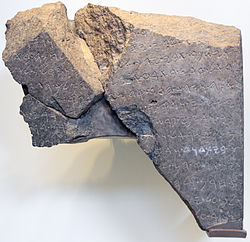
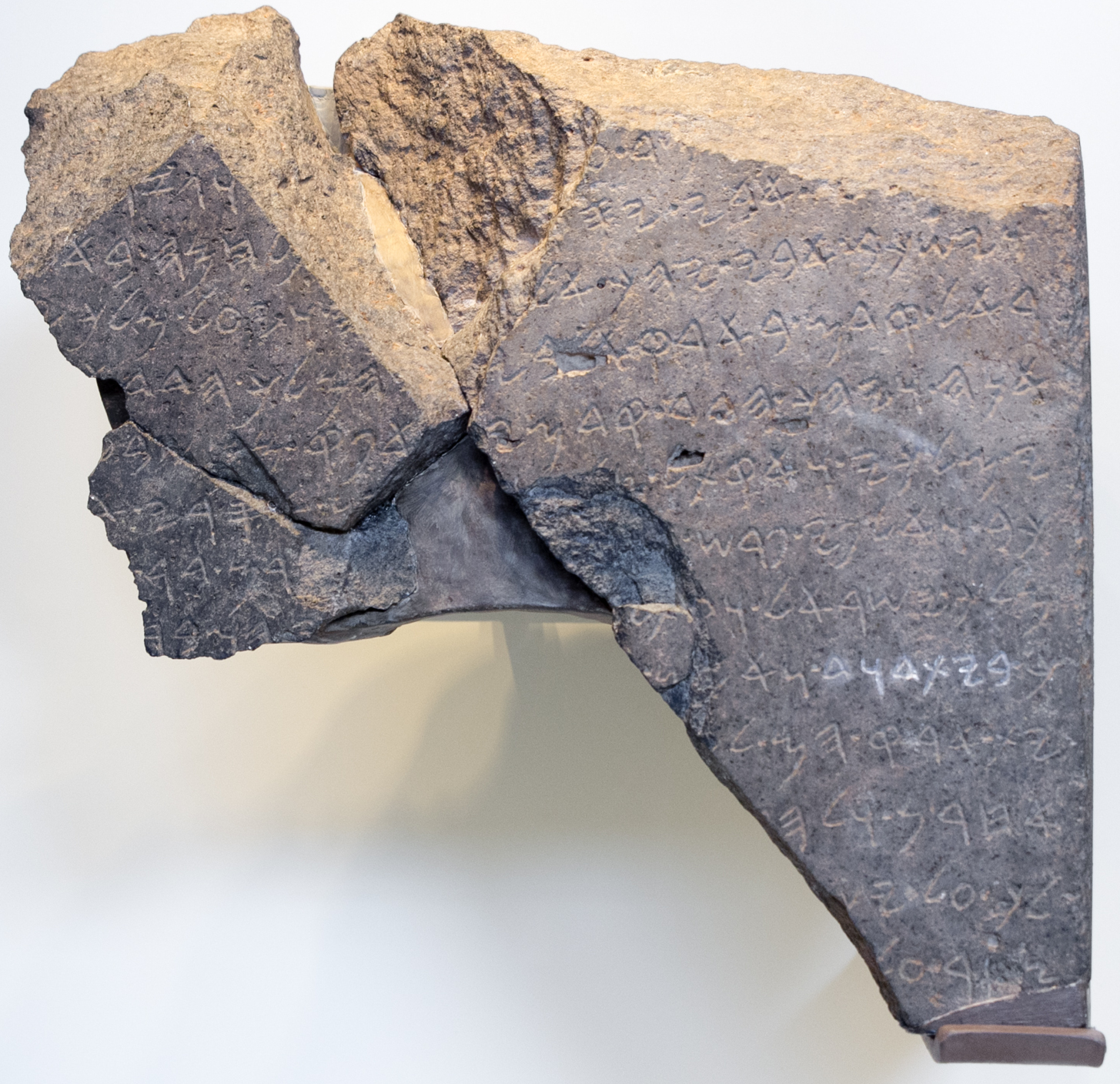
The Tel Dan Stele is a fragmentary stele containing an Aramaic inscription which dates to the 9th century BCE. It is the earliest known extra-biblical archaeological reference to the house of David. The stele was discovered in 1993 in Tel-Dan by Gila Cook, a member of an archaeological team led by Avraham Biran. Its pieces were used to construct an ancient stone wall that survived into modern times. The stele contains several lines of Old Aramaic written in the Phoenician script. The surviving inscription details an individual who killed Jehoram, King of Israel-Samaria, the son of Ahab, and Ahaziah of Judah, a king of the house of David. The stele is on display at the Israel Museum. It is known as KAI 310.
These writings corroborate passages from the Hebrew Bible, as the Second Book of Kings mentions that Jehoram is the son of an Israelite king, Ahab, by his Phoenician wife Jezebel. The likely candidate for having erected the stele, according to the Hebrew Bible, is Hazael, king of Aram-Damascus, whose language would have been Old Aramaic. He is mentioned in 2 Kings 12:17–18 as having conquered Israel-Samaria but not Jerusalem:
At that time, King Hazael of Aram came up and attacked Gath and captured it; and Hazael proceeded to march on Jerusalem. Thereupon King Joash of Judah took all the objects that had been consecrated by his predecessors, Kings Jehoshaphat, Jehoram, and Ahaziah of Judah, and by himself, and all the gold that there was in the treasuries of the Temple of GOD and in the royal palace, and he sent them to King Hazael of Aram, who then turned back from his march on Jerusalem.
Fragment A of the stele was discovered in July 1993 by Gila Cook of Avraham Biran's team who was studying Tel Dan in northern Israel. Fragments B1 and B2 were found in June 1994. The stele was not excavated in its "primary context", but in its "secondary use". The fragments were published by Biran and his colleague Joseph Naveh in 1993 and 1995.
The Tel Dan stele consists of several fragments making up part of a triumphal inscription in Old Aramaic, left most probably by Hazael of Aram-Damascus, an important regional figure in the late 9th century BCE. The unnamed king boasts of his victories over the king of Israel and his apparent ally the king of the "House of David" (Old Aramaic: 𐤁𐤉𐤕𐤃𐤅𐤃, romanized: bytdwd). It is considered the earliest widely accepted reference to the name David as the founder of a Judahite polity outside of the Hebrew Bible, though the earlier Mesha Stele contains several possible references with varying acceptance.
A minority of scholars has disputed the reference to David, due to the lack of a word divider between byt and dwd, and other translations have been proposed. The Tel Dan stele is one of only four known extra-biblical inscriptions made during a roughly 400-year period (1200–800 BCE) containing the name "Israel", the others being the Merneptah Stele, the Mesha Stele, and the Kurkh Monoliths.
The Tel Dan inscription generated considerable debate and a flurry of articles, debating its age, authorship, and authenticity; however, the stele is generally accepted by scholars as genuine and a reference to the house of David.
The following is the transcription. Dots separate words (as in the original), empty square brackets indicate damaged/missing text, and text inside square brackets is reconstructed by Biran and Naveh:
Tel Dan stele
The Tel Dan Stele is a fragmentary stele containing an Aramaic inscription which dates to the 9th century BCE. It is the earliest known extra-biblical archaeological reference to the house of David. The stele was discovered in 1993 in Tel-Dan by Gila Cook, a member of an archaeological team led by Avraham Biran. Its pieces were used to construct an ancient stone wall that survived into modern times. The stele contains several lines of Old Aramaic written in the Phoenician script. The surviving inscription details an individual who killed Jehoram, King of Israel-Samaria, the son of Ahab, and Ahaziah of Judah, a king of the house of David. The stele is on display at the Israel Museum. It is known as KAI 310.
These writings corroborate passages from the Hebrew Bible, as the Second Book of Kings mentions that Jehoram is the son of an Israelite king, Ahab, by his Phoenician wife Jezebel. The likely candidate for having erected the stele, according to the Hebrew Bible, is Hazael, king of Aram-Damascus, whose language would have been Old Aramaic. He is mentioned in 2 Kings 12:17–18 as having conquered Israel-Samaria but not Jerusalem:
At that time, King Hazael of Aram came up and attacked Gath and captured it; and Hazael proceeded to march on Jerusalem. Thereupon King Joash of Judah took all the objects that had been consecrated by his predecessors, Kings Jehoshaphat, Jehoram, and Ahaziah of Judah, and by himself, and all the gold that there was in the treasuries of the Temple of GOD and in the royal palace, and he sent them to King Hazael of Aram, who then turned back from his march on Jerusalem.
Fragment A of the stele was discovered in July 1993 by Gila Cook of Avraham Biran's team who was studying Tel Dan in northern Israel. Fragments B1 and B2 were found in June 1994. The stele was not excavated in its "primary context", but in its "secondary use". The fragments were published by Biran and his colleague Joseph Naveh in 1993 and 1995.
The Tel Dan stele consists of several fragments making up part of a triumphal inscription in Old Aramaic, left most probably by Hazael of Aram-Damascus, an important regional figure in the late 9th century BCE. The unnamed king boasts of his victories over the king of Israel and his apparent ally the king of the "House of David" (Old Aramaic: 𐤁𐤉𐤕𐤃𐤅𐤃, romanized: bytdwd). It is considered the earliest widely accepted reference to the name David as the founder of a Judahite polity outside of the Hebrew Bible, though the earlier Mesha Stele contains several possible references with varying acceptance.
A minority of scholars has disputed the reference to David, due to the lack of a word divider between byt and dwd, and other translations have been proposed. The Tel Dan stele is one of only four known extra-biblical inscriptions made during a roughly 400-year period (1200–800 BCE) containing the name "Israel", the others being the Merneptah Stele, the Mesha Stele, and the Kurkh Monoliths.
The Tel Dan inscription generated considerable debate and a flurry of articles, debating its age, authorship, and authenticity; however, the stele is generally accepted by scholars as genuine and a reference to the house of David.
The following is the transcription. Dots separate words (as in the original), empty square brackets indicate damaged/missing text, and text inside square brackets is reconstructed by Biran and Naveh:
Recent media
Recent media