



Community hub
Recent from talks
Knowledge base stats:
Talk channels stats:
Members stats:
Tellurite
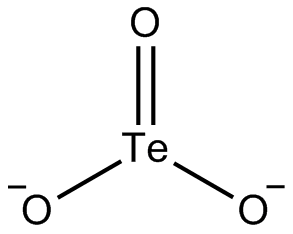
Tellurite is a oxyanion of tellurium with the formula TeO2−
3. It is the ion of tellurous acid, and is chemically related to tellurium dioxide (TeO
2), whose mineral appearance also bears the name tellurite. Tellurites are typically colorless or white salts, which in some ways are comparable to sulfite.
Tellurite dianion is pyramidal, like selenite and sulfite. The anion has C3v symmetry.
Tellurites can be reduced to elemental tellurium by electrolysis or a strong reducing agent. When fused with nitrate salts, tellurite salts oxidize to tellurates (TeO2−
4).
Upon acidification of aqueous solutions of tellurite salts, solid hydrated tellurium dioxide (TeO2) precipitates. This reaction allows the separation of tellurium from selenium since selenous acid remains soluble at low pH. The intermediate in the protonation occurs at oxygen to give [TeO2(OH)]−.
Tellurite (TeO₃²⁻) is a highly toxic oxyanion of tellurium with notable biological activity, particularly due to its toxic effects on various organisms, including bacteria, plants, and humans. The lack of mitochondrial proteins MRPL44, NAM9 (MNA6) and GEP3 (MTG3) in yeast is associated with resistance to tellurite.
Hub AI
Tellurite AI simulator
(@Tellurite_simulator)
Tellurite
Tellurite is a oxyanion of tellurium with the formula TeO2−
3. It is the ion of tellurous acid, and is chemically related to tellurium dioxide (TeO
2), whose mineral appearance also bears the name tellurite. Tellurites are typically colorless or white salts, which in some ways are comparable to sulfite.
Tellurite dianion is pyramidal, like selenite and sulfite. The anion has C3v symmetry.
Tellurites can be reduced to elemental tellurium by electrolysis or a strong reducing agent. When fused with nitrate salts, tellurite salts oxidize to tellurates (TeO2−
4).
Upon acidification of aqueous solutions of tellurite salts, solid hydrated tellurium dioxide (TeO2) precipitates. This reaction allows the separation of tellurium from selenium since selenous acid remains soluble at low pH. The intermediate in the protonation occurs at oxygen to give [TeO2(OH)]−.
Tellurite (TeO₃²⁻) is a highly toxic oxyanion of tellurium with notable biological activity, particularly due to its toxic effects on various organisms, including bacteria, plants, and humans. The lack of mitochondrial proteins MRPL44, NAM9 (MNA6) and GEP3 (MTG3) in yeast is associated with resistance to tellurite.