



Community hub
Recent from talks
Knowledge base stats:
Talk channels stats:
Members stats:
Temperance (virtue)
Temperance in its modern use is defined as moderation or voluntary self-restraint. It is typically described in terms of what a person voluntarily refrains from doing. This includes restraint from revenge by practicing mercy and forgiveness, restraint from arrogance by practicing humility and modesty, restraint from excesses such as extravagant luxury or splurging, restraint from overindulgence in food and drink, and restraint from rage or craving by practicing calmness and equanimity. The distinction between temperance and self-control is subtle. A person who exhibits self-control wisely refrains from giving in to unwise desires. A person who exhibits temperance does not have unwise desires in the first place because they have wisely shaped their character in such a way that their desires are proper ones. Aristotle suggested this analogy: An intemperate person is like a city with bad laws; a person who lacks self control is like a city that has good laws on the books but doesn’t enforce them.
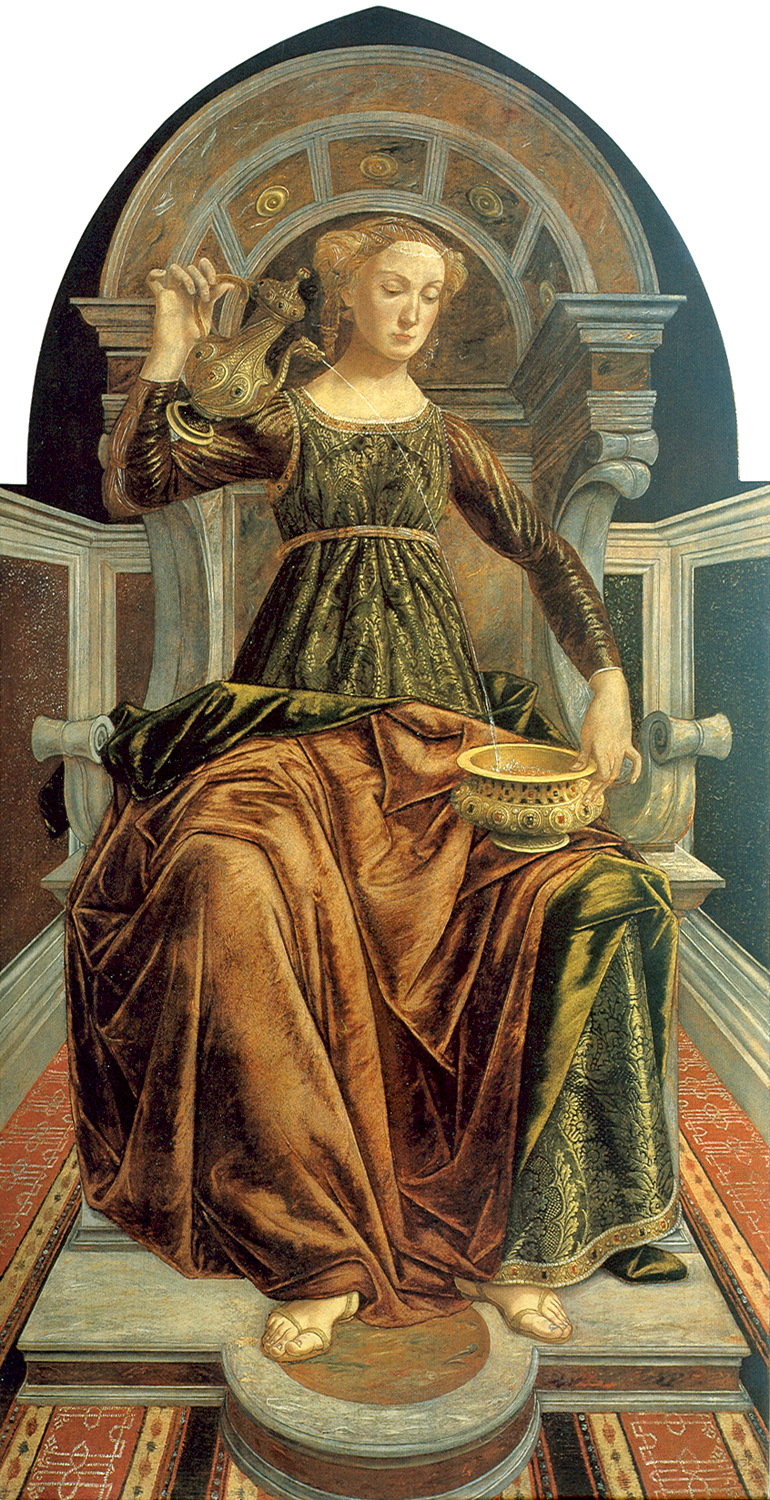
Temperance has been described as a virtue by religious thinkers, philosophers, and more recently, psychologists, particularly in the positive psychology movement. It has a long history in philosophical and religious thought. It is generally characterized as the control over excess, and expressed through characteristics such as chastity, modesty, humility, self-regulation, hospitality, decorum, abstinence, and forgiveness; each of these involves restraining an excess of some impulse, such as sexual desire, vanity, or anger. In classical iconography, the virtue is often depicted as a woman holding two vessels transferring water from one to another. It is one of the cardinal virtues in western thought, and is found in Greek philosophy and Christianity, as well as in Eastern traditions such as Buddhism and Hinduism.
Temperance is one of the six virtues in the Values in Action Inventory of Strengths, along with wisdom, courage, humanity, justice, and transcendence. The term "temperance" can also refer to the abstention from alcohol (teetotalism), especially with reference to the temperance movement. It can also refer to alcohol moderation.
There are two words in ancient Greek that have been translated to "temperance" in English. The first, sôphrosune, largely meant "self-restraint". The other, enkrateia', was a word coined during the time of Aristotle, to mean "control over oneself", or "self-discipline". Enkrateia appears three times in the Bible, where it was translated as "temperance" in the King James translation.[citation needed]
The modern meaning of temperance has evolved since its first usage. In Latin, tempero means restraint (from force or anger), but also more broadly the proper balancing or mixing (particularly, of temperature, or compounds). Hence the phrase "to temper a sword", meaning the heating and cooling process of forging a metal blade. The Latin also referred to governing and control, likely in a moderate way (i.e. not with the use of excessive force).[citation needed]
Temperance is a major Athenian virtue, as advocated by Plato; self-restraint (sôphrosune) is one of his four core virtues of the ideal city. In "Charmides", one of Plato's early dialogues, an attempt is made to describe temperance, but fails to reach an adequate definition.
Aristotle included discussions of both temperance and self-control in his pioneering system of virtue ethics.
Aristotle restricts the sphere of temperance to bodily pleasures, and defines temperance as "a mean with regard to pleasures," distinct from self-indulgence. Like courage, temperance is a virtue concerning our discipline of "the irrational parts of our nature" (fear, in the case of courage; desire, in the case of temperance).
Hub AI
Temperance (virtue) AI simulator
(@Temperance (virtue)_simulator)
Temperance (virtue)
Temperance in its modern use is defined as moderation or voluntary self-restraint. It is typically described in terms of what a person voluntarily refrains from doing. This includes restraint from revenge by practicing mercy and forgiveness, restraint from arrogance by practicing humility and modesty, restraint from excesses such as extravagant luxury or splurging, restraint from overindulgence in food and drink, and restraint from rage or craving by practicing calmness and equanimity. The distinction between temperance and self-control is subtle. A person who exhibits self-control wisely refrains from giving in to unwise desires. A person who exhibits temperance does not have unwise desires in the first place because they have wisely shaped their character in such a way that their desires are proper ones. Aristotle suggested this analogy: An intemperate person is like a city with bad laws; a person who lacks self control is like a city that has good laws on the books but doesn’t enforce them.
Temperance has been described as a virtue by religious thinkers, philosophers, and more recently, psychologists, particularly in the positive psychology movement. It has a long history in philosophical and religious thought. It is generally characterized as the control over excess, and expressed through characteristics such as chastity, modesty, humility, self-regulation, hospitality, decorum, abstinence, and forgiveness; each of these involves restraining an excess of some impulse, such as sexual desire, vanity, or anger. In classical iconography, the virtue is often depicted as a woman holding two vessels transferring water from one to another. It is one of the cardinal virtues in western thought, and is found in Greek philosophy and Christianity, as well as in Eastern traditions such as Buddhism and Hinduism.
Temperance is one of the six virtues in the Values in Action Inventory of Strengths, along with wisdom, courage, humanity, justice, and transcendence. The term "temperance" can also refer to the abstention from alcohol (teetotalism), especially with reference to the temperance movement. It can also refer to alcohol moderation.
There are two words in ancient Greek that have been translated to "temperance" in English. The first, sôphrosune, largely meant "self-restraint". The other, enkrateia', was a word coined during the time of Aristotle, to mean "control over oneself", or "self-discipline". Enkrateia appears three times in the Bible, where it was translated as "temperance" in the King James translation.[citation needed]
The modern meaning of temperance has evolved since its first usage. In Latin, tempero means restraint (from force or anger), but also more broadly the proper balancing or mixing (particularly, of temperature, or compounds). Hence the phrase "to temper a sword", meaning the heating and cooling process of forging a metal blade. The Latin also referred to governing and control, likely in a moderate way (i.e. not with the use of excessive force).[citation needed]
Temperance is a major Athenian virtue, as advocated by Plato; self-restraint (sôphrosune) is one of his four core virtues of the ideal city. In "Charmides", one of Plato's early dialogues, an attempt is made to describe temperance, but fails to reach an adequate definition.
Aristotle included discussions of both temperance and self-control in his pioneering system of virtue ethics.
Aristotle restricts the sphere of temperance to bodily pleasures, and defines temperance as "a mean with regard to pleasures," distinct from self-indulgence. Like courage, temperance is a virtue concerning our discipline of "the irrational parts of our nature" (fear, in the case of courage; desire, in the case of temperance).