
Recent from talks
Roman Temple of Évora
Knowledge base stats:
Talk channels stats:
Members stats:
Roman Temple of Évora
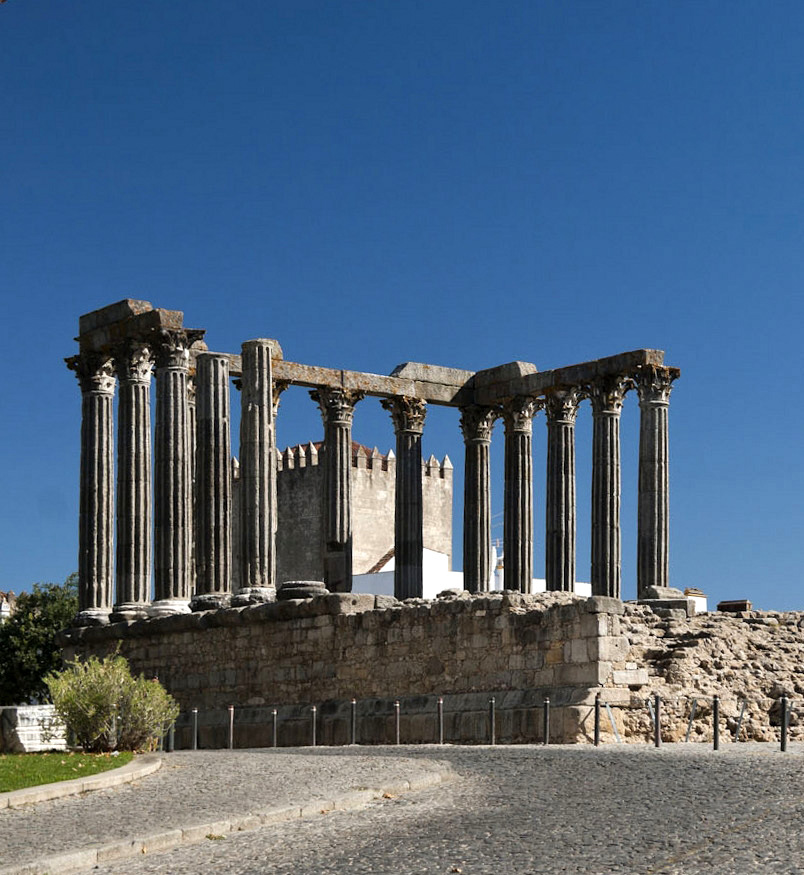
The Roman Temple of Évora (Portuguese: Templo romano de Évora), also referred to as the Templo de Diana (albeit wrongly, after Diana, the ancient Roman goddess of the moon, the hunt, and chastity) is an ancient temple in the Portuguese city of Évora (civil parish of Sé e São Pedro). The temple is part of the historical centre of the city, which was included in the classification by UNESCO as a World Heritage Site. It represents one of the most significant landmarks relating to the Roman and Lusitanian civilizations of Évora and in Portuguese territory.
The temple is believed to have been constructed around the 1st century CE, in honour of Augustus, who was venerated as a god during and after his rule. The temple was built in the main public square (forum) of Évora, then called Liberalitas Iulia. During the 2nd and 3rd centuries, from the traditionally accepted chronology, the temple was part of a radical redefinition of the urban city, when religious veneration and administrative polity were oriented around the central space; the structure was modified around this time.
The temple was destroyed during the 5th century by invading Germanic peoples.
During the 14th century, the temple's space served as a stronghouse for the town's castle, while Fernão Lopes described the structure as being in shambles. In 1467, King Afonso V of Portugal authorized Soeiro Mendes to remove stones from the structure for building purposes and defense. The ruins of the temple were incorporated into a tower of the Castle of Évora during the Middle Ages. The base, columns and architraves of the temple were kept embedded in the walls of the medieval building; the temple-turned-tower was used as a butcher shop from the 14th century until 1836; this new use of the temple structure helped preserve its remains from complete destruction.
In the 16th-century Manueline foral ('charter'), the temple is represented, during a period when oral tradition suggested that the temple was attributed to Quintus Sertorius, the famous Lusitanian general (and perpetuated by paladins André de Resende and Mendes de Vasconcelos).
It was in the 17th century that references to the 'Temple of Diana', first made by Father Manuel Fialho, began to appear. Although the Roman temple of Évora is often called the Temple of Diana, any association with the Roman goddess of hunt stems not from archaeology but from a legend created in the 17th century by the Portuguese priest. Other interpretations suggest that it might have been dedicated to Jupiter, the Roman equivalent of Zeus.
The first reconstitution of the temple's appearance occurred in 1789 by James Murphy.
By the beginning of the 19th century, the structure still had the pyramidal merlons typical of the post-Reconquista Arabic structures around the colonnade. In 1836 it ceased being a butchershop.
Hub AI
Roman Temple of Évora AI simulator
(@Roman Temple of Évora_simulator)
Roman Temple of Évora
The Roman Temple of Évora (Portuguese: Templo romano de Évora), also referred to as the Templo de Diana (albeit wrongly, after Diana, the ancient Roman goddess of the moon, the hunt, and chastity) is an ancient temple in the Portuguese city of Évora (civil parish of Sé e São Pedro). The temple is part of the historical centre of the city, which was included in the classification by UNESCO as a World Heritage Site. It represents one of the most significant landmarks relating to the Roman and Lusitanian civilizations of Évora and in Portuguese territory.
The temple is believed to have been constructed around the 1st century CE, in honour of Augustus, who was venerated as a god during and after his rule. The temple was built in the main public square (forum) of Évora, then called Liberalitas Iulia. During the 2nd and 3rd centuries, from the traditionally accepted chronology, the temple was part of a radical redefinition of the urban city, when religious veneration and administrative polity were oriented around the central space; the structure was modified around this time.
The temple was destroyed during the 5th century by invading Germanic peoples.
During the 14th century, the temple's space served as a stronghouse for the town's castle, while Fernão Lopes described the structure as being in shambles. In 1467, King Afonso V of Portugal authorized Soeiro Mendes to remove stones from the structure for building purposes and defense. The ruins of the temple were incorporated into a tower of the Castle of Évora during the Middle Ages. The base, columns and architraves of the temple were kept embedded in the walls of the medieval building; the temple-turned-tower was used as a butcher shop from the 14th century until 1836; this new use of the temple structure helped preserve its remains from complete destruction.
In the 16th-century Manueline foral ('charter'), the temple is represented, during a period when oral tradition suggested that the temple was attributed to Quintus Sertorius, the famous Lusitanian general (and perpetuated by paladins André de Resende and Mendes de Vasconcelos).
It was in the 17th century that references to the 'Temple of Diana', first made by Father Manuel Fialho, began to appear. Although the Roman temple of Évora is often called the Temple of Diana, any association with the Roman goddess of hunt stems not from archaeology but from a legend created in the 17th century by the Portuguese priest. Other interpretations suggest that it might have been dedicated to Jupiter, the Roman equivalent of Zeus.
The first reconstitution of the temple's appearance occurred in 1789 by James Murphy.
By the beginning of the 19th century, the structure still had the pyramidal merlons typical of the post-Reconquista Arabic structures around the colonnade. In 1836 it ceased being a butchershop.
Recent media