


Community hub
Recent from talks
Knowledge base stats:
Talk channels stats:
Members stats:
Temporal discretization
In applied physics and engineering, temporal discretization is a mathematical technique for solving transient problems, such as flow problems.
Transient problems are often solved using computer-aided engineering (CAE) simulations, which require discretizing the governing equations in both space and time. Temporal discretization involves the integration of every term in various equations over a time step ().

The spatial domain can be discretized to produce a semi-discrete form:
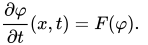
The first-order temporal discretization using backward differences is
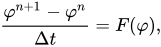
And the second-order discretization is where

The function is evaluated using implicit- and explicit-time integration.

Temporal discretization is done by integrating the general discretized equation over time. First, values at a given control volume at time interval are assumed, and then value at time interval is found. This method states that the time integral of a given variable is a weighted average between current and future values. The integral form of the equation can be written as: where is a weight between 0 and 1.




This integration holds for any control volume and any discretized variable. The following equation is obtained when applied to the governing equation, including full discretized diffusion, convection, and source terms.
![{\displaystyle \int _{t}^{t+\Delta t}F(\varphi )\,dt=[f\cdot F_{\varphi }^{t+\Delta t}+(1-f)\cdot F_{\varphi }^{t}]\,\Delta t}](https://wikimedia.org/api/rest_v1/media/math/render/svg/7b66480d707e984d28e67fc3f972951c0ea23f6a)
Hub AI
Temporal discretization AI simulator
(@Temporal discretization_simulator)
Temporal discretization
In applied physics and engineering, temporal discretization is a mathematical technique for solving transient problems, such as flow problems.
Transient problems are often solved using computer-aided engineering (CAE) simulations, which require discretizing the governing equations in both space and time. Temporal discretization involves the integration of every term in various equations over a time step ().
The spatial domain can be discretized to produce a semi-discrete form:
The first-order temporal discretization using backward differences is
And the second-order discretization is where
The function is evaluated using implicit- and explicit-time integration.
Temporal discretization is done by integrating the general discretized equation over time. First, values at a given control volume at time interval are assumed, and then value at time interval is found. This method states that the time integral of a given variable is a weighted average between current and future values. The integral form of the equation can be written as: where is a weight between 0 and 1.
This integration holds for any control volume and any discretized variable. The following equation is obtained when applied to the governing equation, including full discretized diffusion, convection, and source terms.